

December marks the final month of the Hubble 35th Anniversary Challenge. More about the challenge can be found on the Night Sky page.
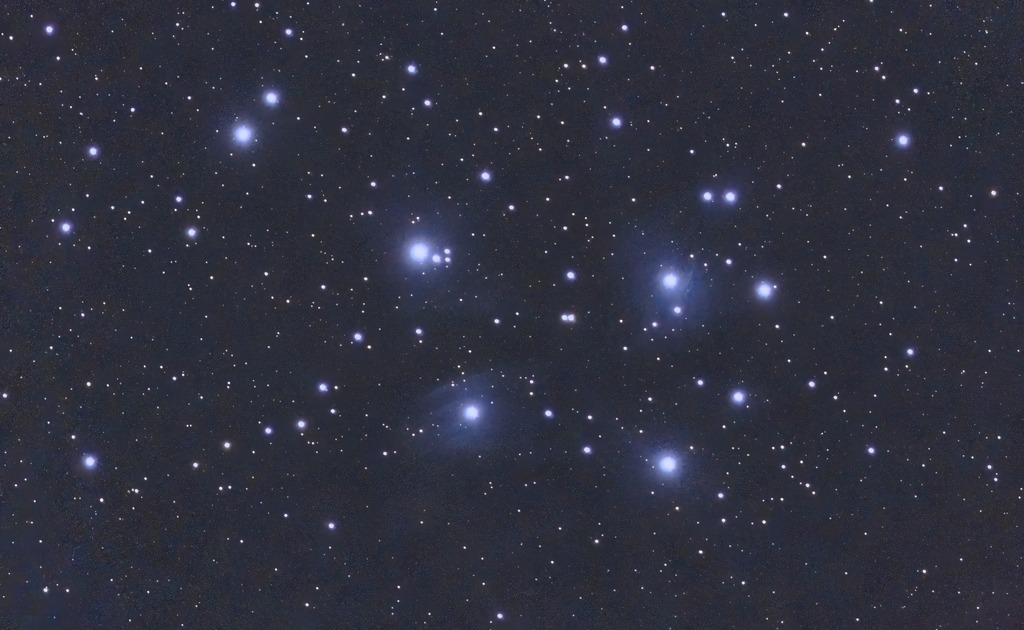
The first target is a familiar one – even to those who view the night sky with their naked eyes – the Pleiades, also known as Seven Sisters and Messier 45 (M45). It is an asterism of an open star cluster containing young B-type stars in the northwest of the constellation Taurus. At a distance of about 444 light-years, it is among the nearest star clusters to Earth and the nearest Messier object to Earth, being the most obvious star cluster to the naked eye in the night sky. It contains the reflection nebulae NGC 1432, an HII region, and NGC 1435, known as the Merope Nebula. Around 2330 BC the Pleiades marked the vernal point. Due to the brightness of its stars, the Pleiades is viewable from most areas on Earth, even in locations with significant light pollution.
The cluster is dominated by hot blue luminous stars that have formed within the last 100 million years. Reflection nebulae around the brightest stars were once thought to be leftover material from their formation, but are now considered likely to be an unrelated dust cloud in the interstellar medium through which the stars are currently passing. Computer simulations have shown that the Pleiades were probably formed from a compact configuration that once resembled the Orion Nebula.
Together with the open star cluster of the Hyades, the Pleiades form the Golden Gate of the Ecliptic. The Pleiades have been said to “resemble a tiny dipper,” and should not be confused with the “Little Dipper,” or Ursa Minor. The cluster has been of considerable cultural and practical importance around the Earth for millennia.
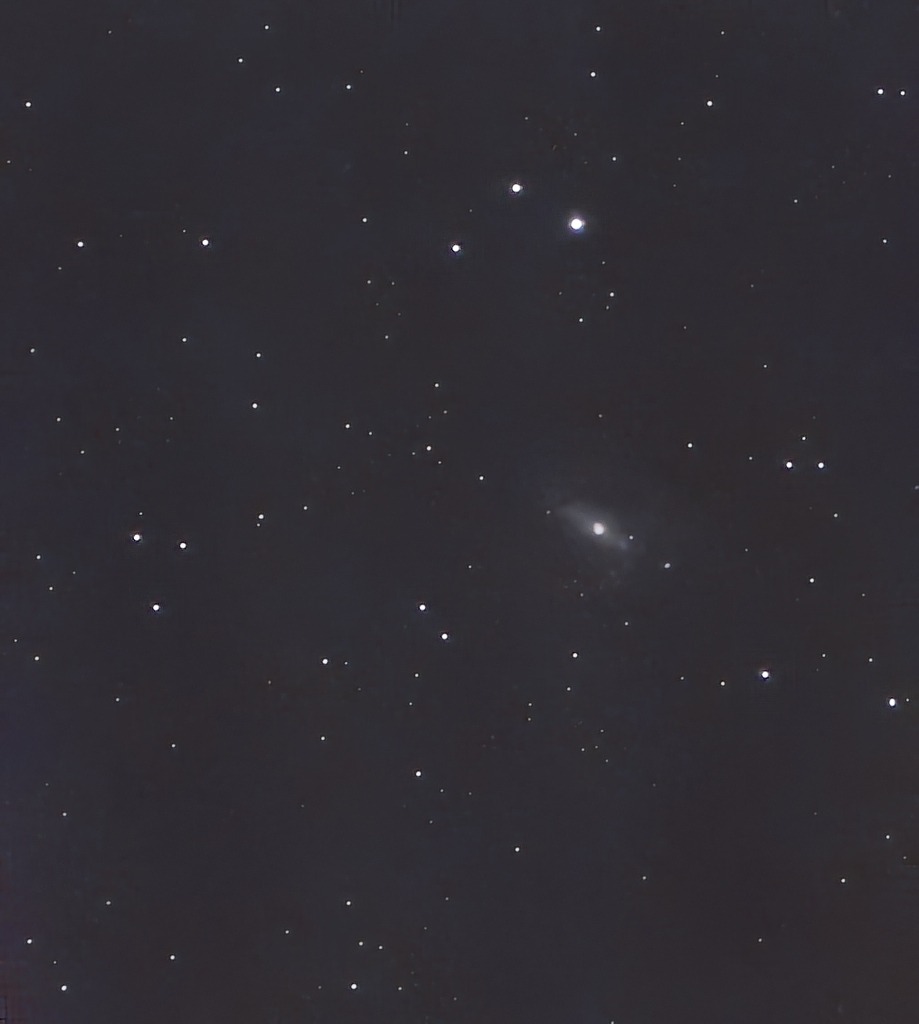
The remaining targets are significantly smaller when viewed in the night sky. Messier 77 (M77), also known as NGC 1068 or the Squid Galaxy, is a barred spiral galaxy in the constellation Cetus. It is about 47 million light-years (14 Mpc) away from Earth, and was discovered by Pierre Méchain in 1780, who originally described it as a nebula. Méchain then communicated his discovery to Charles Messier, who subsequently listed the object in his catalog. Both Messier and William Herschel described this galaxy as a star cluster. Today, however, the object is known to be a galaxy. It is one of the Seyfert galaxies featured this month. Seyfert galaxies are one of the two largest groups of active galaxies, along with quasar host galaxies. They have quasar-like nuclei (very luminous sources of electromagnetic radiation that are outside of our own galaxy) with very high surface brightness whose spectra reveal strong, high-ionization emission lines, but unlike quasars, their host galaxies are clearly detectable. M77 is one of the brightest Seyfert galaxies visible from Earth and has a diameter of about 27.70 kiloparsecs (90,000 light-years).
In a smart telescope, it appears as a roundish, hazy smudge with a bright core.

Next up is Caldwell 67. NGC 1097 (also known as Caldwell 67 or C67) is a barred spiral galaxy about 45 million light years away in the constellation Fornax. It was discovered by William Herschel on 9 October 1790. It is a severely interacting galaxy with obvious tidal debris and distortions caused by interaction with the companion galaxy NGC 1097A. C67 is also a Seyfert galaxy. Deep photographs revealed four narrow optical jets that appear to emanate from the nucleus. These have been interpreted as manifestations of the (currently weak) active nucleus. The optical jets are in fact composed of stars. The failure to detect atomic hydrogen gas in the jets with the Very Large Array radio telescope and numerical simulations led to the current interpretation that the jets are actually the shattered remains of a cannibalized dwarf galaxy. C67 has a supermassive black hole at its center, which is 140 million times the mass of the Sun.
Here C67 appears as an almost edge-on galaxy, a faint elongated smudge with a bright core.
Finally, we come to C24. NGC 1275 (also known as Perseus A or Caldwell 24) is a type 1.5 Seyfert galaxy located around 225 million light-years away from Earth in the direction of the constellation of Perseus. C24 is a member of the large Perseus Cluster of galaxies. It was discovered by German-British astronomer William Herschel on 17 October 1786.
C24 consists of two galaxies, a central type-cD galaxy in the Perseus Cluster, and a so-called high velocity system (HVS) which lies in front of it. The HVS is moving at 3000 km/s towards the dominant system, and is believed to be merging with the Perseus Cluster. The HVS is not affecting the cD galaxy as it lies at least 200 thousand light years from it. However tidal interactions are disrupting it and the ram pressure produced by its interaction with the intra-cluster medium of Perseus is stripping its gas as well as producing large amounts of star formation within it.
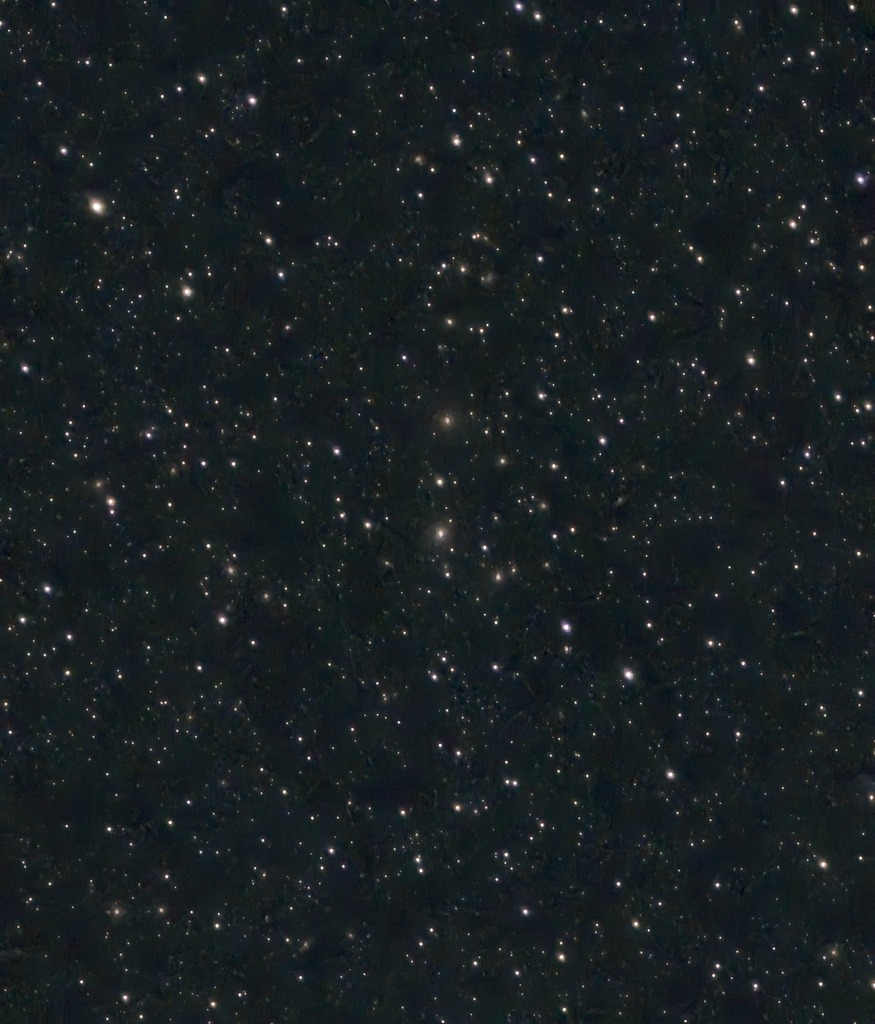
In the photo below, the monster galaxy appears as a roundish smudge near the center. There is a parallelogram shape of four bright smudges. C24 is the lower left member of this group of four.
Leave a Reply