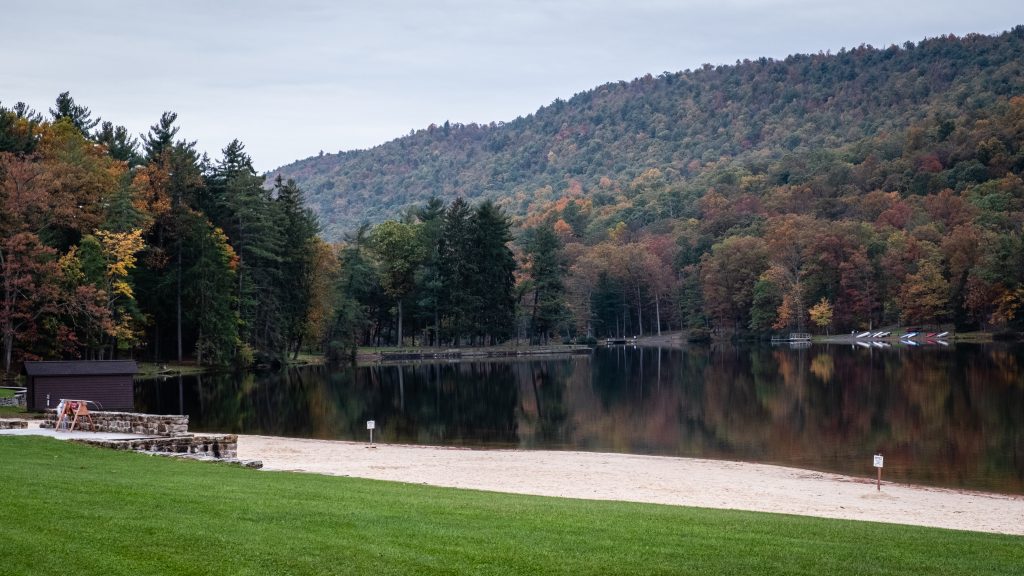
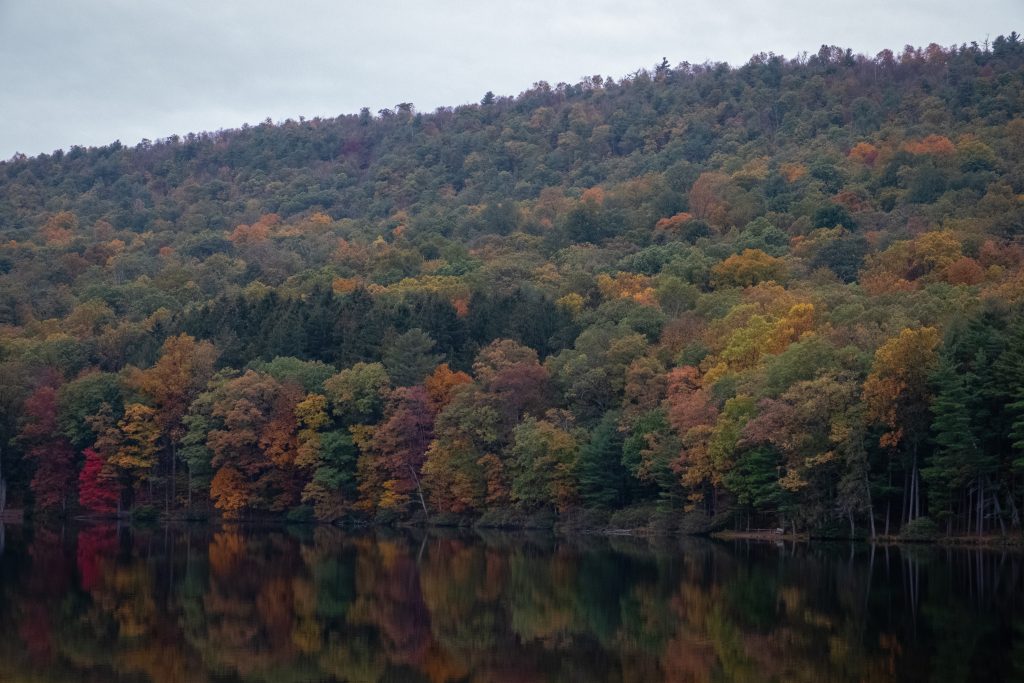
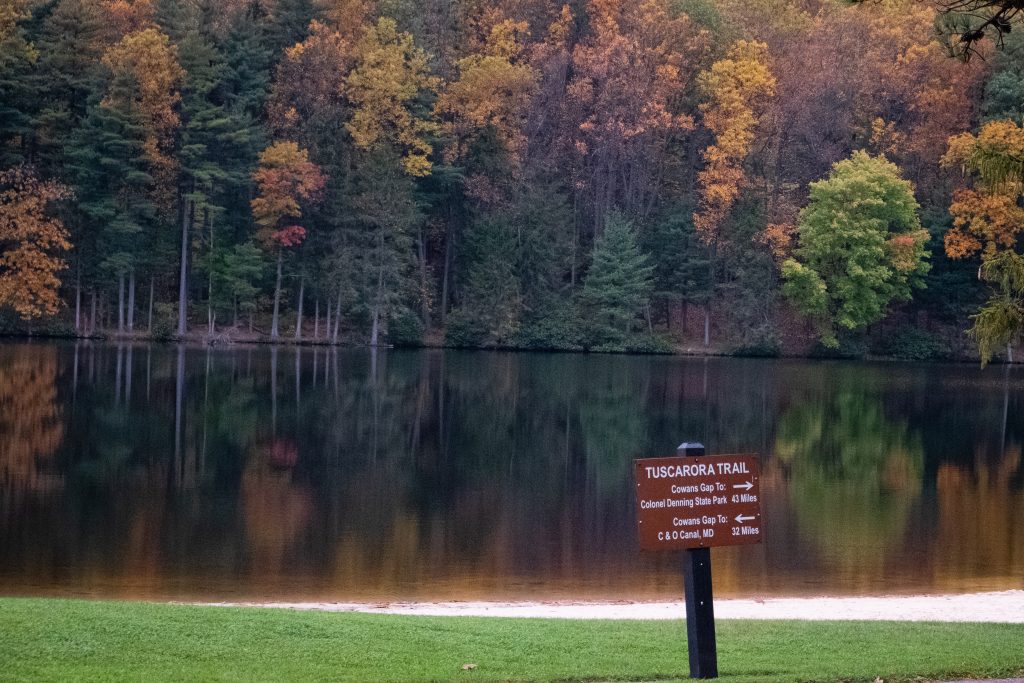
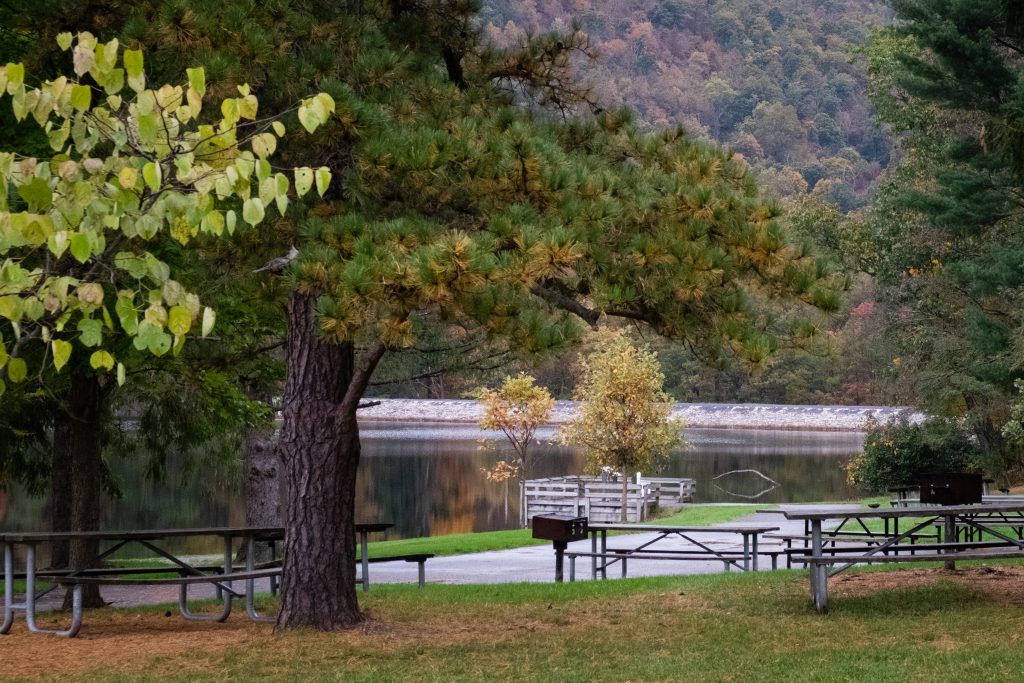
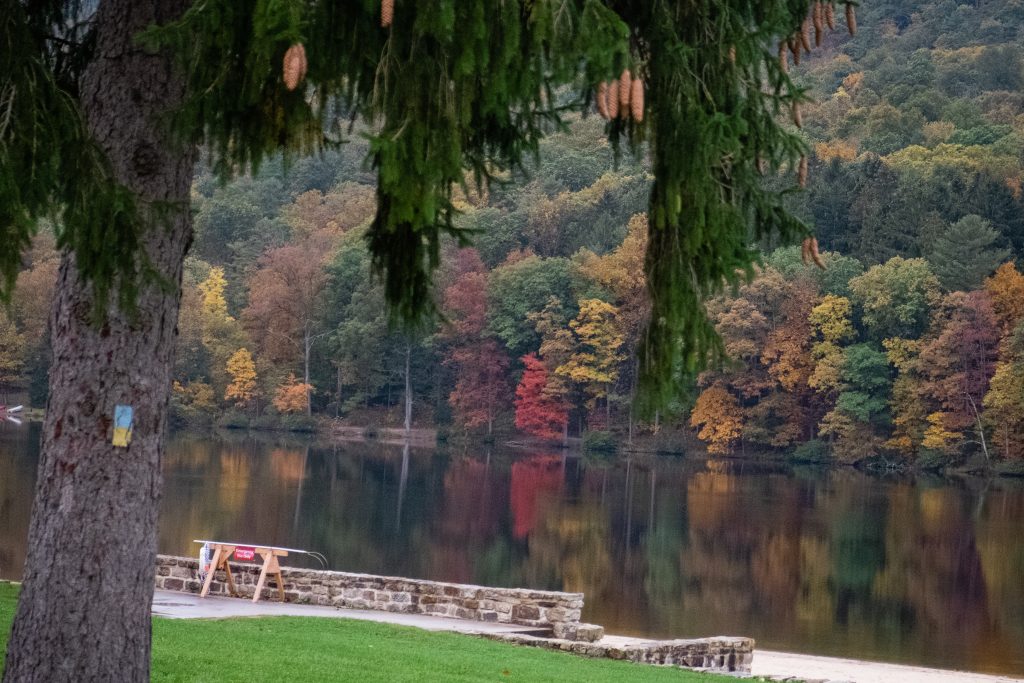
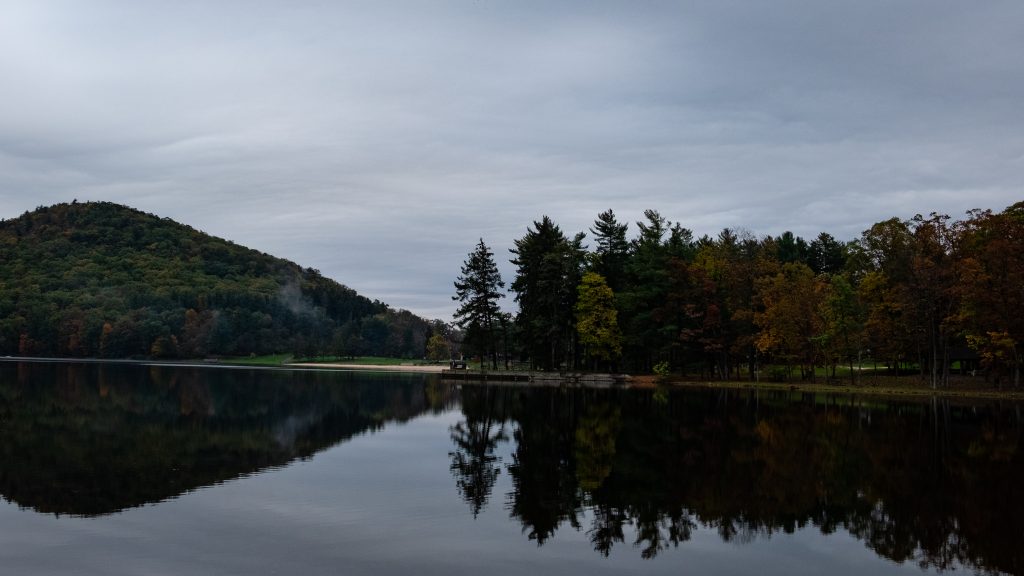
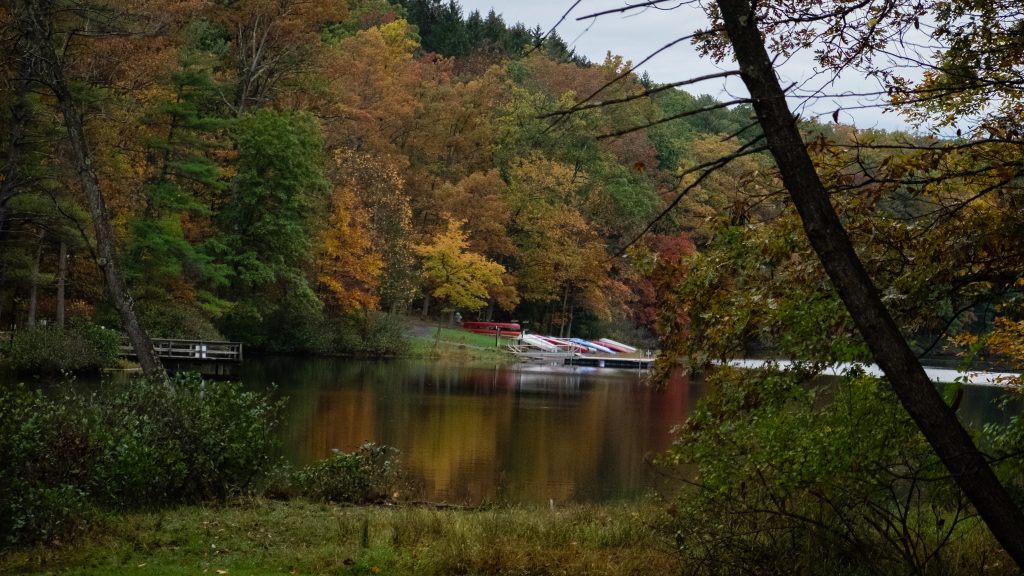
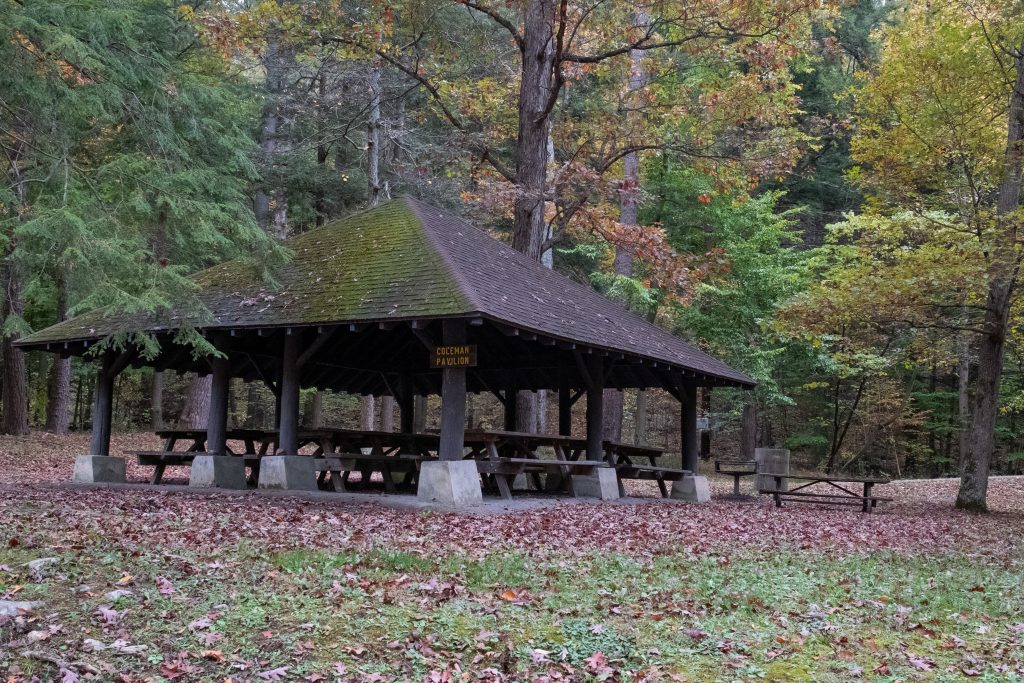
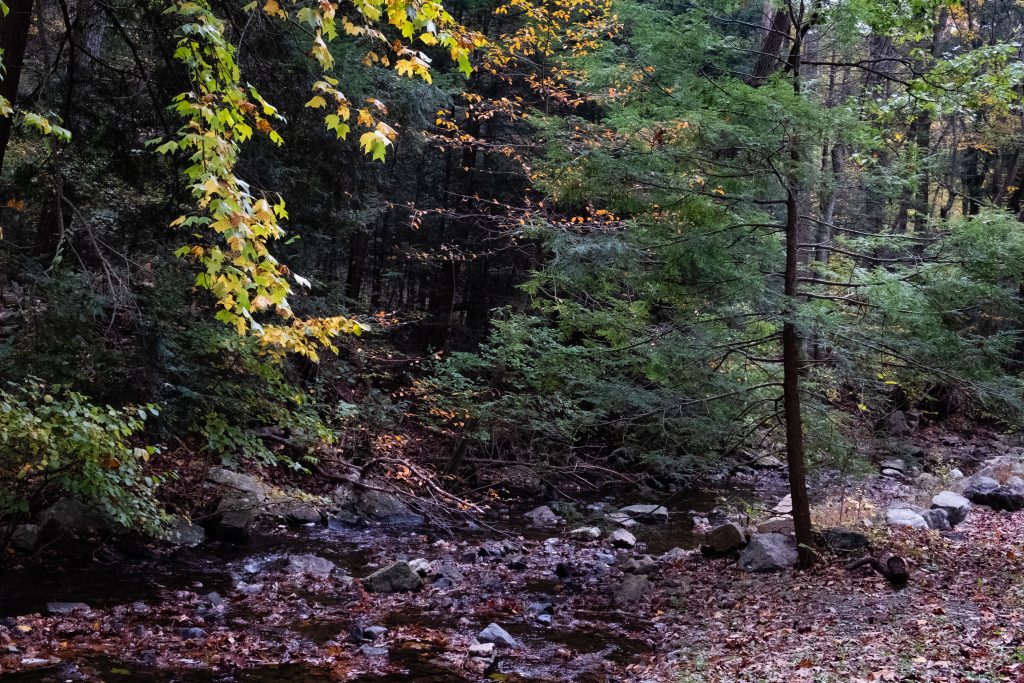
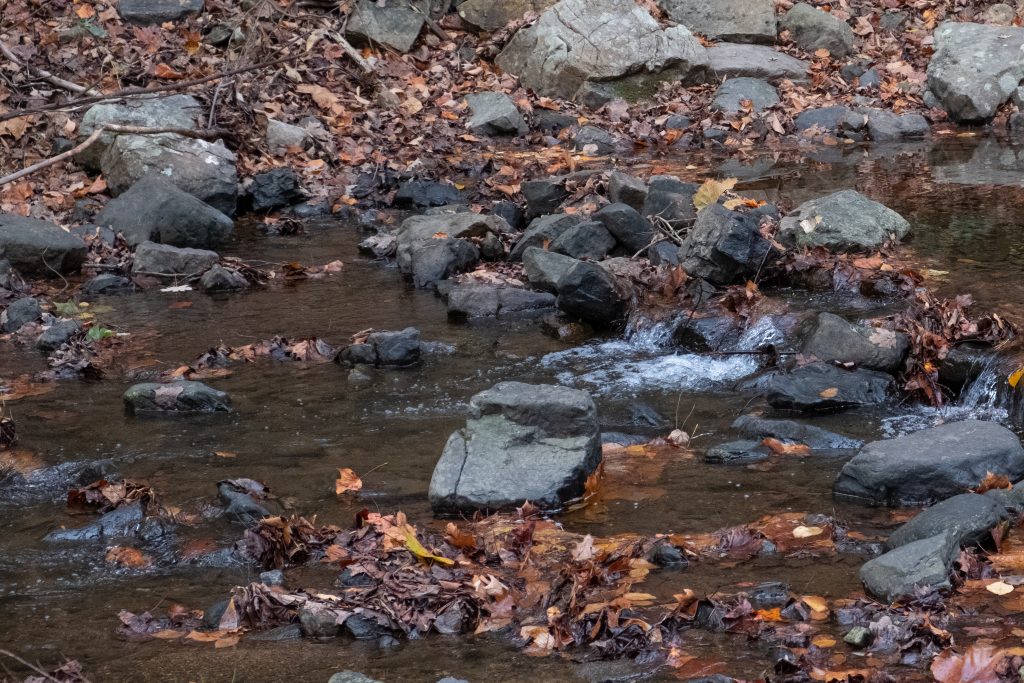
Prompton State Park and the Varden Conservation Area are located near each other in northeastern Pennsylvania’s Wayne County. Prompton State Park provides boat launching and picnicking facilities for the 290-acre Prompton Lake, which is operated by the U.S. Army Corps of Engineers. There are twenty-six miles of hiking trails which surround the lake and a disc golf course.
Morning mists on Prompton Lake ….A little disc golf by the lake.A view of the substantial dam.The west branch of Lackawanna Creek.Half mast for Memorial Day.
A gift from veterinarian Dr. Mead Shaffer, the 444-acre Varden Conservation Area is in an area that was once a remote section of the state, but which is now beginning to feel pressure from development. The land is conserved as open space with opportunities for low impact recreation and educational use. It is a great place to learn about Pennsylvania’s natural history. There is picnicking by and fishing in the pond. There is also hiking in the two tracts which constitute this conservation area. I visited the Tannery Road Tract.
The lovely pond can be used for fishing.Morning mists on an unseasonably cool day.Beautiful irises are indicative of the seasonal flora of this area.
I made my third trip to Promised Land State Park this past Memorial Day weekend. I love the Bear Wallow Cabin area, a cluster of former CCC cabins that still are largely original construction with hand made wood furniture. I also like the proximity of the Wildlife Observation Station to these cabins. The weather was unseasonably cold and raining so most of time was spent travelling around to other nearby sights to get a feel for those places. In this post, I will focus on some of the logistics of the park.
Promised Land contains two lakes with multiple boat launches, a beach with concession, boat rental, hiking and horseback riding. There are opportunities for hunting and fishing in season. The park is mostly surrounded by the Delaware State Forest. It is unusual in that most of the town of Promised Land is within the boundaries of the park and privately owned cabins are tucked away around the lakes.
Cabin number 2, named Buchanan. The cabins come in varying sizes, This is a smaller one.The bathrooms for Cabin 1 and 2. Each cabin has its own bathroom which is unusual in a state park.
The cabins have an oven, fridge, microwave, coffee maker and electrical outlets. Heat is by wood stove and there is no running water. The bathrooms are modern with toilet, shower, and sink and are heated. The park has multiple campgrounds and a variety of different camping options as well.
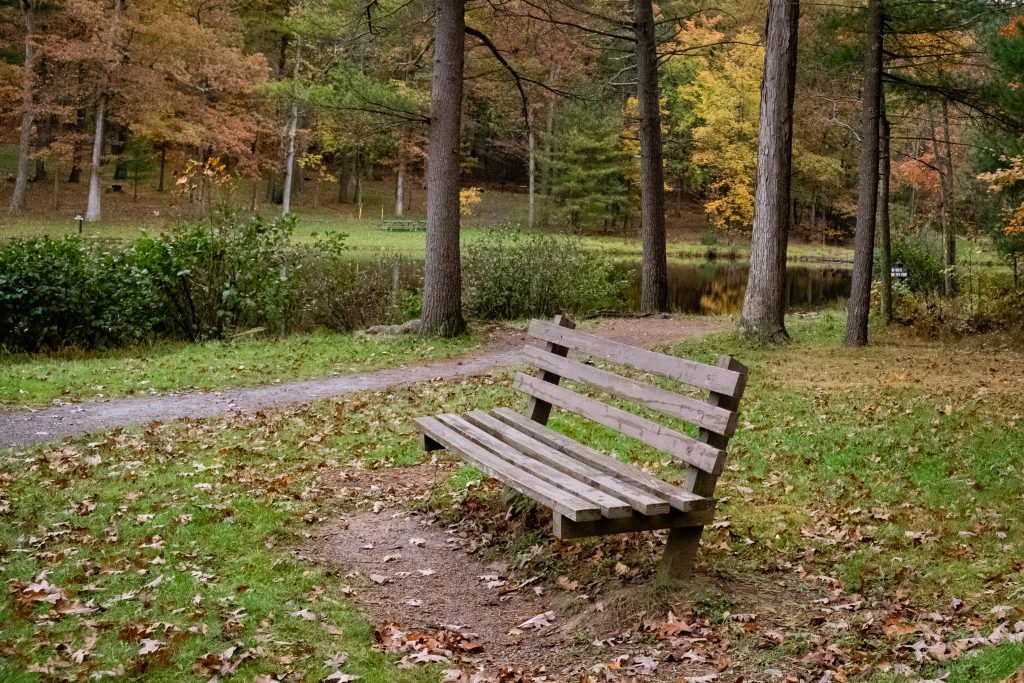
The interior looking toward the bedroom.An old drop down desk.A bench near the Bear Wallow boat launch on the Lower Lake.The statue in front of the Masker Museum, which focuses on the CCC.
Archbald Pothole State Park is a small park located in Lackawanna County just north of a busy shopping strip on Business Route 6. The pothole is the remains of the Wisconsin Glacial Period. It is 38 feet (11.6 m) deep with a largest diameter of 42 feet (12.8 m) by 24 feet (7.3 m). It has been a tourist attraction since it was discovered in 1884.
Archbald Pothole cuts through layers of sandstone, shale and coal. A pothole, in geologic terms, is a hole that is worn into the bedrock of a stream in strong rapids or at the base of a waterfall. The force of the water spins rock fragments, sand and gravel into a small indentation in the bedrock. After years and years of constant spinning, the stones and sands carve out an elliptical hole. Potholes are also formed by the action of glacial meltwater. Archbald Pothole was formed during the Wisconsin Glacial Period. As the glacier melted, a stream that flowed on top may have fallen into a crevasse and then fell to the bedrock. The force of the falling water created a pothole in much the same way that a waterfall creates a pothole. The pothole was filled by falling sand, rocks and gravel as the glacier retreated and created other potholes. Archbald Pothole was preserved underground for nearly 13,000 years until its discovery by Patrick Mahon in 1884 while extending a mine shaft.
A look into the depths of the hole ….You can really see the corkscrew like ridges.Humans for scale.A nearby cool rock formation.
The park also has opportunities for hiking and hunting as well as some picnic tables.
Kurtz’s Mill Covered Bridge is a covered bridge over Mill Creek in Lancaster County Central Park. The bridge is also known as the County Park Covered Bridge, Baer’s Mill Covered Bridge, Isaac Baer’s Mill Bridge, Keystone Mill Covered Bridge, Binder Tongue Carrier Covered Bridge, and Mill 2A Covered Bridge (that’s a lot of names). The bridge is used by road traffic from within the park to access a picnic pavilion.
Kurtz’s Mill Covered Bridge
The bridge has a single span, wooden, double burr arch trusses design with the addition of steel hanger rods. The deck is made from oak planks. It is painted red, the traditional color of Lancaster County covered bridges, on both the inside and outside. Both approaches to the bridge are painted in red with white trim. It has a 94 foot span.
The span of the bridge from the trail below. Excuse the backlighting.
The bridge was built in 1876 by W. W. Upp over the Conestoga River. In 1972, it was damaged by the floodwaters caused by Hurricane Agnes. It was repaired by David Esh in 1975 and moved to its present location in the Lancaster County Park over Mill Creek, a tributary of the Conestoga River. Unlike most historic covered bridges in the county, it is not listed on the National Register of Historic Places.
The onset of Spring turns my mind to birds. This is usually the best time of year to look for birds due to the opportunity to see migrating rarities in bright breeding dress. I frequently stop by Marsh Creek State Park when in the area. This is a good spot for bird watching, but I don’t seem to have much luck here. It probably doesn’t help that I am not a morning person and am, therefore, often looking for birds after 11 am. I did see some distant Common Mergansers on the lake, but had to settle for non-bird photos.
Land cruisin’No entryI always think I am going to find something here but never do ….
I also stopped by Struble Lake that day. This was more promising this time around. I saw a Savannah Sparrow and a lot of Snow Geese. There was still a fair amount of ice on the lake in early March.
Here are some photos of snowy Valley Forge National Historical Park and Chester County. Snow becomes less agreeable to me as I age, but it still looks very pretty.
These views of Valley Forge look down the hill from the Varnum’s Quarters area.
The park was quite full with walkers and sledders under the circumstances.
A drive around northwestern Chester County follows.
The 3,520-acre Swatara State Park consists of rolling fields and woodlands situated in the Swatara Valley, between Second and Blue mountains. Swatara Creek runs through the park and is surrounded by forests and wetlands that support an abundance of wildlife. The park is also a hotbed for fossil hunters.
In the past this landscape was dominated by a feeder branch of the Union Canal and then a railroad. Today, Swatara Park features a rail trail, hiking (including a few miles of the Appalachian Trail), fishing, hunting, cycling, horseback riding and kayaking.
The lovely rail trail.Off for a ride.The mountains are ablaze in Autumn.
Nearby Memorial Lake State Park consists of 230 acres at the the base of Blue Mountain in East Hanover Township, Lebanon County. The park is surrounded by Fort Indiantown Gap, the headquarters for the Pennsylvania Army and Air National Guard. The park is dominated by its lovely lake. It is a great spot for a picnic or some boating and fishing. There are also hiking trails at the park and and an exercise course.
Fort Indiantown Gap was named after the American Indian village known as Indiantown and the gap in the Blue Mountain where Indiantown was located. Indian artifacts found in the Lebanon and Swatara Valleys indicate a human presence as early as 2,500 BC.
Established in 1931, Fort Indiantown Gap was built as a National Guard training center. During World War II, it was used as a training site for seven Army divisions, and also as a demobilization site once the war was over. Memorial Lake was established in 1945 in memory of Pennsylvania National Guard soldiers who served in World War I and World War II. In 1955, Memorial Lake was transferred to the Pennsylvania Department of Conservation and Natural Resources and became Memorial Lake State Park.
I would love to have a canoe moored here.Done fishin’ for the day.A beutiful picnic spot.Let’s just enjoy the beauty of the lake.A great view of Memorial Lake.
Let’s take a look at some state parks in southeastern Pennsylvania from way back in mid September. Benjamin Rush State Park is in norheast Philadelphia and is the only state park within the city boundary. It has trails for hikers and bikers, good spots for wildlife and bird watchers and a model airplane field (like Valley Forge).
The park was named for Benjamin Rush, signer of the Declaration of Independence and attendee at the Continental Congress. He is the Father of American Psychiatry and published the first text book on the subject in the U.S. He advocated improved conditions for mental patients and careful clinical observation and study. Dr. Rush pioneered addiction therapies including treatment of alcoholism as a disease. The park was created out of land from a former state mental hospital.
I found its most notable feature to be its large community garden, however.
Community gardens flying the flag.
The next location was in Bristol, PA, Bucks County, for two of the many access points for Delaware Canal State Park. A walk along the entirety of the 60-mile-long towpath of the Delaware Canal State Park is a stroll back in time. Following the Delaware River between Easton and Bristol, this park contains an historic canal and towpath, a 50-acre pond, many miles of river shoreline, 11 river islands, and diverse scenery.
Boat along the Delaware River.The High Cross Monument to Irish immigration.Harriet Tubman.The Hispanic Monument.
Futher into town, we see the southern end of the canal.
The end of the line.A monument to Irish Civil War veterans and the basin at Bristol.
Finally, White Clay Creek Preserve along the Delaware border is the only property in the state park system called a “preserve.” Maybe because it adjoins White Clay Creek State Park in Delware. The 2,072-acre White Clay Creek Preserve is in southern Chester County. One can enjoy hiking, biking, fishing, and horseback riding in the Preserve. The area of White Clay Creek Preserve is part of a larger tract of land sold to William Penn in 1683 by Lenni Lenape Chief Kekelappen. It is thought that Kekelappen lived in Opasiskunk, an “Indian Town” which appears on a survey map of 1699 at the confluence of the Middle and East branches of White Clay Creek. The creek is named for the white clay found along its banks and used to make pottery.
The London Tract Baptist Meetinghouse, built in 1929, is at the intersection of Sharpless and London Tract roads. In its stone-walled cemetery rest many of the area’s earliest settlers including Dr. David Eaton.
The London Tract Baptist Meeting House, near the park office.The remains of the Sexton’s House across the road.
In 1984, the DuPont Company donated land to Pennsylvania and Delaware for the purpose of preserving the diverse and unique plant and animal species, and the rich cultural heritage of the area. Today, these lands form the bi-state White Clay Creek Preserve. Because White Clay Creek posses outstanding scenic, wildlife, recreational, and cultural value, it has been designated by Congress as a National Wild and Scenic River, and shall be preserved in free-flowing condition for the benefit and enjoyment of present and future generations.
Columbia County is home to a unique pair of bridges. The Twin Bridges, named East Paden and West Paden, are located on Huntington Creek. They were constructed in 1884 by W. C. Pennington for $720, and are named after John Paden, who operated a nearby sawmill. Twin Bridges County Park was created in 1963 when a new road bypassed the bridges.
The original West Paden was washed away by floods waters in June 2006. It was reconstructed in 2008. The bridges are open to foot traffic and contain picnic tables. They are listed on the National Register of Historic Places.
The rebuilt West Paden Bridge – you can see a bit of the new road bridge to the left.A very refreshing dip in Huntington Creek.The view from the side, and picnickers with the downward view.The shady inside.The entrance from the East Paden side.A view from the park of both bridges.Inside East Paden.Casting an interesting shadow.
Now for a bonus bridge – down the road a short distance is the Josiah Hess Covered Bridge. It has a deep woods feeling compared to the Paden Bridges. You can walk through this bridge.
The Josiah Hess Bridge.A very shady interior.Down the side, from the other end of the bridge.
I took advantaage of the fact that the Elmwood Park’s Zoos had its Wild Lights attraction open this holiday season with timed tickets that limited visitor numbers. I think most of this post is self-explanatory, so just enjoy the festive lights and holiday cheer. The Elmwood Park Zoo is located in Norristown, Montgomery County. The pictures are pretty much in the same order as if you followed the pathway through the exhibit.
This Eastern Screech Owl was popular for selfies with the kids.One of the zoo’s jaguars, checking out the tourists. Excuse the glass reflections here.Another owl in a desert exhibit in the jaguar house – it looks like a burrowing owl to me.