The presence of a snowy owl in the area causes great excitement. Even the local news take notice. A bird in eastern Lancaster County recently created the expected onslaught of birders. I set out one Saturday to have a look as well. Note to self: don’t go looking for an owl without your “good” camera.
The bird was close to the road but not in front of the most photogenic backdrop. The online consensus is that it is a “she,” but I’m not sure how you tell juveniles from females.
On a porch roof.Grainy close up courtesy of phone camera.Is the bird thinking “There are so many, but are they edible?”One of the benefits of an owl on your porch roof is that everyone can see your laundry drying.The farm across the road.The area is full of lovely farms.The hay obsession continues. This is quite a pile.Horses had clearly been using this hitching post at Hayloft Ice Cream.The Willows Covered Bridge along busy Route 30. Probably one of the saddest covered bridges in the state.
An unusually bright and sunny day greeted me in late September in Lancaster county. The sky was so blue and the white so white that it almost hurts my eyes. I’m not used to this here in Pennsylvania. As it was a Sunday, the buggy traffic was out in force, and the field horses were grazing in the fields.
I don’t make it to Middle Creek Wildlife Management Area in Lancaster and Lebanon counties all that often during the Summer. Here are a few shots from around the property.
A lovely tiger swallowtail decided to hang out.Geese can be found at Middle Creek almost any time of year.The corn is looking good.Farming is done at Middle Creek. The fields provide habitat and food for some species.Pennsylvania farm country in a nutshell.I never really noticed the hills around this area as much as on this trip.Much to do here other than wildlife viewing. A glamorous egret interloper with the geese.Purple wildflowers along this pond.Lots of wildflowers everywhere ….
Looming over the town of Nicholson, Pennsylvania is the Tunkhannock Creek Viaduct, a railroad bridge completed in 1915. It is a concrete deck arch bridge on the Nicholson Cutoff rail segment of the Norfolk Southern Railway Sunbury Line that spans Tunkhannock Creek. Measuring 2,375 feet (724 m) long and 240 feet (73.15 m) tall when measured from the creek bed (300 feet (91.44 m) from bedrock), it was the largest concrete structure in the world when completed in 1915 and still merited “the title of largest concrete bridge in America, if not the world” 50 years later. Built by the Delaware, Lackawanna and Western Railroad, the bridge is owned today by Norfolk Southern Railway and is still used daily for regular through freight service. Apparently almost half of the bulk of this behemoth is underground, in the form of bridge pillars up to 138 feet (142 m) below ground.
The bridge was listed on the National Register of Historic Places on April 11, 1977. In 1975, the American Society of Civil Engineers or ASCE designated the bridge as a Historic Civil Engineering Landmark. ASCE recognized the bridge as “not only a great feat of construction skill” but also a “bold and successful departure from contemporary, conventional concepts of railroad location in that it carried a mainline transversely to the regional drainage pattern, effectively reducing the distance and grade impediments…”
The bridge towers over the town of Nicholson.A view further upstream.The cows don’t seem to notice the vast structure.
I also swung by Lackawanna State Park on my way back from the bridge. The 1,445-acre park is ten miles north of Scranton. The focus is the 198-acre Lackawanna Lake, which is surrounded by picnic areas and multi-use trails winding through forest. Boating, camping, fishing, mountain biking, and swimming are popular recreation activities here.
I’ve always wanted a canoe mooring on a lake.At least these geese don’t mind the weather.Another rainy late spring day ….Great spot for a picnic and a boat trip.
Nestled in the far north of Susquehanna County not far from the New York line, Salt Springs State Park feels like one of the more remote state parks in Pennsylvania. It is well known for its deep gorge with three waterfalls, old growth hemlock trees and the salt spring which gives the park its name. It is unusual among state parks in that it is managed by the Friends of Salt Springs State Park, a volunteer organization. The Friends also own and operate an adjacent tract of land. Prior to becoming a park, Salt Springs was the homestead of the Wheaton family. The park offers hiking, camping, picnicking, and educational programming.
A beautiful waterfall. The bank is eroded away by flooding and it takes some scrambling to reach the falls.Beautiful spot for a picnic.Dramatically perched trees along the gorge.The BarnAn organic garden.This is a private residence. The Wheaton House is to the left in the back.A lovely little bridge from the camping area.
I visited on a rainy day which cut short some of my planned activities. I had intended to find the salt spring which is near the main homestead. From looking at photos and video on the internet, this spring is gurgle bubbling up through a pipe in a small hole in the ground. It does not seem like a main feature of the park which bears its name.
The park is lovely, especially along Salt Springs Road.
A lovely view over the fields.There is a great mix of green here.A calmer section of Fall Brook.
I made two recent trips to Dixon Meadow Preserve in Montgomery County to see a sora (seen) and a yellow crowned night heron (not seen), This Preserve provides some great bird habitat in the suburbs, especially in connection with the adjacent Erdenheim Farm. With its 14 acres rand boardwalk measuring nearly two-thirds of a mile, the Preserve is a haven for birders, walkers and those who simply enjoy the area’s natural beauty
Purchased by the McCausland family in 2009, Erdenheim farm is home to prize winning Cheviot Sheep, Black Angus cattle, and elegant Morgan Horses. Situated on close to 450 acres, Erdenheim Farm remains one of the last sanctuaries of pastoral life within the greater Philadelphia area.
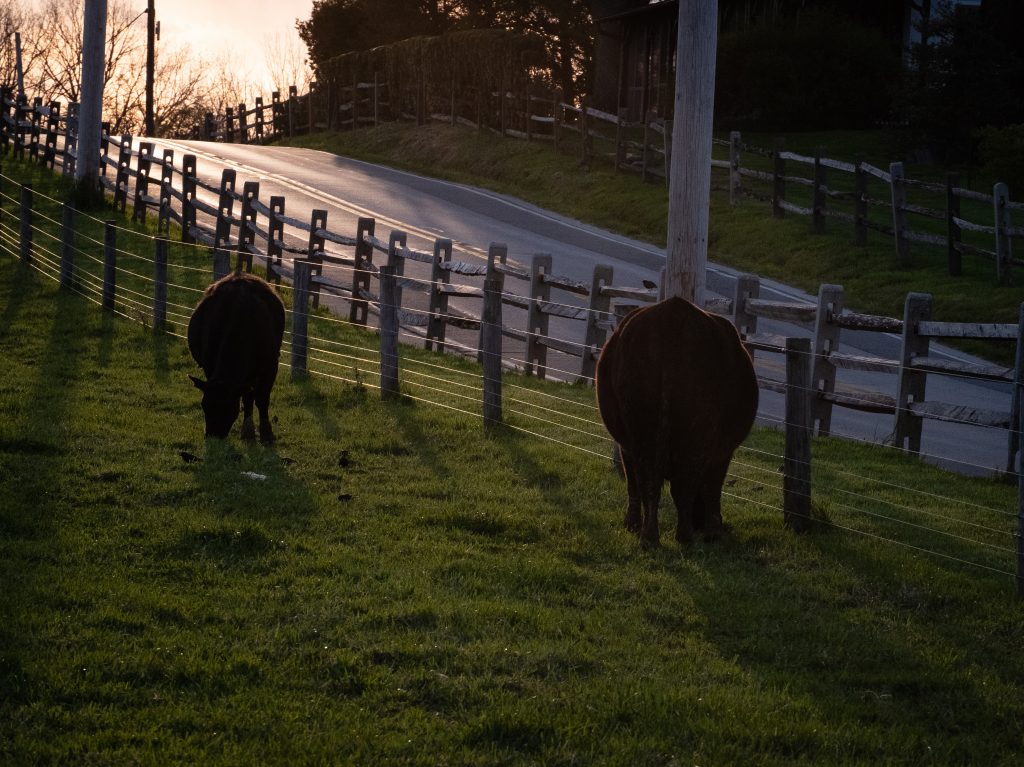
A view of Dixon Meadow Preserve,A stream wanders through the Preserve and under the boardwalk.Redbud in bloom.Erdenheim Farm Black Angus at twilight.
A trip to the Octoraro Lake area for some birding did not produce what I had hoped for on the bird front. I saw some ducks and great blue herons and managed to take some of the worst bird photos I have ever attempted. I did better with photos of the surrounding countryside.
One of the spectacular farms of the area.I usually avoid shooting abandoned buildings, but this is part of a working farm.Enjoying lunch on a sunny day …This was the fastest moving Amish buggy I have ever encountered.While this one was trying to avoid traffic on my way home.
Finally, a shot from northwestern Chester Country, because I like it and don’t have another post to put it in.
I took photos of the dog below on my travels through Chester County. Do you think this guy is real or some kind of doggy scarecrow? If not real, it’s a pretty convincing likeness. Comment below.
Disclaimer: There are no pictures of horned larks in this post
The grapevine (okay, Ebird) continued to carry news of horned larks, Lapland longspurs, and snow buntings in farmers’ fields in northwestern Chester County near Honeybrook. As mentioned in my previous post, I had visited this area over the Winter in connection with a trip to try to find a snowy owl that had briefly been seen nearby. On the first try, I had no luck. This time around I spotted horned larks in small flocks, which is a new species for my life list. This is a very picturesque area with lovely farms that merited more photos.
This young farmer was fertilizing his fields for Spring.
Here’s a better look.
Cattle feeding and soaking up the sun.
Two Amish schoolhouses are close to each other in this area.
Some looks at the farms and fields.
The plastic tubes are there to protect the young trees as they grow along this riparian boundary. The tubes will biodegrade over time.
This Winter I traveled to northwestern Chester County in search of a snowy owl and some horned larks. I didn’t find either. However, I did find some pretty farms, interesting buildings and charismatic farm animals along the way.
Mom and baby?The stare down.“Get off our lawn!”What do you think is down this road?