

The penultimate installment of the Hubble 35th Anniversary Night Sky Challenge went ahead, despite the government shutdown, thanks to the Astronomical League. The League got the word out about the monthly targets.
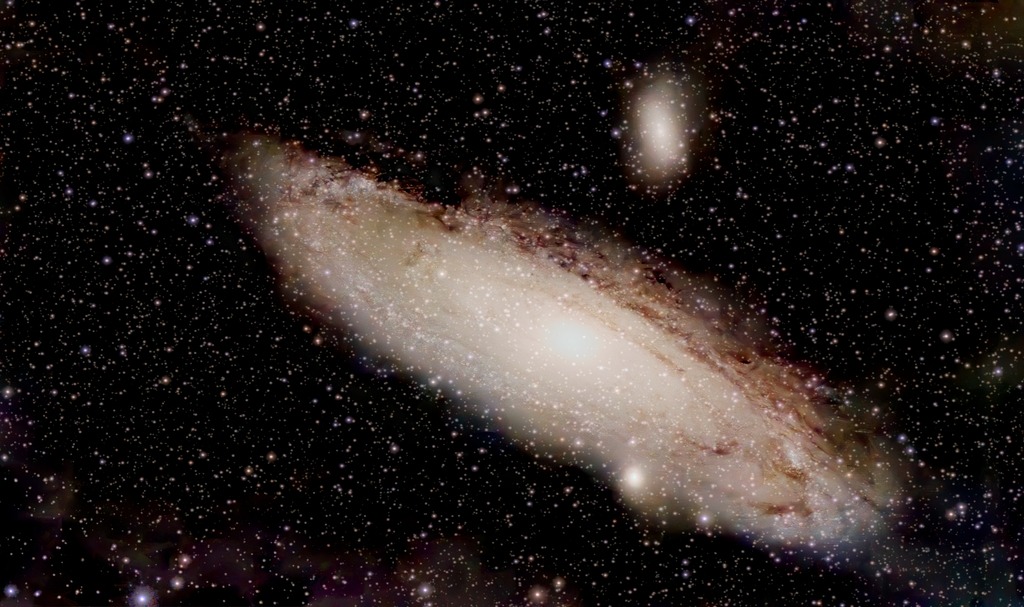
The Andromeda Galaxy is a popular astrophotography target. It is a barred spiral galaxy and is the nearest major galaxy to the Milky Way. It was originally named the Andromeda Nebula and is cataloged as Messier 31, M31, and NGC 224. Andromeda is approximately 765 kpc (2.5 million light-years) from Earth. The galaxy’s name stems from the area of Earth’s sky in which it appears, the constellation of Andromeda, which itself is named after the princess who was the wife of Perseus in Greek mythology. The Andromeda Galaxy has a diameter of about 46.56 kpc (152,000 ly), making it the largest member of the Local Group of galaxies in terms of extension.
The Milky Way and Andromeda galaxies have about a 50% chance of colliding with each other in the next 10 billion years, merging to potentially form a giant elliptical galaxy or a large lenticular galaxy. With an apparent magnitude of 3.4, the Andromeda Galaxy is among the brightest of the Messier objects, and is visible to the naked eye from Earth on moonless nights, even when viewed from areas with moderate light pollution.
It is flanked in this photo by two smaller satellite galaxies M110 (upper center right) and M32 (lower center right on edge of M31). Based on current evidence, it appears that M32 underwent a close encounter with the Andromeda Galaxy in the past. M32 may once have been a larger galaxy that had its stellar disk removed by M31 and underwent a sharp increase of star formation in the core region, which lasted until the relatively recent past. M110 also appears to be interacting with the Andromeda Galaxy, and astronomers have found in the halo of the latter a stream of metal-rich stars that appear to have been stripped from these satellite galaxies. M110 does contain a dusty lane, which may indicate recent or ongoing star formation. M32 has a young stellar population as well.
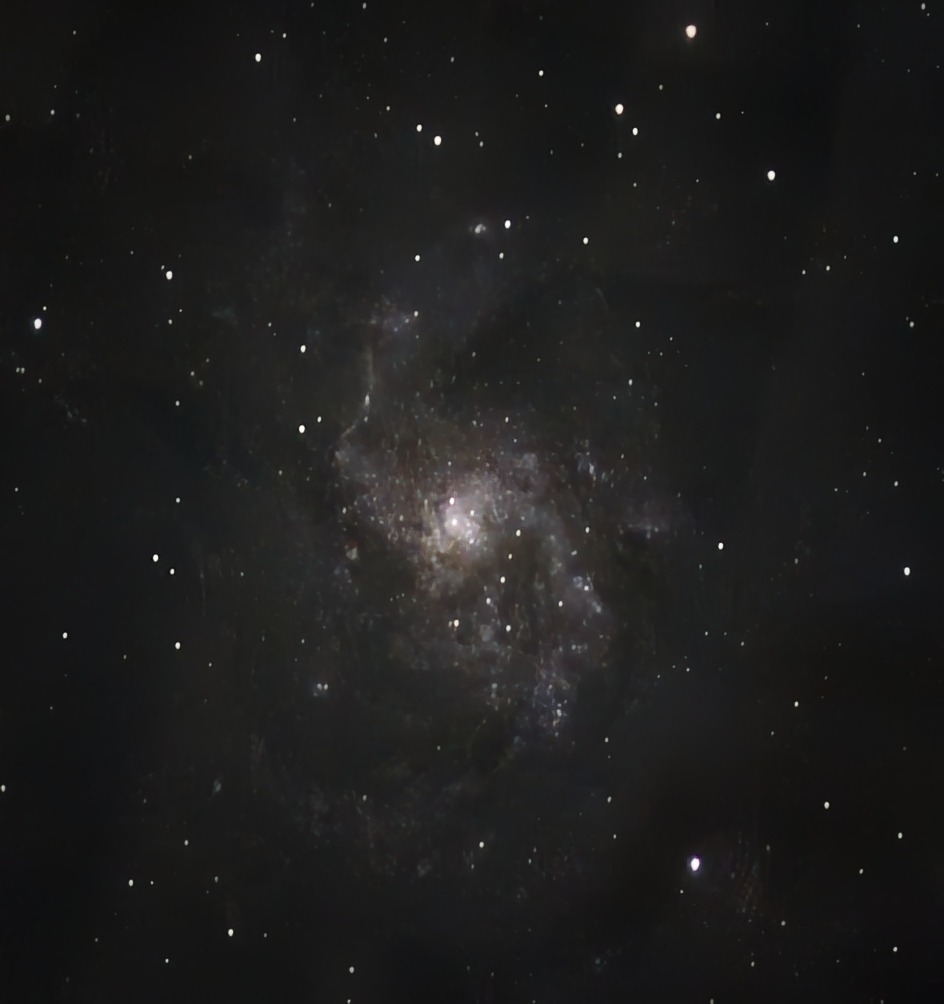
The Triangulum Galaxy is a non-dwarf galaxy that lies 750,000 light-years from Andromeda. It is currently unknown whether it is a satellite of Andromeda.[It is a spiral galaxy 2.73 million light-years (ly) from Earth in the constellation Triangulum. It is catalogued as Messier 33 or NGC 598. The Triangulum Galaxy is the third-largest member of the Local Group of galaxies, behind the Andromeda Galaxy and the Milky Way.
The galaxy is the second-smallest spiral galaxy in the Local Group after the Large Magellanic Cloud, which is a Magellanic-type spiral galaxy. It is believed to be a satellite of the Andromeda Galaxy or on its rebound into the latter due to their interactions, velocities, and proximity to one another in the night sky.
Under exceptionally good viewing conditions with no light pollution, the Triangulum Galaxy can be seen by some people with the fully dark-adapted naked eye; to those viewers, it is the farthest permanent entity visible without magnification, being about half again as distant as Messier 31, the Andromeda Galaxy.
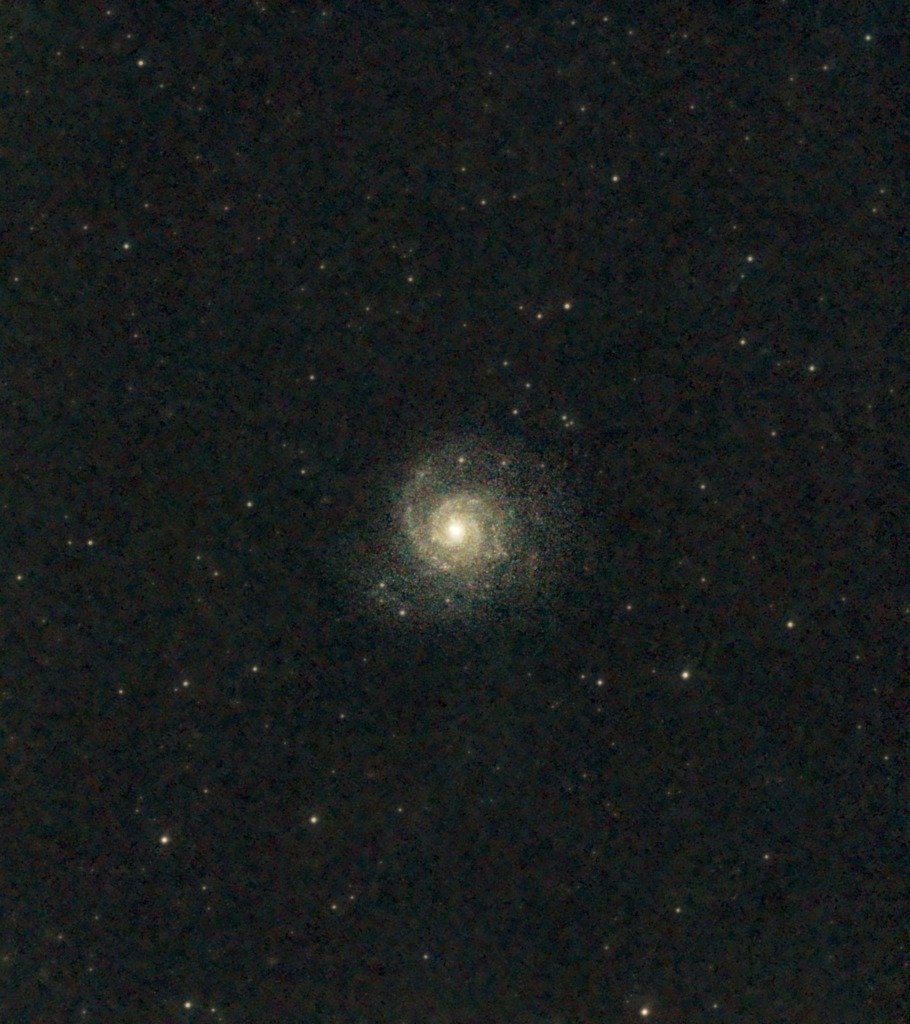
Messier 74 (also known as NGC 628 and Phantom Galaxy) is a large spiral galaxy in the equatorial constellation Pisces. It is about 32 million light-years away from Earth. The galaxy contains two clearly defined spiral arms and is therefore used as an archetypal example of a grand design spiral galaxy. The galaxy’s low surface brightness makes it the most difficult Messier object for amateur astronomers to observe. Its relatively large angular (that is, apparent) size and the galaxy’s face-on orientation make it an ideal object for professional astronomers who want to study spiral arm structure and spiral density waves. It is estimated that M74 hosts about 100 billion stars.
M74 was discovered by Pierre Méchain in 1780. He then communicated his discovery to Charles Messier, who listed the galaxy as M74 in his catalog of permanent celestial objects that should not be confused with transient objects in the sky. This galaxy has the second-lowest Earth-surface brightness of any Messier object, making observation by amateur astronomers a challenge. (M101 has the lowest.) It requires a good night sky.
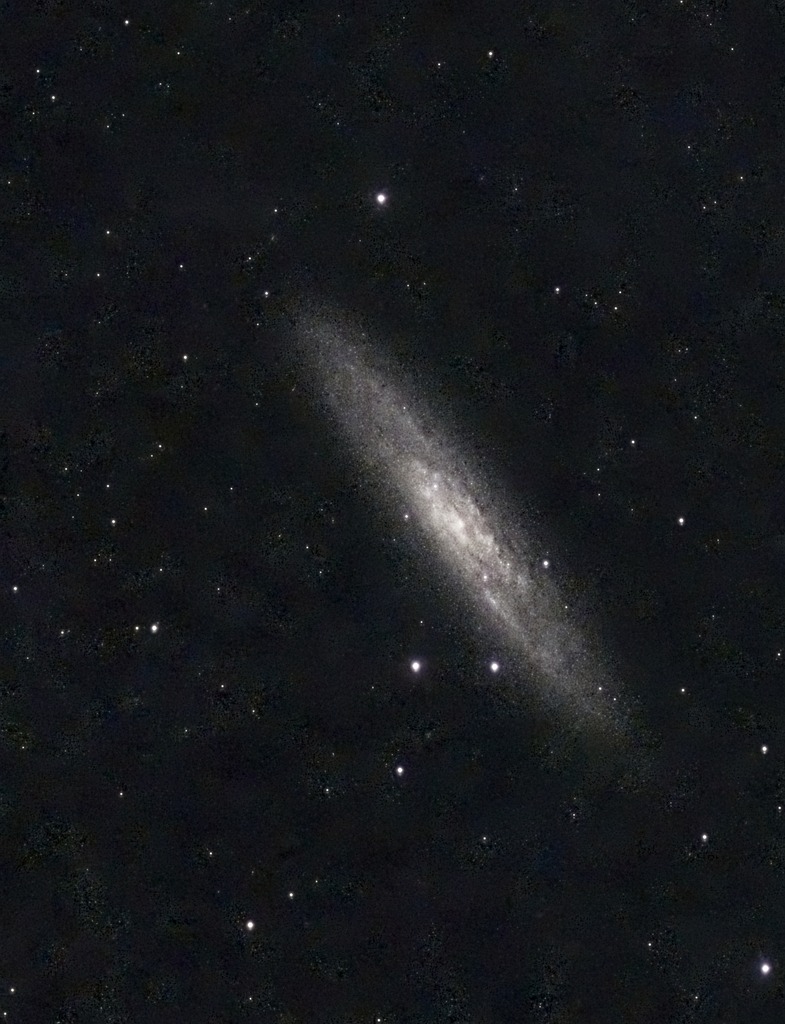
The Sculptor Galaxy (also known as the Silver Coin Galaxy, Silver Dollar Galaxy, NGC 253, or Caldwell 65) is an intermediate spiral galaxy in the constellation Sculptor. The Sculptor Galaxy is a starburst galaxy, which means that it is currently undergoing a period of intense star formation. I found it to be more of a challenge to image as it lies low in my southern skies.
The galaxy was discovered by Caroline Herschel in 1783 during one of her systematic comet searches. Many years later, John Herschel observed it using his 18-inch metallic mirror reflector at the Cape of Good Hope. He wrote: “very bright and large (24′ in length); a superb object…. Its light is somewhat streaky, but I see no stars in it except 4 large and one very small one, and these seem not to belong to it, there being many near…”
In 1961, Allan Sandage wrote in the Hubble Atlas of Galaxies that the Sculptor Galaxy is “the prototype example of a special subgroup of Sc systems….photographic images of galaxies of the group are dominated by the dust pattern. Dust lanes and patches of great complexity are scattered throughout the surface. Spiral arms are often difficult to trace…. The arms are defined as much by the dust as by the spiral pattern.” Bernard Y. Mills, working out of Sydney, discovered that the Sculptor Galaxy is also a fairly strong radio source.
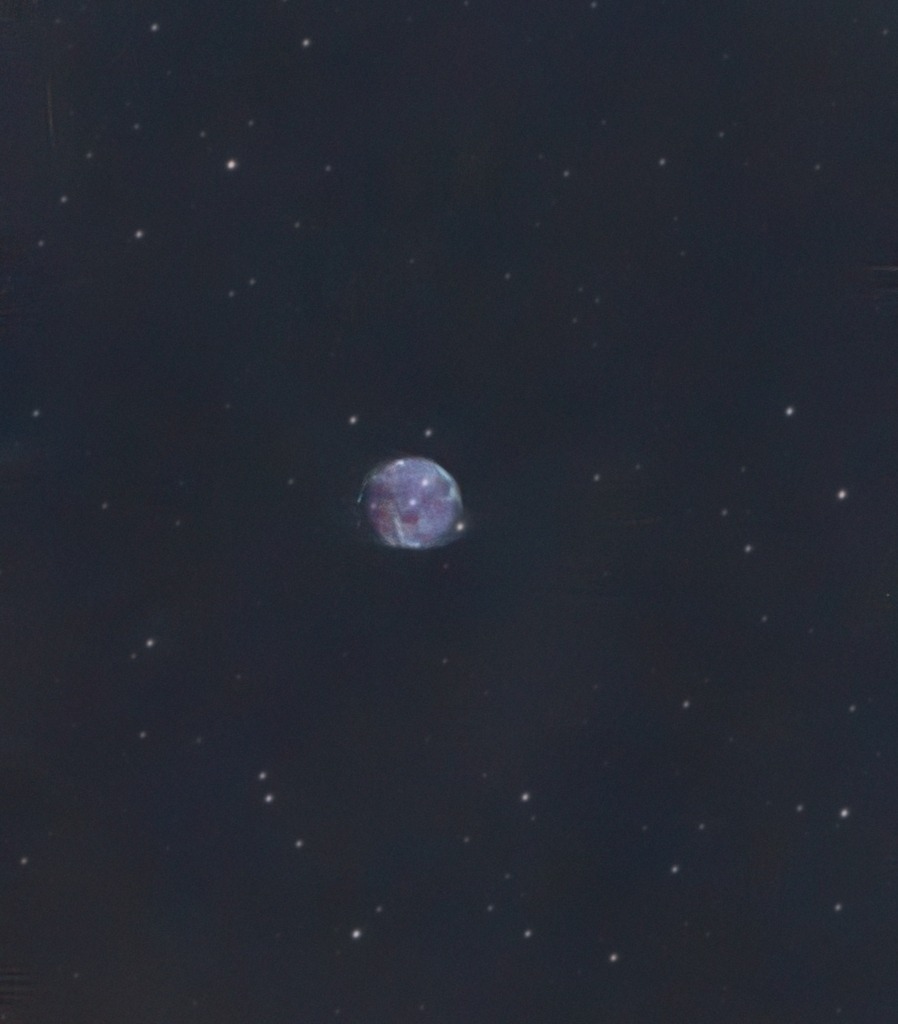
NGC 246 (also known as the Skull Nebula or Caldwell 56) is a planetary nebula in the constellation Cetus. It was discovered in 1785 by William Herschel.
The nebula is roughly 3,500+720 −850 light-years away. NGC 246’s central star is the 12th magnitude white dwarf HIP 3678 A. In 2014, astronomers discovered a second companion to NGC 246’s central star, which has a comoving companion star called HIP 3678 B. The second companion star, a red dwarf known as HIP 3678 C, was discovered using the European Southern Observatory’s Very Large Telescope. This makes NGC 246 the first planetary nebula to have a hierarchical triple star system at its center. It is currently the only known example of a planetary nebula with more than two central stars.
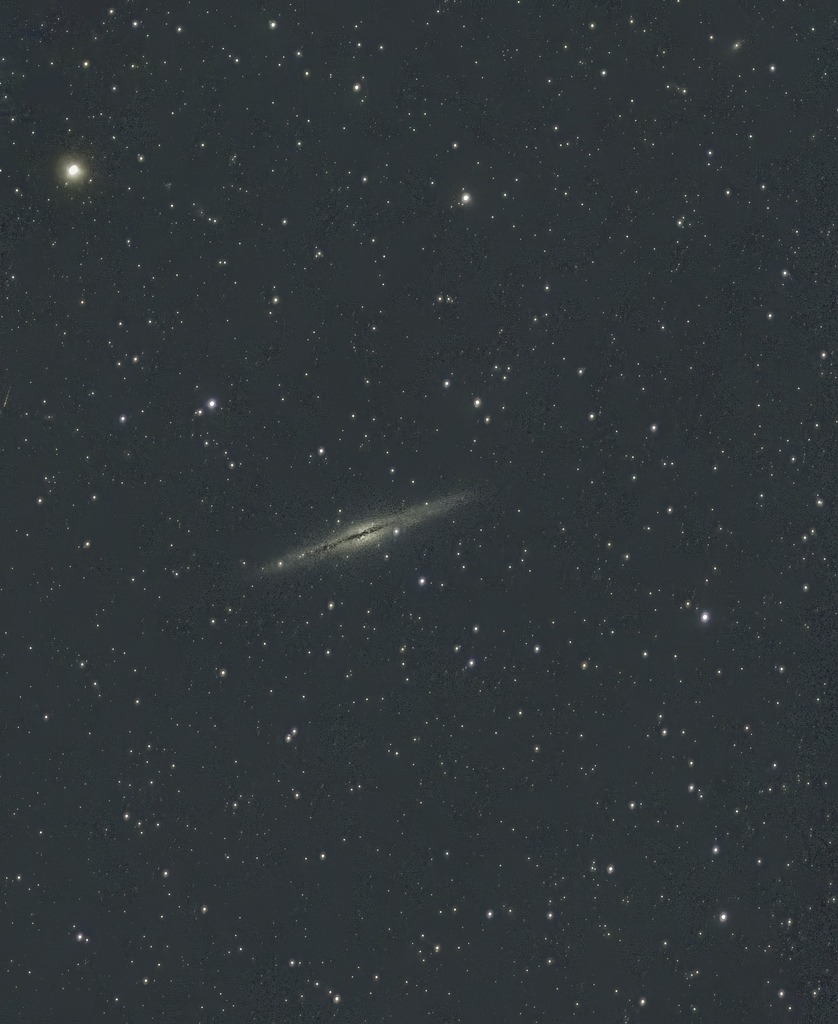
NGC 891 (also known as Caldwell 23, the Silver Sliver Galaxy, and the Outer Limits Galaxy) is an edge-on unbarred spiral galaxy about 30 million light-years away in the constellation Andromeda. It was discovered by William Herschel on October 6, 1784. The galaxy is a member of the NGC 1023 group of galaxies in the Local Supercluster. It has an H II nucleus. The object is visible in small to moderate size telescopes as a faint elongated smear of light with a dust lane visible in larger apertures.
In 2005, due to its attractiveness and scientific interest, NGC 891 was selected to be the first light image of the Large Binocular Telescope.[In 2012, it was again used as a first light image of the Lowell Discovery Telescope with the Large Monolithic Imager. Supernova SN 1986J was discovered on August 21, 1986 at apparent magnitude 14.
NGC 891 appears alongside M67, the Sombrero Galaxy(M104), the Pinwheel Galaxy(M101), NGC 5128, NGC 1300, M81, and the Andromeda Galaxy in the end credits of the Outer Limits TV series, which is why it is occasionally called the Outer Limits Galaxy.
The soundtrack of the 1974 film Dark Star by John Carpenter features a muzak-style instrumental piece called “When Twilight Falls on NGC 891”. The first solo album by Edgar Froese, Aqua, also released in 1974, contained a track called “NGC 891”. Side 2 of the album, which included this track, was unusual in having been a rare example of a commercially issued piece of music recorded using the artificial head system.
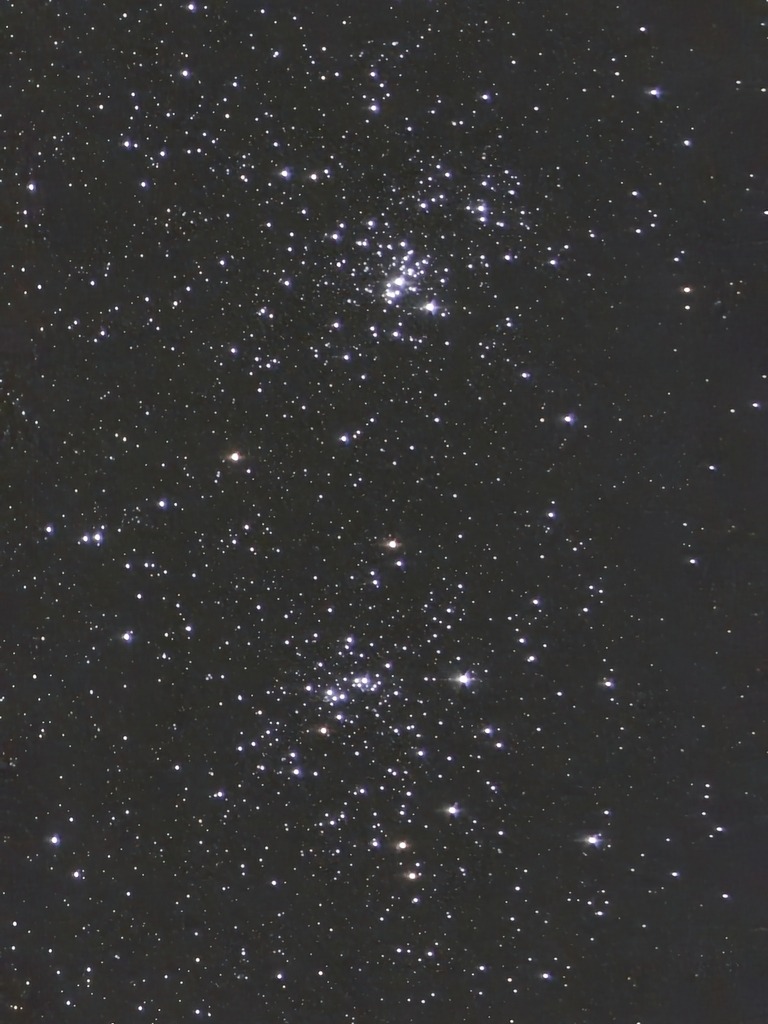
Finally we have another non-galaxy, the Double Cluster, also known as Caldwell 14, consists of the open clusters NGC 869 and NGC 884 (often designated h Persei and χ (chi) Persei, respectively), which are close together in the constellation Perseus. Both visible to the naked eye, NGC 869 and NGC 884 lie at a distance of about 7,500 light-years (2,300 pc) in the Perseus Arm of the Milky Way galaxy.
Greek astronomer Hipparchus cataloged the object (a patch of light in Perseus) as early as 130 BCE. To Bedouin Arabs the cluster marked the tail of the smaller of two fish they visualized in this area, and it was shown on illustrations in Abd al-Rahman al-Sufi’s Book of Fixed Stars. However, the true nature of the Double Cluster was not discovered until the invention of the telescope, many centuries later. In the early 19th century William Herschel was the first to recognize the object as two separate clusters. The Double Cluster is not included in Messier’s catalog, but is included in the Caldwell catalogue of popular deep-sky objects.
Leave a Reply