

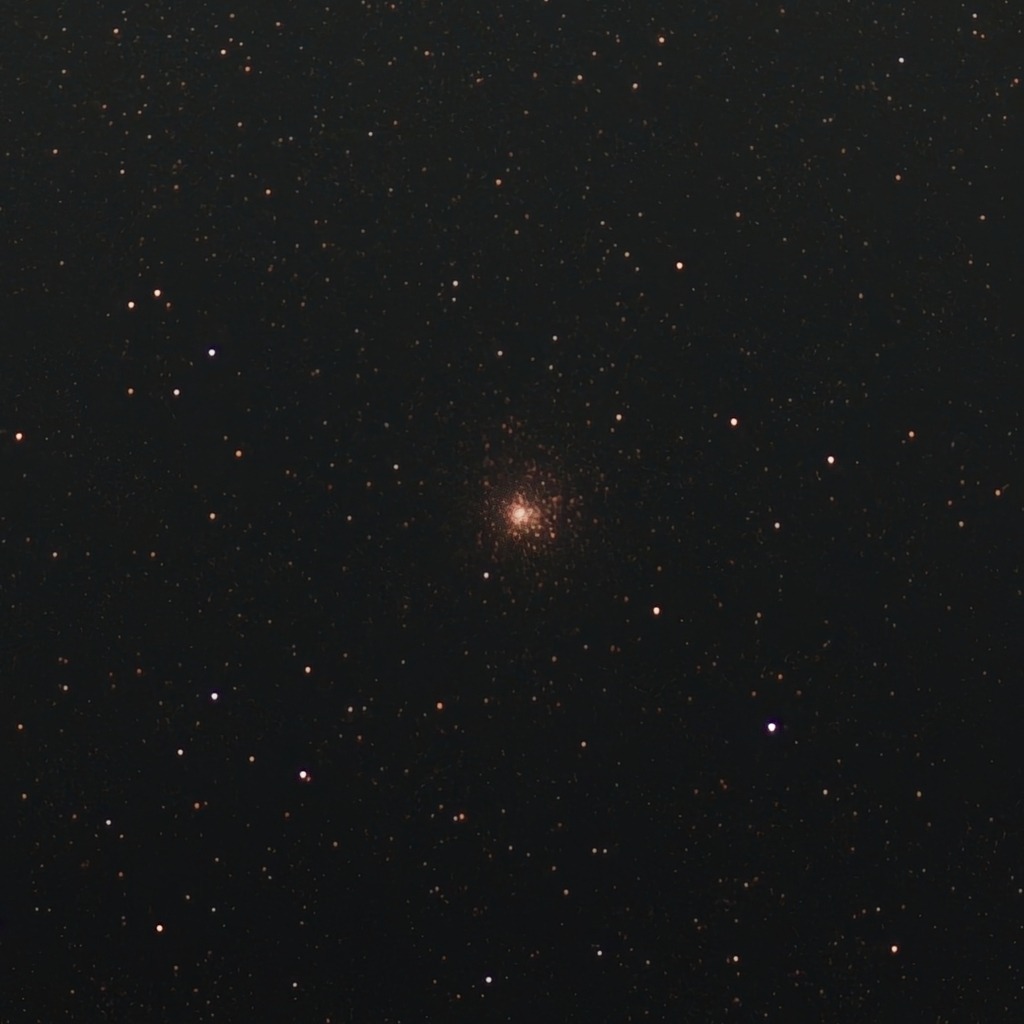
The Hubble 35th Anniversary Challenge for July put the emphasis on globular clusters. These dense star formations are forgiving astrophotography targets, so this month’s batch of photos may be a bit better than the usual mixed bag of results.
A globular cluster is a spherical collection of stars, typically containing hundreds of thousands or even millions of stars, all gravitationally bound together. These clusters are ancient, with their stars often being among the oldest in their host galaxies, and they orbit the galactic core in a halo-like structure.
One of the most famous is Messier 13 (M 13 or NGC 6205) in the constellation Hercules , which contains several hundred thousand stars. Messier 13 was discovered by Edmond Halley in 1714, and cataloged by Charles Messier on June 1, 1764, into his list of objects not to mistake for comets; Messier’s list, including Messier 13, eventually became known as the Messier catalog. Messier 13 is often described by astronomers as the most magnificent globular cluster visible to northern observers.

Messier 92 (also known as M92, M 92, or NGC 6341) is a globular cluster of stars also in the constellation of Hercules. It was discovered by Johann Elert Bode on December 27, 1777, then published in the Berliner Astronomisches Jahrbuch during 1779. It was inadvertently rediscovered by Charles Messier on March 18, 1781, and added as the 92nd entry in his catalog. William Herschel first resolved individual stars in 1783.
It is one of the brighter of its sort in apparent magnitude in the northern hemisphere and in its absolute magnitude in the galaxy, but it is often overlooked by amateur astronomers due to proximity to bright Messier 13. Though when compared to M13, M92 is only slightly less bright, but about 1/3 less extended. It is visible to the naked eye under very good viewing conditions.With a small telescope, M92 can be seen as a smudge even in a severely light-polluted sky.

Messier 107 or M107, also known as NGC 6171 or the Crucifix Cluster, is a very loose globular cluster in a southern part of the sky in Ophiuchus, and is the last object in the Messier Catalog. It was discovered by Pierre Méchain in April 1782, then independently by William Herschel in 1793. Herschel’s son, John, in his 1864 General Catalog, described it as a “globular cluster of stars, large, very rich, very much compressed, round, well resolved, clearly consisting of stars”

Messier 62 or M62, also known as NGC 6266 or the Flickering Globular Cluster, is a globular cluster of stars in the south of the equatorial constellation of Ophiuchus. It was discovered in 1771 by Charles Messier, then added to his catalog eight years later.
M62 is among the ten most massive and luminous globular clusters in the Milky Way, showing an integrated absolute magnitude of −9.18. It is essentially spherical.
Leave a Reply