A trip tp eastern Lancaster County provided a look at the following scenes:
A group of vultures found something dead and furry by the side of the road. There was one black vulture and several turkey vultures.
Who’s the other guy?When I circled back around, the turkey vultures had decided to show off the interloper. More vultures were in the air.
There were also plenty of horses enjoying their Sunday off. I think almost everyone likes horses.
A peaceful browse.Now I don’t know know what this one is trying to say, but he doesn’t seem happy with me.Some more horses off in the distance.A bonus shot of an Amish buggy.
Looming over the town of Nicholson, Pennsylvania is the Tunkhannock Creek Viaduct, a railroad bridge completed in 1915. It is a concrete deck arch bridge on the Nicholson Cutoff rail segment of the Norfolk Southern Railway Sunbury Line that spans Tunkhannock Creek. Measuring 2,375 feet (724 m) long and 240 feet (73.15 m) tall when measured from the creek bed (300 feet (91.44 m) from bedrock), it was the largest concrete structure in the world when completed in 1915 and still merited “the title of largest concrete bridge in America, if not the world” 50 years later. Built by the Delaware, Lackawanna and Western Railroad, the bridge is owned today by Norfolk Southern Railway and is still used daily for regular through freight service. Apparently almost half of the bulk of this behemoth is underground, in the form of bridge pillars up to 138 feet (142 m) below ground.
The bridge was listed on the National Register of Historic Places on April 11, 1977. In 1975, the American Society of Civil Engineers or ASCE designated the bridge as a Historic Civil Engineering Landmark. ASCE recognized the bridge as “not only a great feat of construction skill” but also a “bold and successful departure from contemporary, conventional concepts of railroad location in that it carried a mainline transversely to the regional drainage pattern, effectively reducing the distance and grade impediments…”
The bridge towers over the town of Nicholson.A view further upstream.The cows don’t seem to notice the vast structure.
I also swung by Lackawanna State Park on my way back from the bridge. The 1,445-acre park is ten miles north of Scranton. The focus is the 198-acre Lackawanna Lake, which is surrounded by picnic areas and multi-use trails winding through forest. Boating, camping, fishing, mountain biking, and swimming are popular recreation activities here.
I’ve always wanted a canoe mooring on a lake.At least these geese don’t mind the weather.Another rainy late spring day ….Great spot for a picnic and a boat trip.
A trip to the Octoraro Lake area for some birding did not produce what I had hoped for on the bird front. I saw some ducks and great blue herons and managed to take some of the worst bird photos I have ever attempted. I did better with photos of the surrounding countryside.
One of the spectacular farms of the area.I usually avoid shooting abandoned buildings, but this is part of a working farm.Enjoying lunch on a sunny day …This was the fastest moving Amish buggy I have ever encountered.While this one was trying to avoid traffic on my way home.
Finally, a shot from northwestern Chester Country, because I like it and don’t have another post to put it in.
I took photos of the dog below on my travels through Chester County. Do you think this guy is real or some kind of doggy scarecrow? If not real, it’s a pretty convincing likeness. Comment below.
Disclaimer: There are no pictures of horned larks in this post
The grapevine (okay, Ebird) continued to carry news of horned larks, Lapland longspurs, and snow buntings in farmers’ fields in northwestern Chester County near Honeybrook. As mentioned in my previous post, I had visited this area over the Winter in connection with a trip to try to find a snowy owl that had briefly been seen nearby. On the first try, I had no luck. This time around I spotted horned larks in small flocks, which is a new species for my life list. This is a very picturesque area with lovely farms that merited more photos.
This young farmer was fertilizing his fields for Spring.
Here’s a better look.
Cattle feeding and soaking up the sun.
Two Amish schoolhouses are close to each other in this area.
Some looks at the farms and fields.
The plastic tubes are there to protect the young trees as they grow along this riparian boundary. The tubes will biodegrade over time.
This Winter I traveled to northwestern Chester County in search of a snowy owl and some horned larks. I didn’t find either. However, I did find some pretty farms, interesting buildings and charismatic farm animals along the way.
Mom and baby?The stare down.“Get off our lawn!”What do you think is down this road?
On my way home from Swatara and Memorial Lake State Parks, I decided to swing through Middle Creek Wildlife Management Area. Middle Creek is not a place I visit much in Autumn, but it is well worth a stop. Middle Creek is administered by the Pennsylvania Game Commission for game propogation and wildlife conservation, but it feels park-like. With opportunities for hiking, picnicing, boating and fantastic birding and wildlife watching, it makes for a great day out.
The view from the Visitor’s Center.Relaxing by the lake.The nearby area has some lovely farms.These horses are enjoying a fine Autumn day.
This post is just the beginning of the promised photos of covered bridges. I set out on a mission to view and, in most cases, photograph my local covered bridges. For those of you interested in finding these bridges for yourself, I recommend this site. A view of the Knox (Valley Forge) covered bridge can be found in my earlier post.
Covered bridges were sometimes called “kissing bridges” because they provided some privacy for travellers to sneak a kiss. While at the Mercer’s Mill Covered Bridge, I met a guy who used to bring his girlfriend there from Delaware in the 1980s. So it seems the tradition of young lovers being drawn to covered bridges extended well into the twentieth century.
The Mercer’s Mills covered bridge. Horses hanging out at a nearby farm.
The Bartram covered bridge straddles the border with Delaware County on Crum Creek. It would make one end, at least, Delaware County’s only covered bridge.
The Bartram Covered bridge.
The Gibson covered bridge sits along side a busy road. Traffic through the bridge is only one way. The eastern side has a parking area for access to local hiking in the Brandywine Meadows Preserve.
The Gibson Covered Bridge.The Larkin Covered Bridge – sadly out of use, but it has a walking path nearby.
Nestled between the mountain ridges in Perry County is Sherman’s Valley. The valley is traversed by Route 274, with its heart in Blain, PA. I came here in search of a couple of covered bridges on Sherman Creek. The narrow valley feels remote due to its situation between two ridge lines. However, it is not to far from Carlisle and Harrisburg.
It was, unfortunately, quite a gloomy morning when I was there. Here is a sampling of what I saw (and, or course, those covered bridges):
Farm house across the road – like my grandparent’s former farm.The Mount Pleasant Covered Bridge.Sherman CreekThe New Germantown Covered BridgeI see these stars all over the place on homes and barns. This one has a twist with the flag motif.Great red color on this barn.Nestled against the backdrop of mountains.I love how this house has been built around a log structure.Another great red barn.
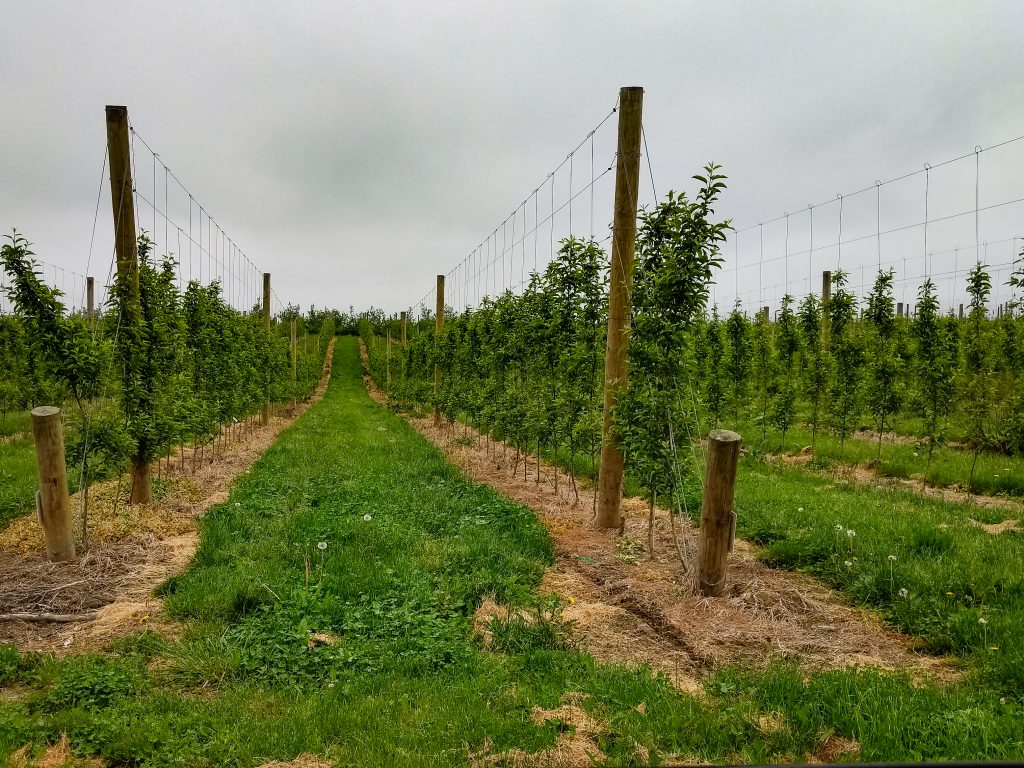
Western Adams County, along the slopes of South Mountain, hosts a large number of orchards. I was on my way to Gettysburg from Pine Grove Furnace and happened on this area by chance. It was a nice surprise.
A look down a row of new trees.A mature orchard,I loved this farm peeking out from behind the pond.
I had to visit the Historic Round Barn and Farm Market in Biglerville, PA. The family-owned market has fresh fruits and vegetables, jams, jellies, honey, canned fruits and vegetables, snacks, candy, and gift items. It is well worth a visit if you are near Gettysburg.
A very interesting building and well-maintained.A signature painted horse out front.Some adorable residents.