• As Thoughts Turn to Winter …

    At this time of year, skiing is now on people’s mind. Ski Sawmill Family Resort, located in Tioga County, offers a family atmosphere and a range of options for skiers and snowboarders of all skill levels. The ski rea has 12 slopes and 3 lifts.

    The resort’s peak elevation reaches 2,215 feet, with a base elevation of 1,770 feet, providing a 515-foot vertical drop. For those seeking even more excitement, the terrain park, conveniently located adjacent to the double chairlift, offers a variety of features for freestyle enthusiasts. There are also a variety of casual lodging offering onsite, a retail store and main lodge.

    The Morris location of the Oregon Hill Winery is a short distance down the road. The Winery produces award-winning “Pennsylvania Mountain Wines.” Since 1983, our family-owned winery has been creating a variety of wines from bold, oaky reds to crisp, blush wines, as well as sweet fruit wines. The actual Winery is located in Wellsboro .

  • The Final Hubble Installment

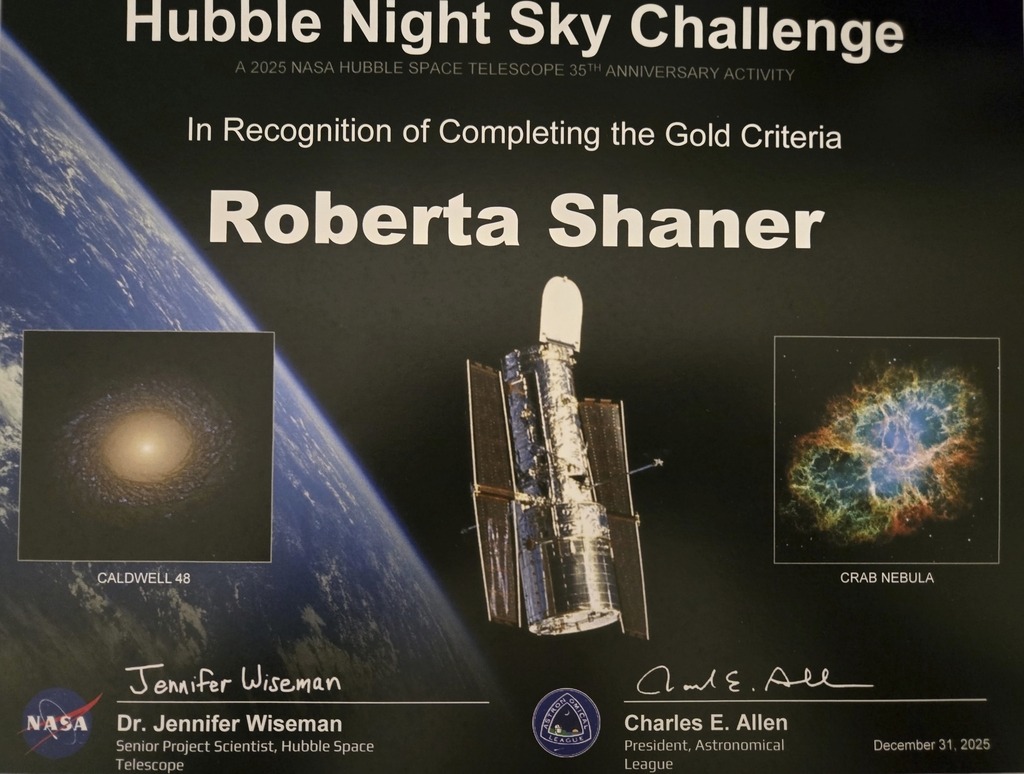
    December marks the final month of the Hubble 35th Anniversary Challenge. More about the challenge can be found on the Night Sky page.

    The first target is a familiar one – even to those who view the night sky with their naked eyes – the Pleiades, also known as Seven Sisters and Messier 45 (M45). It is an asterism of an open star cluster containing young B-type stars in the northwest of the constellation Taurus. At a distance of about 444 light-years, it is among the nearest star clusters to Earth and the nearest Messier object to Earth, being the most obvious star cluster to the naked eye in the night sky. It contains the reflection nebulae NGC 1432, an HII region, and NGC 1435, known as the Merope Nebula. Around 2330 BC the Pleiades marked the vernal point. Due to the brightness of its stars, the Pleiades is viewable from most areas on Earth, even in locations with significant light pollution.

    The cluster is dominated by hot blue luminous stars that have formed within the last 100 million years. Reflection nebulae around the brightest stars were once thought to be leftover material from their formation, but are now considered likely to be an unrelated dust cloud in the interstellar medium through which the stars are currently passing. Computer simulations have shown that the Pleiades were probably formed from a compact configuration that once resembled the Orion Nebula.

    Together with the open star cluster of the Hyades, the Pleiades form the Golden Gate of the Ecliptic. The Pleiades have been said to “resemble a tiny dipper,” and should not be confused with the “Little Dipper,” or Ursa Minor. The cluster has been of considerable cultural and practical importance around the Earth for millennia.

    M45 – The Pleiades, the blue nebulousness around the stars is apparent.

    The remaining targets are significantly smaller when viewed in the night sky. Messier 77 (M77), also known as NGC 1068 or the Squid Galaxy, is a barred spiral galaxy in the constellation Cetus. It is about 47 million light-years (14 Mpc) away from Earth, and was discovered by Pierre Méchain in 1780, who originally described it as a nebula. Méchain then communicated his discovery to Charles Messier, who subsequently listed the object in his catalog. Both Messier and William Herschel described this galaxy as a star cluster. Today, however, the object is known to be a galaxy. It is one of the Seyfert galaxies featured this month. Seyfert galaxies are one of the two largest groups of active galaxies, along with quasar host galaxies. They have quasar-like nuclei (very luminous sources of electromagnetic radiation that are outside of our own galaxy) with very high surface brightness whose spectra reveal strong, high-ionization emission lines, but unlike quasars, their host galaxies are clearly detectable. M77 is one of the brightest Seyfert galaxies visible from Earth and has a diameter of about 27.70 kiloparsecs (90,000 light-years).

    In a smart telescope, it appears as a roundish, hazy smudge with a bright core.

    M77

    Next up is Caldwell 67. NGC 1097 (also known as Caldwell 67 or C67) is a barred spiral galaxy about 45 million light years away in the constellation Fornax. It was discovered by William Herschel on 9 October 1790. It is a severely interacting galaxy with obvious tidal debris and distortions caused by interaction with the companion galaxy NGC 1097A. C67 is also a Seyfert galaxy. Deep photographs revealed four narrow optical jets that appear to emanate from the nucleus. These have been interpreted as manifestations of the (currently weak) active nucleus. The optical jets are in fact composed of stars. The failure to detect atomic hydrogen gas in the jets with the Very Large Array radio telescope and numerical simulations led to the current interpretation that the jets are actually the shattered remains of a cannibalized dwarf galaxy. C67 has a supermassive black hole at its center, which is 140 million times the mass of the Sun.

    Here C67 appears as an almost edge-on galaxy, a faint elongated smudge with a bright core.

    C67

    Finally, we come to C24. NGC 1275 (also known as Perseus A or Caldwell 24) is a type 1.5 Seyfert galaxy located around 225 million light-years away from Earth in the direction of the constellation of Perseus. C24 is a member of the large Perseus Cluster of galaxies. It was discovered by German-British astronomer William Herschel on 17 October 1786.


    C24 consists of two galaxies, a central type-cD galaxy in the Perseus Cluster, and a so-called high velocity system (HVS) which lies in front of it. The HVS is moving at 3000 km/s towards the dominant system, and is believed to be merging with the Perseus Cluster. The HVS is not affecting the cD galaxy as it lies at least 200 thousand light years from it. However tidal interactions are disrupting it and the ram pressure produced by its interaction with the intra-cluster medium of Perseus is stripping its gas as well as producing large amounts of star formation within it.

    In the photo below, the monster galaxy appears as a roundish smudge near the center. There is a parallelogram shape of four bright smudges. C24 is the lower left member of this group of four.

    C24

  • It’s Not a Grand Canyon

    Pine Creek Gorge is a 47-mile (76 km) gorge carved into the Allegheny Plateau by Pine Creek in north-central Pennsylvania. It sits in about 160,000 acres (650 km2) of the Tioga State Forest. The gorge begins south of Ansonia, near Wellsboro, along U.S. Route 6 and continues south. Its deepest point is 1,450 feet (440 m) at Waterville, near the southern end.

    The Gorge has the unfortunate nickname of “The Grand Canyon of Pennsylvania.” Not only is this a wild exaggeration, but the area’s unique beauty deserves to stand on its own and does not require comparison. The area most associated with the Gorge is near Leonard Harrison and Colton Point State Parks, where it is more than 800 feet (240 m) deep and the distance rim-to-rim is about 4,000 feet (1,200 m). I visited Leonard Harrison in October.

    The Visitor’s Center
    The view down into the Gorge.
    That’s Pine Creek down there.
  • Pine Creek Northbound

    Near Waterville, Route 414 turns north up the Pine Creek valley. The southern part of this valley feels wider and has more towns along the banks of the stream. Most of this area is still in Lycoming County until just south of Blackwell. The Pine Creek area was the site of major logging activity from the late 18th through early 20th century and is now a major hub for recreation. Much of the now second-growth forest is protected by a network of parks, state game lands and state forest,

    The aptly named “Bottom Lodge.”
    There are several points to launch small boats into Pine Creek and access the Rail Trail.
    From the bridge at Slate Run
    Hilborn Iron Bridge

  • A Garland of Galaxies

    The penultimate installment of the Hubble 35th Anniversary Night Sky Challenge went ahead, despite the government shutdown, thanks to the Astronomical League. The League got the word out about the monthly targets.

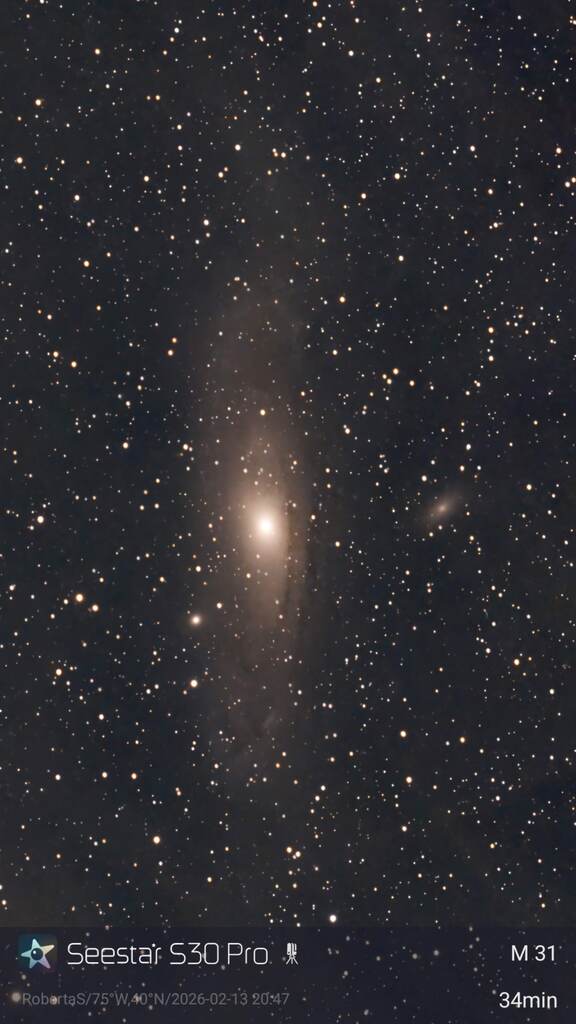
    The Andromeda Galaxy is a popular astrophotography target. It is a barred spiral galaxy and is the nearest major galaxy to the Milky Way. It was originally named the Andromeda Nebula and is cataloged as Messier 31, M31, and NGC 224. Andromeda is approximately 765 kpc (2.5 million light-years) from Earth. The galaxy’s name stems from the area of Earth’s sky in which it appears, the constellation of Andromeda, which itself is named after the princess who was the wife of Perseus in Greek mythology. The Andromeda Galaxy has a diameter of about 46.56 kpc (152,000 ly), making it the largest member of the Local Group of galaxies in terms of extension.

    The Milky Way and Andromeda galaxies have about a 50% chance of colliding with each other in the next 10 billion years, merging to potentially form a giant elliptical galaxy or a large lenticular galaxy. With an apparent magnitude of 3.4, the Andromeda Galaxy is among the brightest of the Messier objects, and is visible to the naked eye from Earth on moonless nights, even when viewed from areas with moderate light pollution.

    It is flanked in this photo by two smaller satellite galaxies M110 (upper center right) and M32 (lower center right on edge of M31). Based on current evidence, it appears that M32 underwent a close encounter with the Andromeda Galaxy in the past. M32 may once have been a larger galaxy that had its stellar disk removed by M31 and underwent a sharp increase of star formation in the core region, which lasted until the relatively recent past. M110 also appears to be interacting with the Andromeda Galaxy, and astronomers have found in the halo of the latter a stream of metal-rich stars that appear to have been stripped from these satellite galaxies. M110 does contain a dusty lane, which may indicate recent or ongoing star formation. M32 has a young stellar population as well.

    M31, M32 and M110

    The Triangulum Galaxy is a non-dwarf galaxy that lies 750,000 light-years from Andromeda. It is currently unknown whether it is a satellite of Andromeda.[It is a spiral galaxy 2.73 million light-years (ly) from Earth in the constellation Triangulum. It is catalogued as Messier 33 or NGC 598. The Triangulum Galaxy is the third-largest member of the Local Group of galaxies, behind the Andromeda Galaxy and the Milky Way.

    The galaxy is the second-smallest spiral galaxy in the Local Group after the Large Magellanic Cloud, which is a Magellanic-type spiral galaxy. It is believed to be a satellite of the Andromeda Galaxy or on its rebound into the latter due to their interactions, velocities, and proximity to one another in the night sky.

    Under exceptionally good viewing conditions with no light pollution, the Triangulum Galaxy can be seen by some people with the fully dark-adapted naked eye; to those viewers, it is the farthest permanent entity visible without magnification, being about half again as distant as Messier 31, the Andromeda Galaxy.

    M33

    Messier 74 (also known as NGC 628 and Phantom Galaxy) is a large spiral galaxy in the equatorial constellation Pisces. It is about 32 million light-years away from Earth. The galaxy contains two clearly defined spiral arms and is therefore used as an archetypal example of a grand design spiral galaxy. The galaxy’s low surface brightness makes it the most difficult Messier object for amateur astronomers to observe. Its relatively large angular (that is, apparent) size and the galaxy’s face-on orientation make it an ideal object for professional astronomers who want to study spiral arm structure and spiral density waves. It is estimated that M74 hosts about 100 billion stars.


    M74 was discovered by Pierre Méchain in 1780. He then communicated his discovery to Charles Messier, who listed the galaxy as M74 in his catalog of permanent celestial objects that should not be confused with transient objects in the sky. This galaxy has the second-lowest Earth-surface brightness of any Messier object, making observation by amateur astronomers a challenge. (M101 has the lowest.) It requires a good night sky.

    M74

    The Sculptor Galaxy (also known as the Silver Coin Galaxy, Silver Dollar Galaxy, NGC 253, or Caldwell 65) is an intermediate spiral galaxy in the constellation Sculptor. The Sculptor Galaxy is a starburst galaxy, which means that it is currently undergoing a period of intense star formation. I found it to be more of a challenge to image as it lies low in my southern skies.


    The galaxy was discovered by Caroline Herschel in 1783 during one of her systematic comet searches. Many years later, John Herschel observed it using his 18-inch metallic mirror reflector at the Cape of Good Hope. He wrote: “very bright and large (24′ in length); a superb object…. Its light is somewhat streaky, but I see no stars in it except 4 large and one very small one, and these seem not to belong to it, there being many near…”

    In 1961, Allan Sandage wrote in the Hubble Atlas of Galaxies that the Sculptor Galaxy is “the prototype example of a special subgroup of Sc systems….photographic images of galaxies of the group are dominated by the dust pattern. Dust lanes and patches of great complexity are scattered throughout the surface. Spiral arms are often difficult to trace…. The arms are defined as much by the dust as by the spiral pattern.” Bernard Y. Mills, working out of Sydney, discovered that the Sculptor Galaxy is also a fairly strong radio source.

    C65

    NGC 246 (also known as the Skull Nebula[5] or Caldwell 56) is a planetary nebula in the constellation Cetus. It was discovered in 1785 by William Herschel.

    The nebula is roughly 3,500+720 −850 light-years away. NGC 246’s central star is the 12th magnitude white dwarf HIP 3678 A. In 2014, astronomers discovered a second companion to NGC 246’s central star, which has a comoving companion star called HIP 3678 B. The second companion star, a red dwarf known as HIP 3678 C, was discovered using the European Southern Observatory’s Very Large Telescope. This makes NGC 246 the first planetary nebula to have a hierarchical triple star system at its center. It is currently the only known example of a planetary nebula with more than two central stars.

    C56

    NGC 891 (also known as Caldwell 23, the Silver Sliver Galaxy, and the Outer Limits Galaxy) is an edge-on unbarred spiral galaxy about 30 million light-years away in the constellation Andromeda. It was discovered by William Herschel on October 6, 1784. The galaxy is a member of the NGC 1023 group of galaxies in the Local Supercluster. It has an H II nucleus. The object is visible in small to moderate size telescopes as a faint elongated smear of light with a dust lane visible in larger apertures.

    In 2005, due to its attractiveness and scientific interest, NGC 891 was selected to be the first light image of the Large Binocular Telescope.[In 2012, it was again used as a first light image of the Lowell Discovery Telescope with the Large Monolithic Imager. Supernova SN 1986J was discovered on August 21, 1986 at apparent magnitude 14.

    NGC 891 appears alongside M67, the Sombrero Galaxy(M104), the Pinwheel Galaxy(M101), NGC 5128, NGC 1300, M81, and the Andromeda Galaxy in the end credits of the Outer Limits TV series, which is why it is occasionally called the Outer Limits Galaxy.

    The soundtrack of the 1974 film Dark Star by John Carpenter features a muzak-style instrumental piece called “When Twilight Falls on NGC 891”. The first solo album by Edgar Froese, Aqua, also released in 1974, contained a track called “NGC 891”. Side 2 of the album, which included this track, was unusual in having been a rare example of a commercially issued piece of music recorded using the artificial head system.

    C23

    Finally we have another non-galaxy, the Double Cluster, also known as Caldwell 14, consists of the open clusters NGC 869 and NGC 884 (often designated h Persei and χ (chi) Persei, respectively), which are close together in the constellation Perseus. Both visible to the naked eye, NGC 869 and NGC 884 lie at a distance of about 7,500 light-years (2,300 pc) in the Perseus Arm of the Milky Way galaxy.

    Greek astronomer Hipparchus cataloged the object (a patch of light in Perseus) as early as 130 BCE. To Bedouin Arabs the cluster marked the tail of the smaller of two fish they visualized in this area, and it was shown on illustrations in Abd al-Rahman al-Sufi’s Book of Fixed Stars. However, the true nature of the Double Cluster was not discovered until the invention of the telescope, many centuries later. In the early 19th century William Herschel was the first to recognize the object as two separate clusters. The Double Cluster is not included in Messier’s catalog, but is included in the Caldwell catalogue of popular deep-sky objects.

    C14

  • Waterville and a State Forest

    The town of Wateville sits near the confluence of Pine and Little Pine Creeks in Lycoming County. It is a popular jumping off point for exploring the Pine Creek Valley and the Pine Creek Rail Trail, with a restaurant, bar, hotel and a convenience store with a gas station.

    The Pine Creek Rail Trail and one of its iron bridges.
    This home looks like a former Church and is a popular photo subject.
    The Waterville Hotel still provides lodging and has a restaurant and bar.

    Up Route 44 from the town is the Tiadaghton Forest District Office. It is a large building with exhibits and the grounds are scenic. Though most of Tiadaghton State Forest’s 146,539 acres reside in Lycoming County, some tracts extend into Tioga County, Potter County, Clinton County and Union County. Tiadaghton’s forest features high-country flats bisected by clean, fast-moving mountain streams, including Pine Creek and Slate Run. It is one of eight state forests located in the Pennsylvania Wilds region.

  • Little Pine Redux

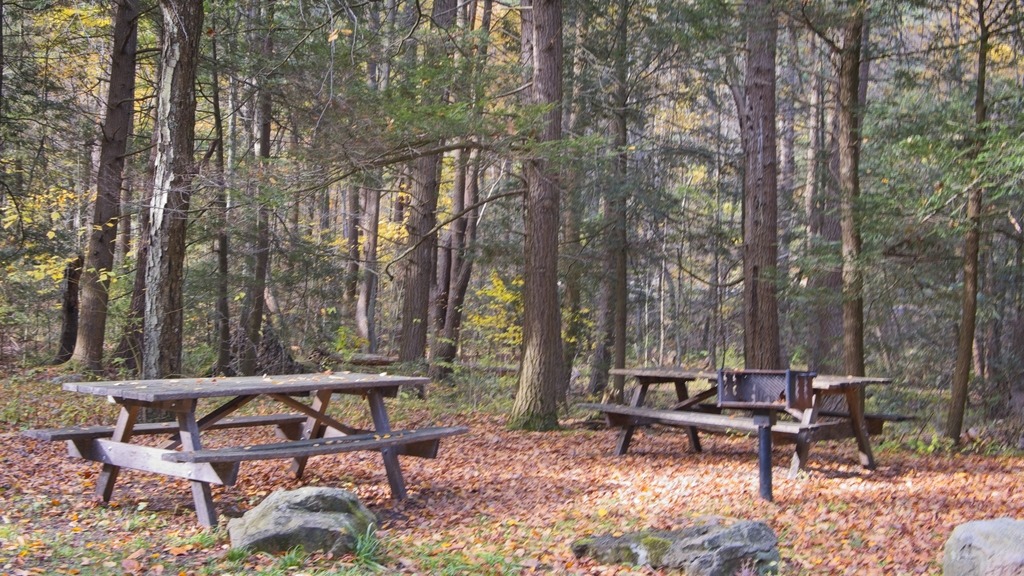
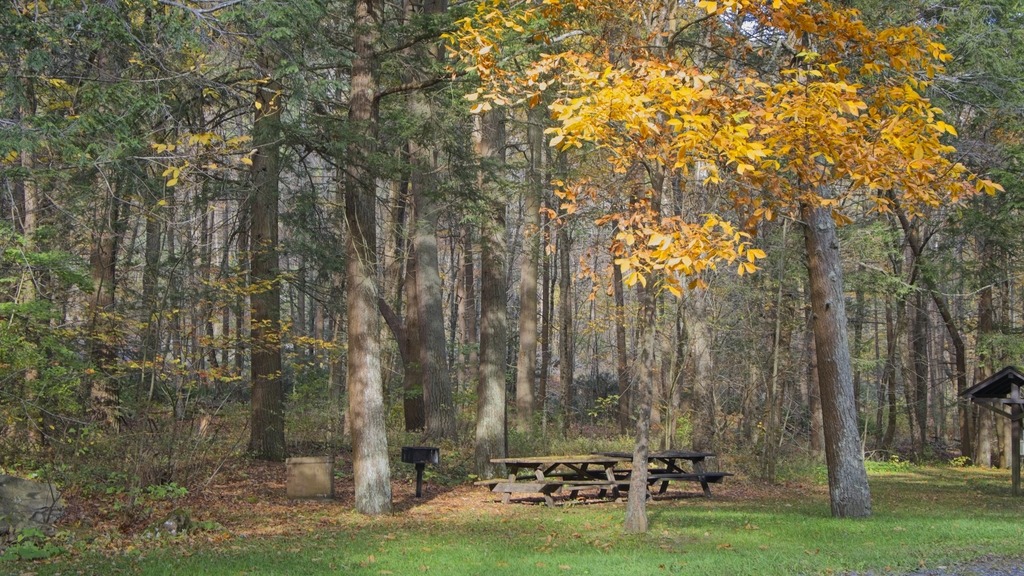
    Little Pine State Park has many lovely spots away from the main day use area. The first location going north from Waterville is the Little Pine Lower Picnic Area. On that day, it was showing its fall colors.

    Little Pine State Park also has an archery and a shooting range. to the north of the main day use area. These features are unusual in a Pennsylvania state park.

    The archery range.
    This is one of the nicest shooting ranges I’ve seen in the state.
  • On Little Pine Creek

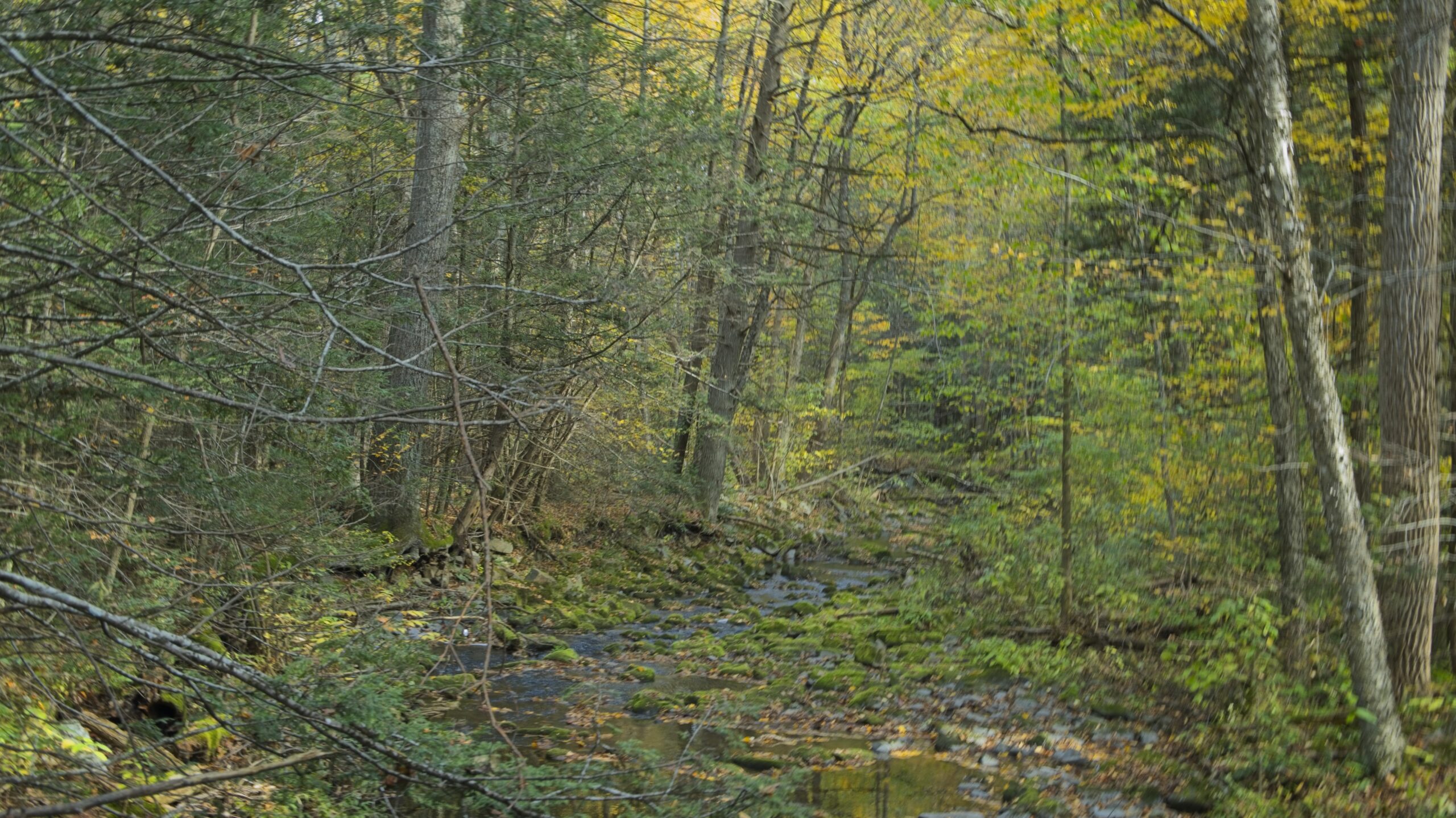
    My Autumn destination this October was Little Pine State Park in northern Lycoming County. The 2,158-acre Little park is surrounded by a beautiful mountain section of Tiadaghton State Forest . The 45-acre Little Pine Lake, hiking trails, campground, and nesting bald eagles are prime features of the park, along with nearby access to Pine Creek.

    During 1933, the Civilian Conservation Corps (CCC) built Camp S-129-PA and a small picnic area along Little Pine Creek. During 1937, the camp was closed and the property turned over to the Bureau of State Parks. When the park opened, it used many of the CCC buildings. In 1950, a dual-purpose flood control/recreation dam was constructed. The park remained a picnic area until the campground, beach, and swimming area were constructed in 1958. In 1972, Hurricane Agnes flooded and destroyed many park facilities, including all but a few remnants of the former CCC facilities. Hurricane Agnes was the only time water went over the spillway. In 1975-76, federal disaster aid helped build a new beach house, office, maintenance area, and a new campground with modern restrooms. As part of the “Growing Greener” initiative, several major improvements began in 2002, including, enlarging and modernizing the park office and putting showers in the campground.

    Below are photos of the lake and day use area.

    A gaggle of geese.
  • A Covered Bridge in a Quiet Valley

    On my way to the Pine Creek area, I made a quick stop in Columbia County to view the Kramer Covered Bridge. I had somehow missed photographing this bridge, even though it is near where my relatives live.

    Showing signs of Autumn …
    A stop at Kitchens Cemerery where my grandparents are buried.

    The Kramer Covered Bridge is a wooden covered bridge that is located in Greenwood Township. It crosses Mud Run. It was listed on the National Register of Historic Places in 1979. Built in 1881, this historic structure is a 50-foot-long (15 m), Queen Post Truss bridge with a metal roof constructed in 1881. It is one of twenty-eight historic covered bridges that are located in Columbia and Montour Counties.

    Finally, the covered bridge.
    Mud Run
  • A Colorful Circle of Light

    The targets for the Hubble Telescope 35th Anniversary Challenge were a diverse range of objects.

    The first up is my favorite planetary nebula – the Helix Nebula (NGC 7293 or Caldwell 63). Although not quite as easy to photograph as the Dumbbell Nebula, I like the circular form and range of colors in the Helix. The object is a planetary nebula located in the constellation Aquarius. Discovered by Karl Ludwig Harding, most likely before 1824, this object is one of the closest of all the bright planetary nebulae to Earth. The distance is 655±13 light-years from Earth. It is similar in appearance to the Cat’s Eye Nebula and the Ring Nebula, whose size, age, and physical characteristics are in turn similar to the Dumbbell Nebula, differing only in their relative proximity and the appearance from the equatorial viewing angle. The Helix Nebula has sometimes been referred to as the “Eye of God” in pop culture, as well as the “Eye of Sauron”.

    C63

    Messier 30 (also known as M30, NGC 7099, or the Jellyfish Cluster) is a pretty globular cluster of stars in the constellation of Capricornus. It was discovered by the French astronomer Charles Messier in 1764, who described it as a circular nebula without a star. In the New General Catalogue, compiled during the 1880s, it was described as a “remarkable globular, bright, large, slightly oval.” It can be easily viewed with a pair of 10×50 binoculars, forming a patch of hazy light some 4 arcminutes wide that is slightly elongated along the east–west axis.

    M30

    Messier 2 or M2 (also designated NGC 7089) is also a globular cluster, but in the constellation Aquarius, five degrees north of the star Beta Aquarii. It was discovered by Jean-Dominique Maraldi in 1746, and is one of the largest known globular clusters. M2 was discovered by the French astronomer Jean-Dominique Maraldi in 1746 while observing a comet with Jacques Cassini. Charles Messier rediscovered it in 1760, but thought that it is a nebula without any stars associated with it. William Herschel, in 1783, was the first to resolve individual stars in the cluster. M2 is, under extremely good conditions, just visible to the naked eye. Binoculars or a small telescope will identify this cluster as non-stellar, while larger telescopes will resolve individual stars, of which the brightest are of apparent magnitude 6.5.

    M2

    NGC 7814 (also known as Caldwell 43) is a spiral galaxy about 40 million light-years away in the constellation Pegasus. The galaxy is seen edge-on from Earth. It is sometimes referred to as “the little sombrero”, a miniature version of Messier 104. The star field behind NGC 7814 is known for its density of faint, remote galaxies as can be seen in the vicinity of this object, in the same vein as the Hubble Deep Field.

    It’s among the few bright galaxies that exhibit modest distortion and twisting of the galaxy’s plane in optical wavelengths. The light from the distant background galaxies becomes more red as it passes through NGC 7814’s halo. This has been used to determine the amount of gas and dust in the halo. One supernova has been observed in NGC 7814: SN 2021rhu (Type Ia, mag 15.66) was discovered by Automatic Learning for the Rapid Classification of Events (ALeRCE) on 1 July 2021.

    C43. You can see a central dust lane here.

    NGC 7662 is a planetary nebula located in the northern constellation Andromeda. It is known as the Blue Snowball Nebula, Snowball Nebula, and Caldwell 22. This nebula was discovered October 6, 1784 by the German-born English astronomer William Herschel. In the New General Catalogue it is described as a “magnificent planetary or annular nebula, very bright, pretty small in angular size, round, blue, variable nucleus”. The object has an apparent visual magnitude of 8.3. Parallax measurements give a distance estimate of 5,730 ± 340 ly (1,757 ± 103 pc). NGC 7662 is a popular planetary nebula for casual observers. A small telescope will reveal a star-like object with slight nebulosity. A 6″ telescope with a magnification around 100x will reveal a slightly bluish disk.

    C22 (bright blue ringed object in upper center of photo)
error: Content is protected !!