On my way home from Swatara and Memorial Lake State Parks, I decided to swing through Middle Creek Wildlife Management Area. Middle Creek is not a place I visit much in Autumn, but it is well worth a stop. Middle Creek is administered by the Pennsylvania Game Commission for game propogation and wildlife conservation, but it feels park-like. With opportunities for hiking, picnicing, boating and fantastic birding and wildlife watching, it makes for a great day out.
The view from the Visitor’s Center.Relaxing by the lake.The nearby area has some lovely farms.These horses are enjoying a fine Autumn day.
The 3,520-acre Swatara State Park consists of rolling fields and woodlands situated in the Swatara Valley, between Second and Blue mountains. Swatara Creek runs through the park and is surrounded by forests and wetlands that support an abundance of wildlife. The park is also a hotbed for fossil hunters.
In the past this landscape was dominated by a feeder branch of the Union Canal and then a railroad. Today, Swatara Park features a rail trail, hiking (including a few miles of the Appalachian Trail), fishing, hunting, cycling, horseback riding and kayaking.
The lovely rail trail.Off for a ride.The mountains are ablaze in Autumn.
Nearby Memorial Lake State Park consists of 230 acres at the the base of Blue Mountain in East Hanover Township, Lebanon County. The park is surrounded by Fort Indiantown Gap, the headquarters for the Pennsylvania Army and Air National Guard. The park is dominated by its lovely lake. It is a great spot for a picnic or some boating and fishing. There are also hiking trails at the park and and an exercise course.
Fort Indiantown Gap was named after the American Indian village known as Indiantown and the gap in the Blue Mountain where Indiantown was located. Indian artifacts found in the Lebanon and Swatara Valleys indicate a human presence as early as 2,500 BC.
Established in 1931, Fort Indiantown Gap was built as a National Guard training center. During World War II, it was used as a training site for seven Army divisions, and also as a demobilization site once the war was over. Memorial Lake was established in 1945 in memory of Pennsylvania National Guard soldiers who served in World War I and World War II. In 1955, Memorial Lake was transferred to the Pennsylvania Department of Conservation and Natural Resources and became Memorial Lake State Park.
I would love to have a canoe moored here.Done fishin’ for the day.A beutiful picnic spot.Let’s just enjoy the beauty of the lake.A great view of Memorial Lake.
Here are some late leaf season shots of Blue Marsh Lake in Berks County. I’ve been holding off on the Christmas posts as long as I can just as I was trying hold onto Autumn on this day in late October.
Blue Marsh National Recreation Area contains an artificial lake located northwest of Reading, Pennsylvania. It was constructed and is managed by the U.S. Army Corps of Engineers. It is fed by the Tulpehocken Creek. Blue Marsh was the name of the village that was located where the lake now is. It was the first settlement in Lower Heidelberg Township. The United States Army Corps of Engineers began constructing the lake in March 1974 with the impoundment of the Tulpehocken Creek and was completed in September 1979. The lake is now a popular spot for recreation, including swimming, boating, fishing, wildlife watching and picnicing.
A view toward the mountains.One of several great overlooks toward the lake.The Autumn color was haning on.This snag looks great against the fall leaves.A view toward the dam.A lovely old barn.This shoreline is very inviting.The color of this tree is just … wow!A great view of the lake.A close-up toward the left.
Greenwood Furnace and Penn-Roosevelt State Park may be close to one another, but they are very different in history and atmosphere. First up is Greenwood Furnace, which is one of those state parks with a lot of different activities available. It is in Huntingdon, PA.
In its 423 acres, the park offers a lake with swimming, small craft boating, hiking, camping, hunting, fishing, as well as a chance to view some local history. The park also provides access to the 80,000 acre Rothrock State Forest. However, a trip to the park begins with its historic district, which contains a blacksmith shop and the remains of an iron furnace. The community that existed on the site from 1834 to 1904 was a 19th century ironmaking complex.
The village blacksmith shop.An old iron furnace.The dam at the lake at Greenwood Furnace.Care for a dip?
Penn-Roosevelt is a 41-acre park is in an isolated area of the Seven Mountains region known as the Stone Creek Kettle. While the park is small in size, it is surrounded by a large block of Rothrock State Forest in Centre County.
Penn-Roosevelt is a good base for those seeking off the beaten track, low-density recreation in the State Forest. Activities include hiking on the Mid-State or other trails, gravel-riding on over 100 miles of Forestry roads, and mountain biking the nearby Cooper’s Gap area. There is also picnicking available. The small campground is rustic (tent camping only with latrines). However, one really does have the sense of being deep in the woods here. There is fishing in the streams in the park and access to hunting in the State Forest.
One of the most notable aspects of Penn-Roosevelt State Park is that it was constructed during the Great Depression by the Civilian Conservation Corps Camp S-62, which was built in Stone Creek Kettle. This was, unfortunately per CCC policy, a segregated camp. The members of the camp were all African-American and it was one of only 12 such CCC camps in Pennsylvania. The members of Camp S-62 constructed many of the facilities in use today at Penn-Roosevelt State Park. They constructed a log-crib dam that has since received a stone facing. They also built many of the roads and trails in the surrounding Rothrock State Forest. Remnants of the camp, including two stone fireplaces and a stone bake oven, can be seen today in the woods of Penn-Roosevelt State Park.
This post is a beginning of a series on some central Pennsylvania state parks that I visited in October. The first up is Little Buffalo State Park in Newport, Perry County, PA. The visitor to Little Buffalo can partake of campgrounds, a swimming pool, a lake, hunting, fishing, picnicking and hiking. The park is 923 acres and was opened in 1972. It also features some historical sites which we’ll take a look at below.
Little Buffalo State Park is named for Little Buffalo Creek which runs through the park. The creek and the nearby Buffalo Ridge are named for the bison that are believed to have once roamed the ridge and valley region of Pennsylvania. Humans have lived in what is now Pennsylvania since at least 10,000 BC. The first settlers were Paleo-Indian nomadic hunters known from their stone tools. The hunter-gatherers of the Archaic period, which lasted locally from 7000 to 1000 BC, used a greater variety of more sophisticated stone artifacts. The Woodland period marked the gradual transition to semi-permanent villages and horticulture, between 1000 BC and 1500 AD. Archeological evidence found in the state from this time includes a range of pottery types and styles, burial mounds, pipes, bows and arrow, and ornaments. Perry County was part of the Albany Purchase of 1754 when the colonists purchased a large tract of land from the Iroquois League of Six Nations.
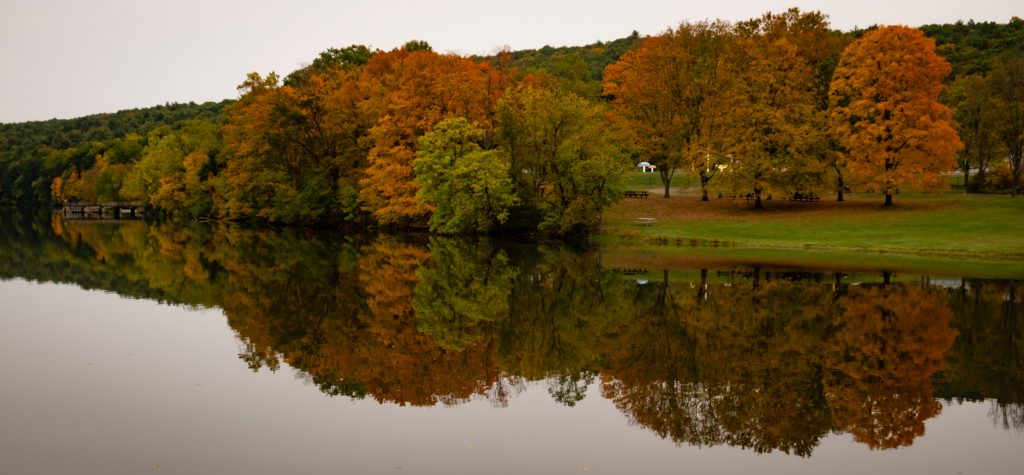
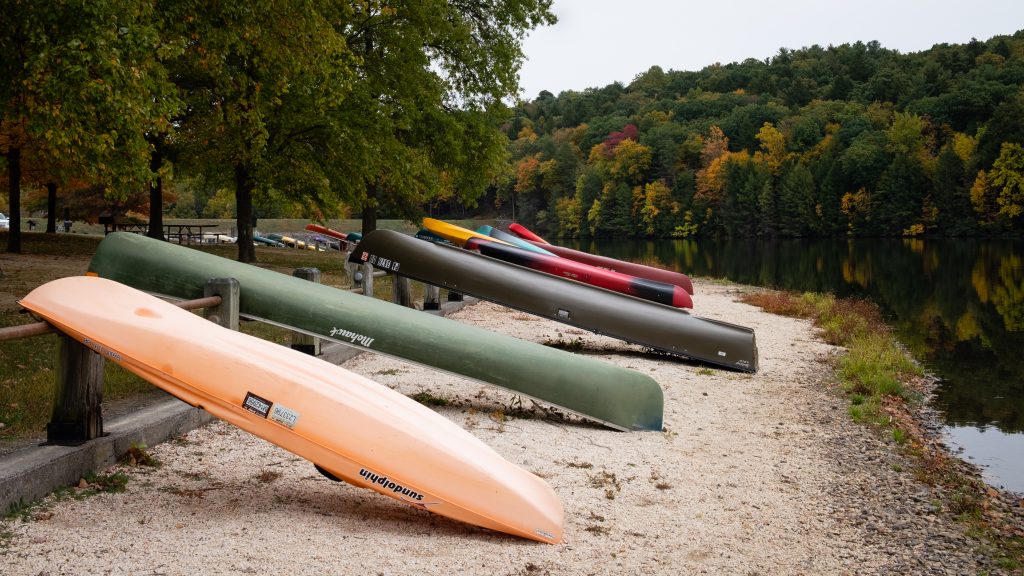
The lake reflecting the fall colors.A quiet moment under a blaze of orange.Canoe season is almost over.
European settlers arrived in the area in force after the Revolutionary War. John Koch, one of the first to farm the area in the 1790s, opened the Blue Ball Tavern in 1811. The tavern offered food, drink, and a sleeping loft. The Blue Ball Tavern served as a rest stop for messengers who travelled between Carlisle and Sunbury during the War of 1812. It is rumored that the tavern was where the plans for the creation of Perry County were made in 1821. The tavern was closed in 1841. A farmhouse was built in 1865 on the foundation of the tavern. Some recycled boards and hardware from the tavern were used in the construction of the farmhouse which currently houses the Blue Ball Tavern Museum and a library that are operated by the Perry County Historical Society.
The Blue Ball Tavern Museum.
William Shoaff bought 63 acres of land in the area and a gristmill from the Juniata Iron Works in 1849 after it had been shut down. The local farmers brought their crops to Shoaff’s Mill until the 1940s. The mill has since been restored and is back in operation. Visitors to the park can observe the milling of cornmeal, cracked corn and the grinding of apples for apple cider.
The mill. Sadly, the wheel was not running when I visited.
For me, not surprisingly, a covered bridge was one of the highlights. This is Clay’s Covered Bridge. It is a short walk from a parking area on your way to the mill.
Bald Eagle State Park in Howard, PA is a 5,000 park that features a large reservoir for boating, fishing, and swimming, two campgrounds, hiking, hunting, and other activities. It is also the home of the Nature Inn, a unique hotel within the Pennsylvania state park system. The Foster Joseph Sayers Reservoir, was formed by damming Bald Eagle Creek and other smaller streams. Bald Eagle State Park is at the meeting point of two distinct geologic features. The Allegheny Plateau is to the north and the Ridge and Valley area of Pennsylvania is to the south.
The park is named for the Lenape chief, Woapalanne, meaning bald eagle. Chief Woapalanne lived in the area for a brief period of time during the mid-18th century in a village that was on Bald Eagle Creek Path, part of the much more extensive Great Indian Warpath that stretched from New York into the Carolinas. This path was used by the Iroquois to conduct raids on the Cherokee in North Carolina, South Carolina, Tennessee, and Georgia. Pennsylvania Route 150 follows this path in some areas near Bald Eagle State Park.
Foster Joseph Sayers Reservoir is a 1,730-acre (700 ha) reservoir that was built in 1971 by the U.S. Army Corps of Engineers as part of a flood control project on the Susquehanna River basin. It stretches upstream for 8 miles (12.87 km) and has 23 miles (37.01 km) of shoreline.
The lake is named for Foster Joseph Sayers, a World War II hero. Sayers grew up in Marsh Creek. He received the Medal of Honor for acts of bravery on November 12, 1944 near Thionville, France. His Medal of Honor citation reads as follows:
CITATION: Rank and organization: Private First Class, U.S. Army, Company L, 357th Infantry, 90th Infantry Division. Place and date: Near Thionville, France, 12 November 1944. Entered service at: Howard, Pa. Birth: Marsh Creek, Pa. G.O. No.: 89, 19 October 1945. He displayed conspicuous gallantry above and beyond the call of duty in combat on 12 November 1944, near Thionville, France. During an attack on strong hostile forces entrenched on a hill he fearlessly ran up the steep approach toward his objective and set up his machinegun 20 yards from the enemy. Realizing it would be necessary to attract full attention of the dug-in Germans while his company crossed an open area and flanked the enemy, he picked up his gun, charged through withering machinegun and rifle fire to the very edge of the emplacement, and there killed 12 German soldiers with devastating close-range fire. He took up a position behind a log and engaged the hostile infantry from the flank in an heroic attempt to distract their attention while his comrades attained their objective at the crest of the hill. He was killed by the very heavy concentration of return fire; but his fearless assault enabled his company to sweep the hill with minimum of casualties, killing or capturing every enemy soldier on it. Pfc. Sayers’ indomitable fighting spirit, aggressiveness, and supreme devotion to duty live on as an example of the highest traditions of the military service.
This beautiful park is well worth visiting and the lake is a fitting tribute to an American hero.
The Foster Joseph Sayers Medal of Honor Memorial is at the dam end of the lake.Boating is a very popular activity at the lake.The park, with its woodlands, meadows, and lake, is a frequent stop for birders.Some Autumn views of the lake …
Today we have a temporary break from covered bridges. On my trips to photograph these bridges, I come upon other interesting stuff. In fact, one of my all-time-favorite shots, was a picture I took after turning 180 degrees around from a covered bridge. The idly curious can check out the first shot on this post. Here are some views from around Columbia County:
Nice view of a campground across a lake. Near Esther Furnace Covered Bridge.I really like the hand-made star and red and white paint on these buildings.This really lovely barn is near Benton.
I also made my way over to Frances Slocum State Park in Luzerne County that same weekend.
Labor Day action at Frances Slocum.A peaceful fishing spot on the lake.
i spent this past Labor Day at Ricketts Glen State Park. I avoided the crowds on the Falls Trail and spent the days photographing covered bridges and other nearby areas. The cottages on Lake Jean are some of my favorites in the state park system.
The front of the cottage faces the lake.Sunset on Lake Jean. This view is facing east, so there is better view …at sunrise. Seriously, I am never up this early.Expressing how many feel, at a nearby location on Route 118.
The park was open, with some restrictions on check in times and requirements for mask usage in bath houses and park office buildings. Some facilities, such as the boat rental, were closed. Most things seemed to be operating normally.
I did see some interesting birds just sitting outside the cottage. A bald eagle, Canada warbler, a possible vireo, great blue heron, as well as a number of more common species such as chickadee, white breasted nuthatch, robin, chipping sparrow, catbird, and mallard.
As an added bonus, below are a few shots of holiday activity at Frances Slocum State Park in Luzerne County.
The lakeside is a popular area.He had this fishing pier all to himself.
The town of Boiling Springs in Cumberland County is one of Pennsylvania’s Appalachian Trail towns. It is known for its beautiful scenery and world-famous fly fishing. Founded in 1845, but settled prior to 1737, Boiling Springs is a village that surrounds the Children’s Lake. The town hosts the regional office of the Appalachian Trail Conservancy. The Memorial Clock Tower, erected in 1956 and the Boiling Springs (Grist) Mill, on record as early as 1785, are two landmarks in the village. Boiling Springs was also a site for the underground railroad before the civil war and a tourist destination in the early 1900’s. It is now a location for small shops, art galleries, cafes and restaurants, recreation and relaxation and is the home of the Allenberry Resort.
Boiling Springs gets its name from natural artesian well springs located around the town. The well known trout streams in the area are the Yellow Breeches Creek, Mountain Creek, Big Spring Creek, and LeTort Spring Run. The waters are kept cool by the limestone springs which feed them. Part of the Yellow Breeches Creek is maintained for catch and release, artificial lures only, fishing.
Let’s take a look around town.
A view of Children’s Lake and the Grist Mill.The Memorial Clock Tower.An old artillery piece near the Clock Tower.The park is a great place for some family time.One of the beautiful homes overlooking the lake.This Mallard duck family have some prime real estate.The Grist Mill, close up.Let’s go fishin’A view down Front Street.
It shouldn’t come as a surprise, that due the corona virus lock down, I haven’t been out much doing photography. I did manage to drive around my local community getting some photos of the spring flowers and flowering trees. I also checked up on two of my local state parks, which were well attended by people glad to get out of the house while maintaining a safe distance from others.
The local; cherry trees are in bloom.Tulips are always lovely.This pony at Ridley Creek State Park finds things greener on the other side of the fence.These horses aren’t bothered by Covid 19. I love this barn at Hope Springs Farm at Marsh Creek State Park.It has a great silo.The horses were enjoying a day in the pasture.Down at the West Launch a kayaker is getting ready to shove off.Someone else has a faster way to get around.
Socially distant dispersed outdoor recreational fun was had by all.