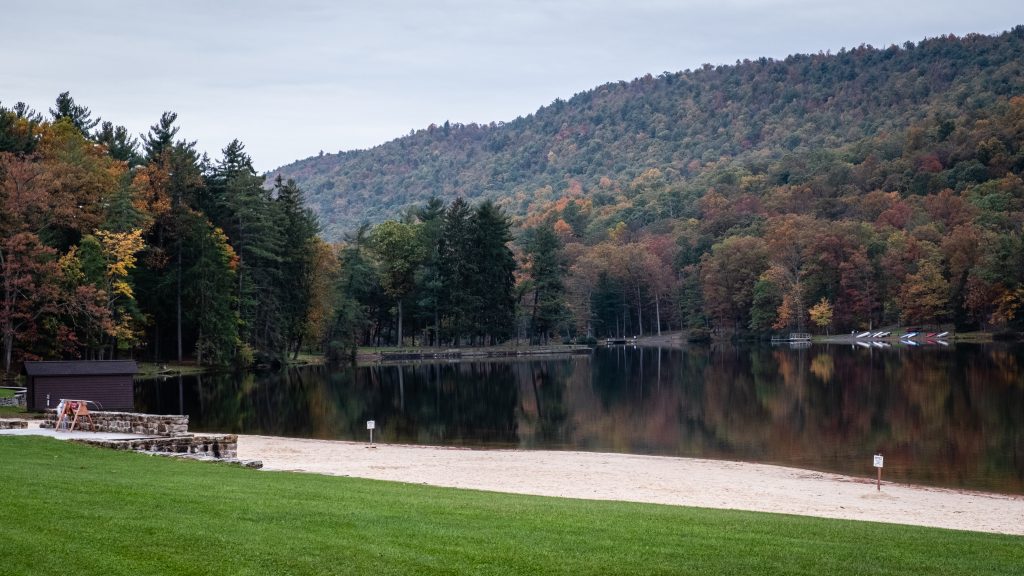
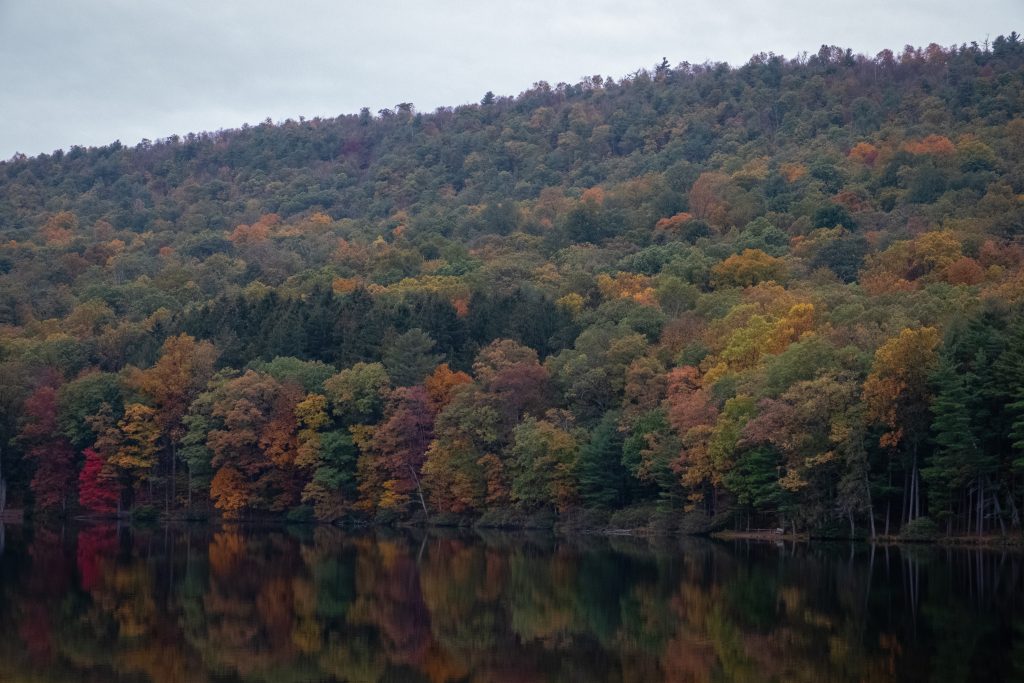
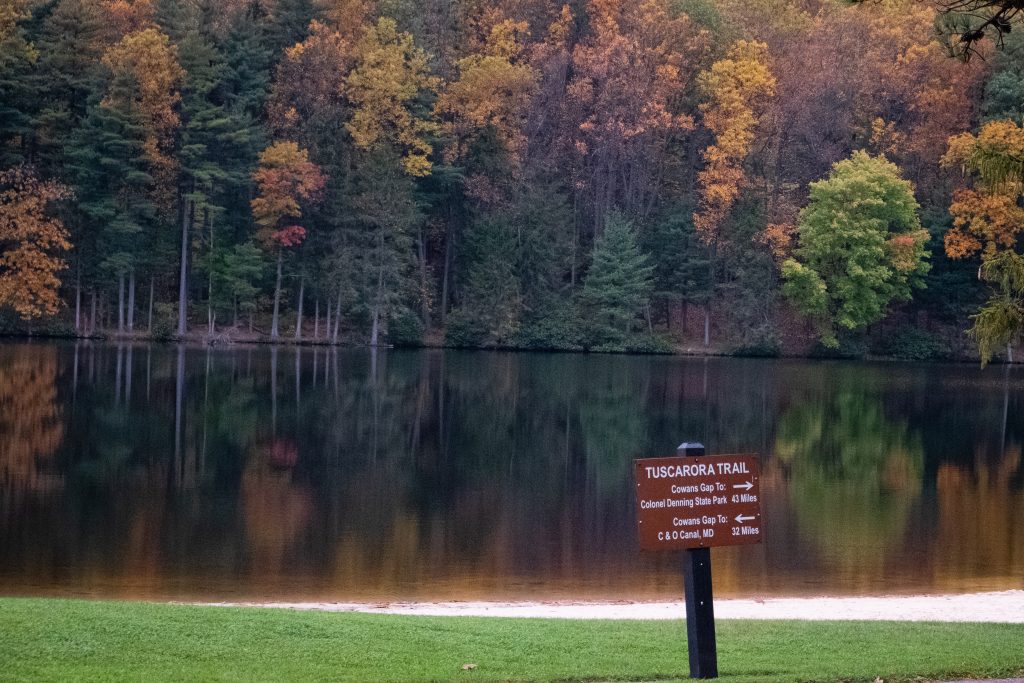
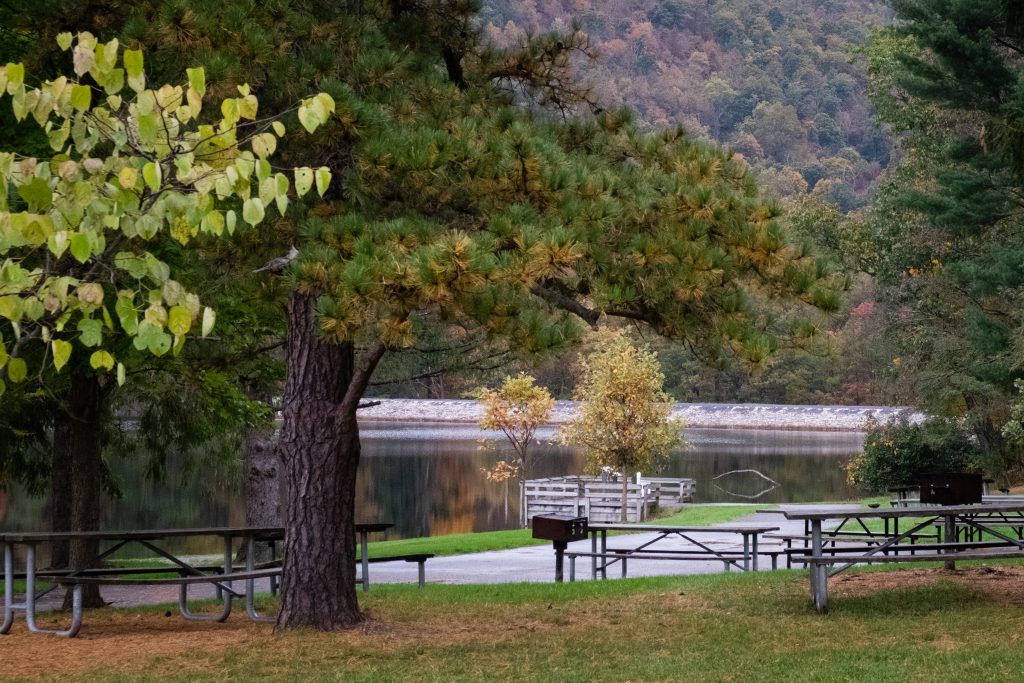
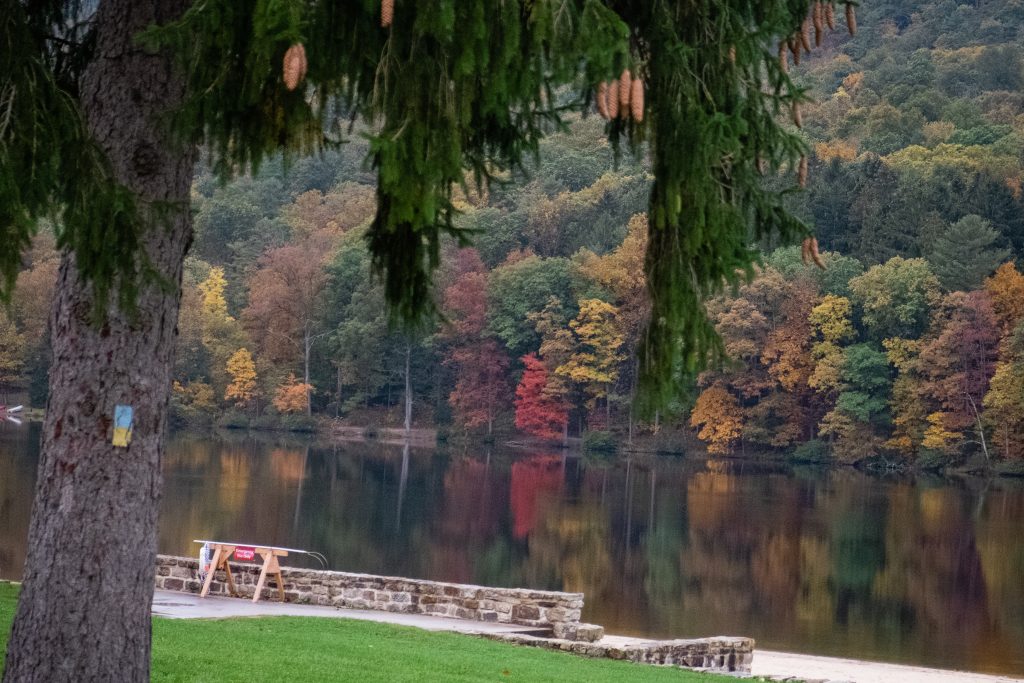
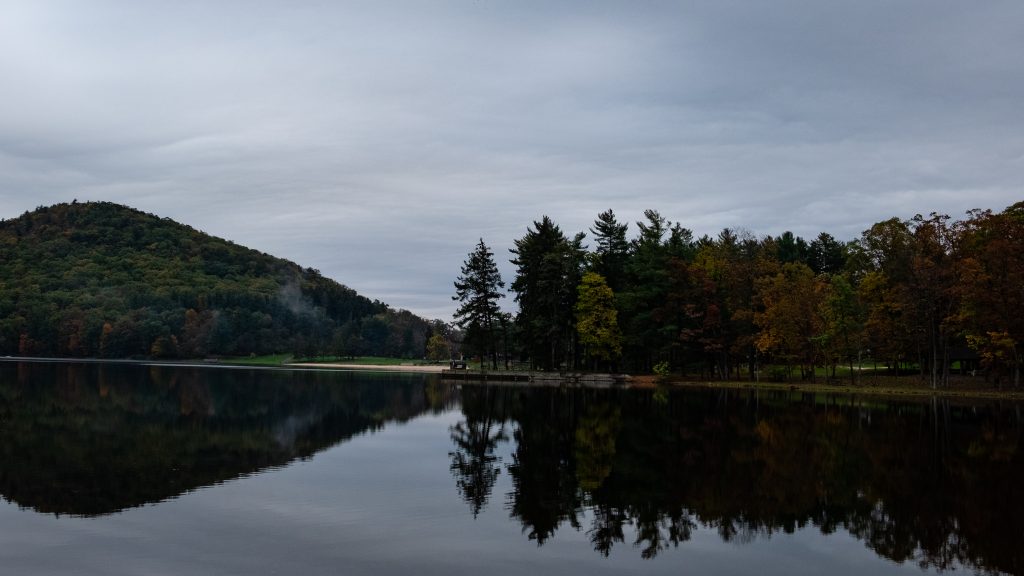
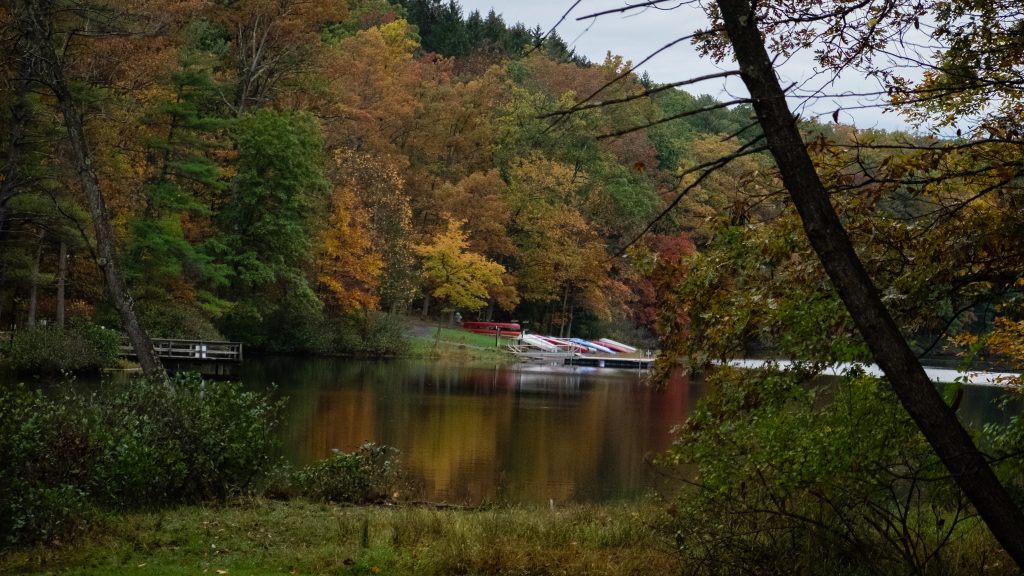
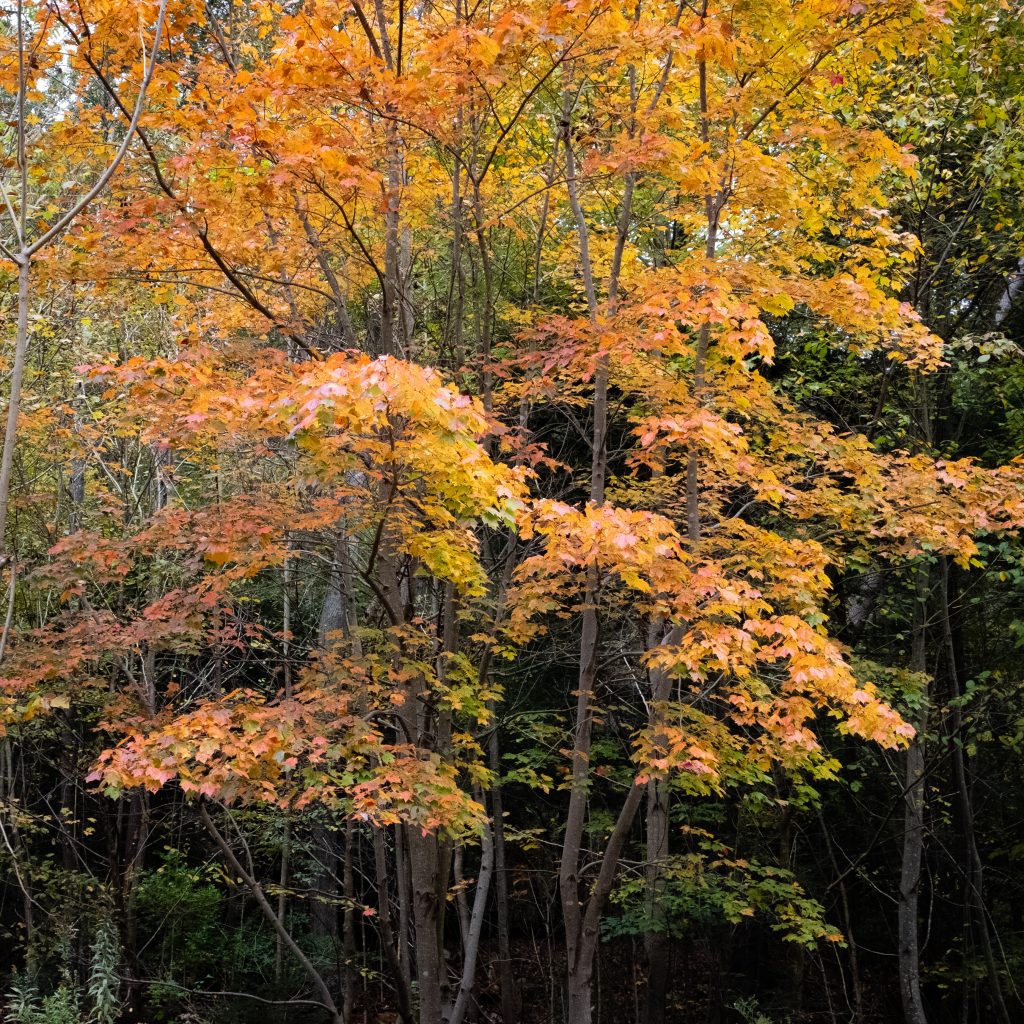
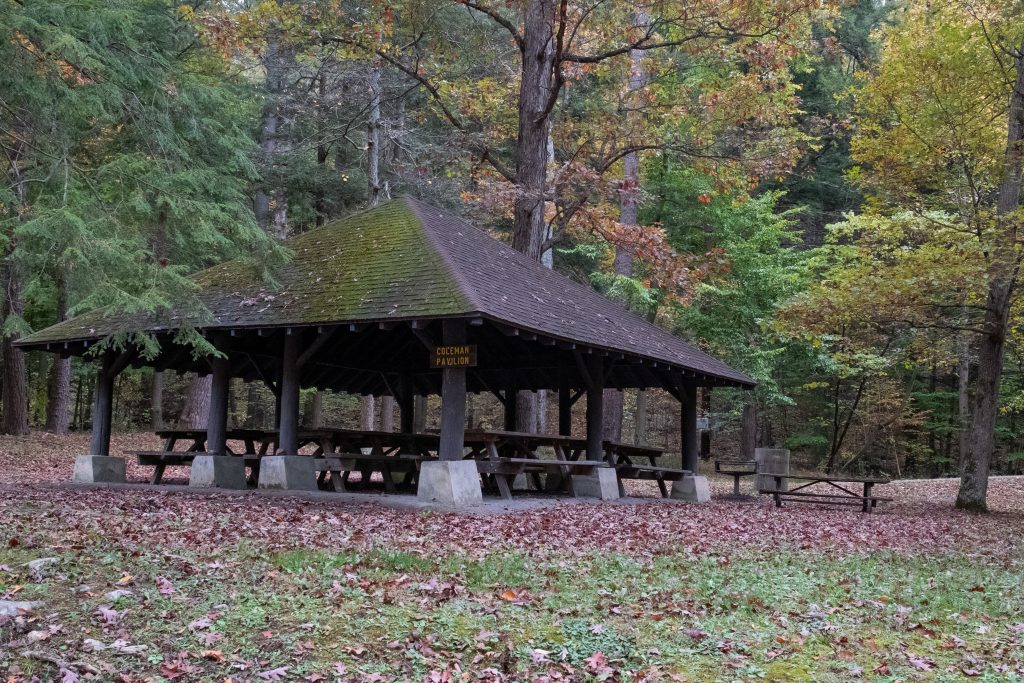
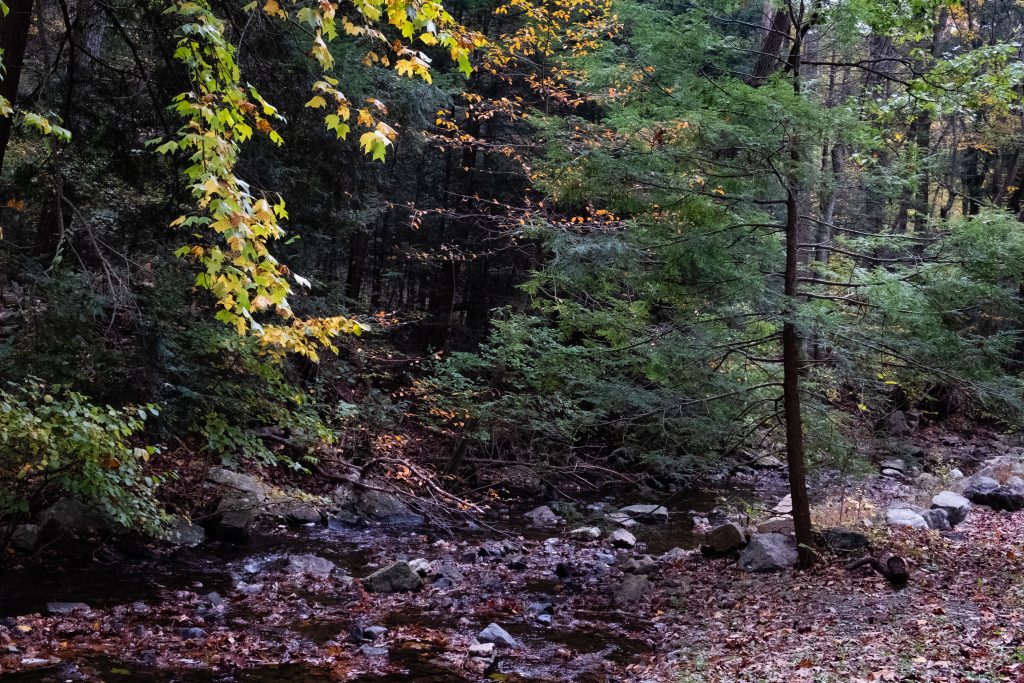
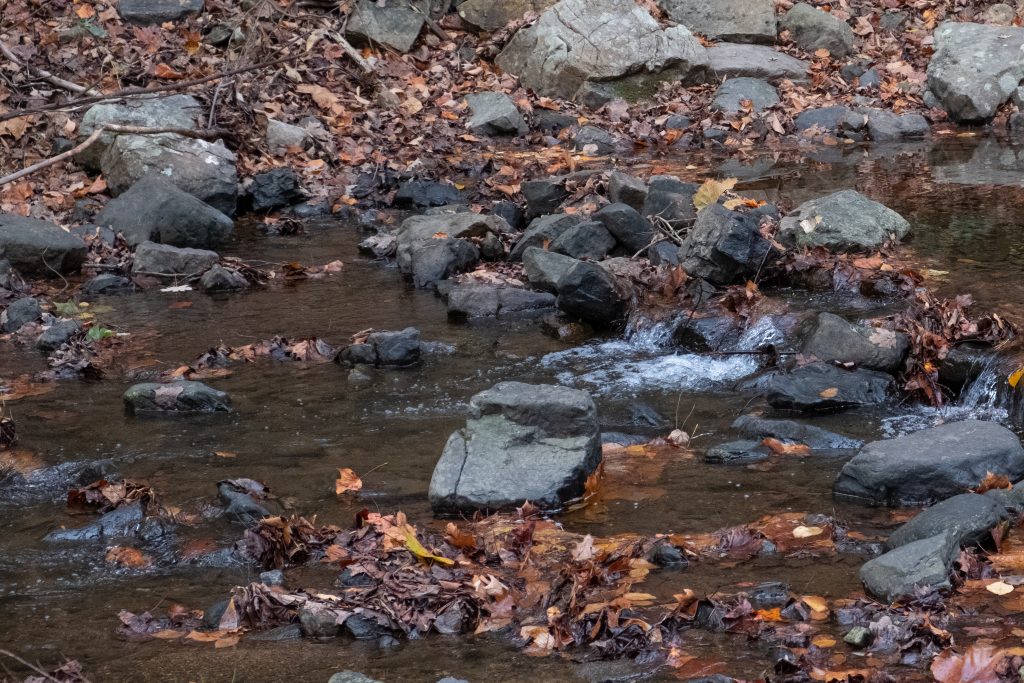
Trees and forested areas can be some of the most difficult to photograph. For me, it’s primarily the challenge of finding the strong focal point. The woods in Promised Land State park are some of my favorites. Let’s take a drive around the Upper Lake.
A lake in the picture never hurts.I love how this spot emphasis the boggy and marshy qualities of the Poconos.I would love this dock.
Looming over the town of Nicholson, Pennsylvania is the Tunkhannock Creek Viaduct, a railroad bridge completed in 1915. It is a concrete deck arch bridge on the Nicholson Cutoff rail segment of the Norfolk Southern Railway Sunbury Line that spans Tunkhannock Creek. Measuring 2,375 feet (724 m) long and 240 feet (73.15 m) tall when measured from the creek bed (300 feet (91.44 m) from bedrock), it was the largest concrete structure in the world when completed in 1915 and still merited “the title of largest concrete bridge in America, if not the world” 50 years later. Built by the Delaware, Lackawanna and Western Railroad, the bridge is owned today by Norfolk Southern Railway and is still used daily for regular through freight service. Apparently almost half of the bulk of this behemoth is underground, in the form of bridge pillars up to 138 feet (142 m) below ground.
The bridge was listed on the National Register of Historic Places on April 11, 1977. In 1975, the American Society of Civil Engineers or ASCE designated the bridge as a Historic Civil Engineering Landmark. ASCE recognized the bridge as “not only a great feat of construction skill” but also a “bold and successful departure from contemporary, conventional concepts of railroad location in that it carried a mainline transversely to the regional drainage pattern, effectively reducing the distance and grade impediments…”
The bridge towers over the town of Nicholson.A view further upstream.The cows don’t seem to notice the vast structure.
I also swung by Lackawanna State Park on my way back from the bridge. The 1,445-acre park is ten miles north of Scranton. The focus is the 198-acre Lackawanna Lake, which is surrounded by picnic areas and multi-use trails winding through forest. Boating, camping, fishing, mountain biking, and swimming are popular recreation activities here.
I’ve always wanted a canoe mooring on a lake.At least these geese don’t mind the weather.Another rainy late spring day ….Great spot for a picnic and a boat trip.
Prompton State Park and the Varden Conservation Area are located near each other in northeastern Pennsylvania’s Wayne County. Prompton State Park provides boat launching and picnicking facilities for the 290-acre Prompton Lake, which is operated by the U.S. Army Corps of Engineers. There are twenty-six miles of hiking trails which surround the lake and a disc golf course.
Morning mists on Prompton Lake ….A little disc golf by the lake.A view of the substantial dam.The west branch of Lackawanna Creek.Half mast for Memorial Day.
A gift from veterinarian Dr. Mead Shaffer, the 444-acre Varden Conservation Area is in an area that was once a remote section of the state, but which is now beginning to feel pressure from development. The land is conserved as open space with opportunities for low impact recreation and educational use. It is a great place to learn about Pennsylvania’s natural history. There is picnicking by and fishing in the pond. There is also hiking in the two tracts which constitute this conservation area. I visited the Tannery Road Tract.
The lovely pond can be used for fishing.Morning mists on an unseasonably cool day.Beautiful irises are indicative of the seasonal flora of this area.
I made my third trip to Promised Land State Park this past Memorial Day weekend. I love the Bear Wallow Cabin area, a cluster of former CCC cabins that still are largely original construction with hand made wood furniture. I also like the proximity of the Wildlife Observation Station to these cabins. The weather was unseasonably cold and raining so most of time was spent travelling around to other nearby sights to get a feel for those places. In this post, I will focus on some of the logistics of the park.
Promised Land contains two lakes with multiple boat launches, a beach with concession, boat rental, hiking and horseback riding. There are opportunities for hunting and fishing in season. The park is mostly surrounded by the Delaware State Forest. It is unusual in that most of the town of Promised Land is within the boundaries of the park and privately owned cabins are tucked away around the lakes.
Cabin number 2, named Buchanan. The cabins come in varying sizes, This is a smaller one.The bathrooms for Cabin 1 and 2. Each cabin has its own bathroom which is unusual in a state park.
The cabins have an oven, fridge, microwave, coffee maker and electrical outlets. Heat is by wood stove and there is no running water. The bathrooms are modern with toilet, shower, and sink and are heated. The park has multiple campgrounds and a variety of different camping options as well.
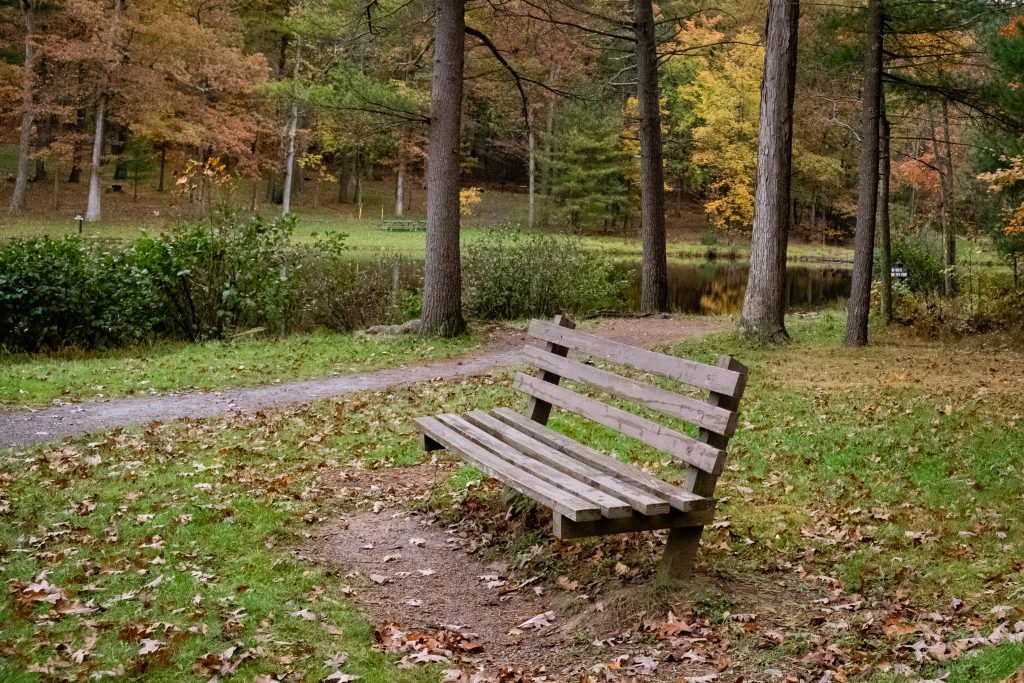
The interior looking toward the bedroom.An old drop down desk.A bench near the Bear Wallow boat launch on the Lower Lake.The statue in front of the Masker Museum, which focuses on the CCC.
The onset of Spring turns my mind to birds. This is usually the best time of year to look for birds due to the opportunity to see migrating rarities in bright breeding dress. I frequently stop by Marsh Creek State Park when in the area. This is a good spot for bird watching, but I don’t seem to have much luck here. It probably doesn’t help that I am not a morning person and am, therefore, often looking for birds after 11 am. I did see some distant Common Mergansers on the lake, but had to settle for non-bird photos.
Land cruisin’No entryI always think I am going to find something here but never do ….
I also stopped by Struble Lake that day. This was more promising this time around. I saw a Savannah Sparrow and a lot of Snow Geese. There was still a fair amount of ice on the lake in early March.
On my way home from Swatara and Memorial Lake State Parks, I decided to swing through Middle Creek Wildlife Management Area. Middle Creek is not a place I visit much in Autumn, but it is well worth a stop. Middle Creek is administered by the Pennsylvania Game Commission for game propogation and wildlife conservation, but it feels park-like. With opportunities for hiking, picnicing, boating and fantastic birding and wildlife watching, it makes for a great day out.
The view from the Visitor’s Center.Relaxing by the lake.The nearby area has some lovely farms.These horses are enjoying a fine Autumn day.
The 3,520-acre Swatara State Park consists of rolling fields and woodlands situated in the Swatara Valley, between Second and Blue mountains. Swatara Creek runs through the park and is surrounded by forests and wetlands that support an abundance of wildlife. The park is also a hotbed for fossil hunters.
In the past this landscape was dominated by a feeder branch of the Union Canal and then a railroad. Today, Swatara Park features a rail trail, hiking (including a few miles of the Appalachian Trail), fishing, hunting, cycling, horseback riding and kayaking.
The lovely rail trail.Off for a ride.The mountains are ablaze in Autumn.
Nearby Memorial Lake State Park consists of 230 acres at the the base of Blue Mountain in East Hanover Township, Lebanon County. The park is surrounded by Fort Indiantown Gap, the headquarters for the Pennsylvania Army and Air National Guard. The park is dominated by its lovely lake. It is a great spot for a picnic or some boating and fishing. There are also hiking trails at the park and and an exercise course.
Fort Indiantown Gap was named after the American Indian village known as Indiantown and the gap in the Blue Mountain where Indiantown was located. Indian artifacts found in the Lebanon and Swatara Valleys indicate a human presence as early as 2,500 BC.
Established in 1931, Fort Indiantown Gap was built as a National Guard training center. During World War II, it was used as a training site for seven Army divisions, and also as a demobilization site once the war was over. Memorial Lake was established in 1945 in memory of Pennsylvania National Guard soldiers who served in World War I and World War II. In 1955, Memorial Lake was transferred to the Pennsylvania Department of Conservation and Natural Resources and became Memorial Lake State Park.
I would love to have a canoe moored here.Done fishin’ for the day.A beutiful picnic spot.Let’s just enjoy the beauty of the lake.A great view of Memorial Lake.
Here are some late leaf season shots of Blue Marsh Lake in Berks County. I’ve been holding off on the Christmas posts as long as I can just as I was trying hold onto Autumn on this day in late October.
Blue Marsh National Recreation Area contains an artificial lake located northwest of Reading, Pennsylvania. It was constructed and is managed by the U.S. Army Corps of Engineers. It is fed by the Tulpehocken Creek. Blue Marsh was the name of the village that was located where the lake now is. It was the first settlement in Lower Heidelberg Township. The United States Army Corps of Engineers began constructing the lake in March 1974 with the impoundment of the Tulpehocken Creek and was completed in September 1979. The lake is now a popular spot for recreation, including swimming, boating, fishing, wildlife watching and picnicing.
A view toward the mountains.One of several great overlooks toward the lake.The Autumn color was haning on.This snag looks great against the fall leaves.A view toward the dam.A lovely old barn.This shoreline is very inviting.The color of this tree is just … wow!A great view of the lake.A close-up toward the left.
Greenwood Furnace and Penn-Roosevelt State Park may be close to one another, but they are very different in history and atmosphere. First up is Greenwood Furnace, which is one of those state parks with a lot of different activities available. It is in Huntingdon, PA.
In its 423 acres, the park offers a lake with swimming, small craft boating, hiking, camping, hunting, fishing, as well as a chance to view some local history. The park also provides access to the 80,000 acre Rothrock State Forest. However, a trip to the park begins with its historic district, which contains a blacksmith shop and the remains of an iron furnace. The community that existed on the site from 1834 to 1904 was a 19th century ironmaking complex.
The village blacksmith shop.An old iron furnace.The dam at the lake at Greenwood Furnace.Care for a dip?
Penn-Roosevelt is a 41-acre park is in an isolated area of the Seven Mountains region known as the Stone Creek Kettle. While the park is small in size, it is surrounded by a large block of Rothrock State Forest in Centre County.
Penn-Roosevelt is a good base for those seeking off the beaten track, low-density recreation in the State Forest. Activities include hiking on the Mid-State or other trails, gravel-riding on over 100 miles of Forestry roads, and mountain biking the nearby Cooper’s Gap area. There is also picnicking available. The small campground is rustic (tent camping only with latrines). However, one really does have the sense of being deep in the woods here. There is fishing in the streams in the park and access to hunting in the State Forest.
One of the most notable aspects of Penn-Roosevelt State Park is that it was constructed during the Great Depression by the Civilian Conservation Corps Camp S-62, which was built in Stone Creek Kettle. This was, unfortunately per CCC policy, a segregated camp. The members of the camp were all African-American and it was one of only 12 such CCC camps in Pennsylvania. The members of Camp S-62 constructed many of the facilities in use today at Penn-Roosevelt State Park. They constructed a log-crib dam that has since received a stone facing. They also built many of the roads and trails in the surrounding Rothrock State Forest. Remnants of the camp, including two stone fireplaces and a stone bake oven, can be seen today in the woods of Penn-Roosevelt State Park.
This post is a beginning of a series on some central Pennsylvania state parks that I visited in October. The first up is Little Buffalo State Park in Newport, Perry County, PA. The visitor to Little Buffalo can partake of campgrounds, a swimming pool, a lake, hunting, fishing, picnicking and hiking. The park is 923 acres and was opened in 1972. It also features some historical sites which we’ll take a look at below.
Little Buffalo State Park is named for Little Buffalo Creek which runs through the park. The creek and the nearby Buffalo Ridge are named for the bison that are believed to have once roamed the ridge and valley region of Pennsylvania. Humans have lived in what is now Pennsylvania since at least 10,000 BC. The first settlers were Paleo-Indian nomadic hunters known from their stone tools. The hunter-gatherers of the Archaic period, which lasted locally from 7000 to 1000 BC, used a greater variety of more sophisticated stone artifacts. The Woodland period marked the gradual transition to semi-permanent villages and horticulture, between 1000 BC and 1500 AD. Archeological evidence found in the state from this time includes a range of pottery types and styles, burial mounds, pipes, bows and arrow, and ornaments. Perry County was part of the Albany Purchase of 1754 when the colonists purchased a large tract of land from the Iroquois League of Six Nations.
The lake reflecting the fall colors.A quiet moment under a blaze of orange.Canoe season is almost over.
European settlers arrived in the area in force after the Revolutionary War. John Koch, one of the first to farm the area in the 1790s, opened the Blue Ball Tavern in 1811. The tavern offered food, drink, and a sleeping loft. The Blue Ball Tavern served as a rest stop for messengers who travelled between Carlisle and Sunbury during the War of 1812. It is rumored that the tavern was where the plans for the creation of Perry County were made in 1821. The tavern was closed in 1841. A farmhouse was built in 1865 on the foundation of the tavern. Some recycled boards and hardware from the tavern were used in the construction of the farmhouse which currently houses the Blue Ball Tavern Museum and a library that are operated by the Perry County Historical Society.
The Blue Ball Tavern Museum.
William Shoaff bought 63 acres of land in the area and a gristmill from the Juniata Iron Works in 1849 after it had been shut down. The local farmers brought their crops to Shoaff’s Mill until the 1940s. The mill has since been restored and is back in operation. Visitors to the park can observe the milling of cornmeal, cracked corn and the grinding of apples for apple cider.
The mill. Sadly, the wheel was not running when I visited.
For me, not surprisingly, a covered bridge was one of the highlights. This is Clay’s Covered Bridge. It is a short walk from a parking area on your way to the mill.