It feels like the season is a bit late this year. However, the early bulbs and the forsythia are finally making an effort.


Below are some early Spring scenes from around Valley Forge.

It feels like the season is a bit late this year. However, the early bulbs and the forsythia are finally making an effort.
Below are some early Spring scenes from around Valley Forge.
The grim winter weather continues in Chester County. I was able to get away on a Sunday to visit a few spots along French Creek.
Rapp’s Dam Covered bridge has been featured before on this blog. This bridge is a 105-foot-long (32 m), Burr truss bridge that was constructed in 1866 by Benjamin F. Hartman. It has fieldstone abutments, horizontal siding and boxed cornices with returns at its portals. It is one of three covered bridges that cross French Creek, the others being Hall’s Bridge and Kennedy Bridge. The Rapps Bridge was renovated in 1978 and again in 2011.


The bridge is adjacent to the French Creek Heritage Park which has picnic tables and access for the French Creek Trail.

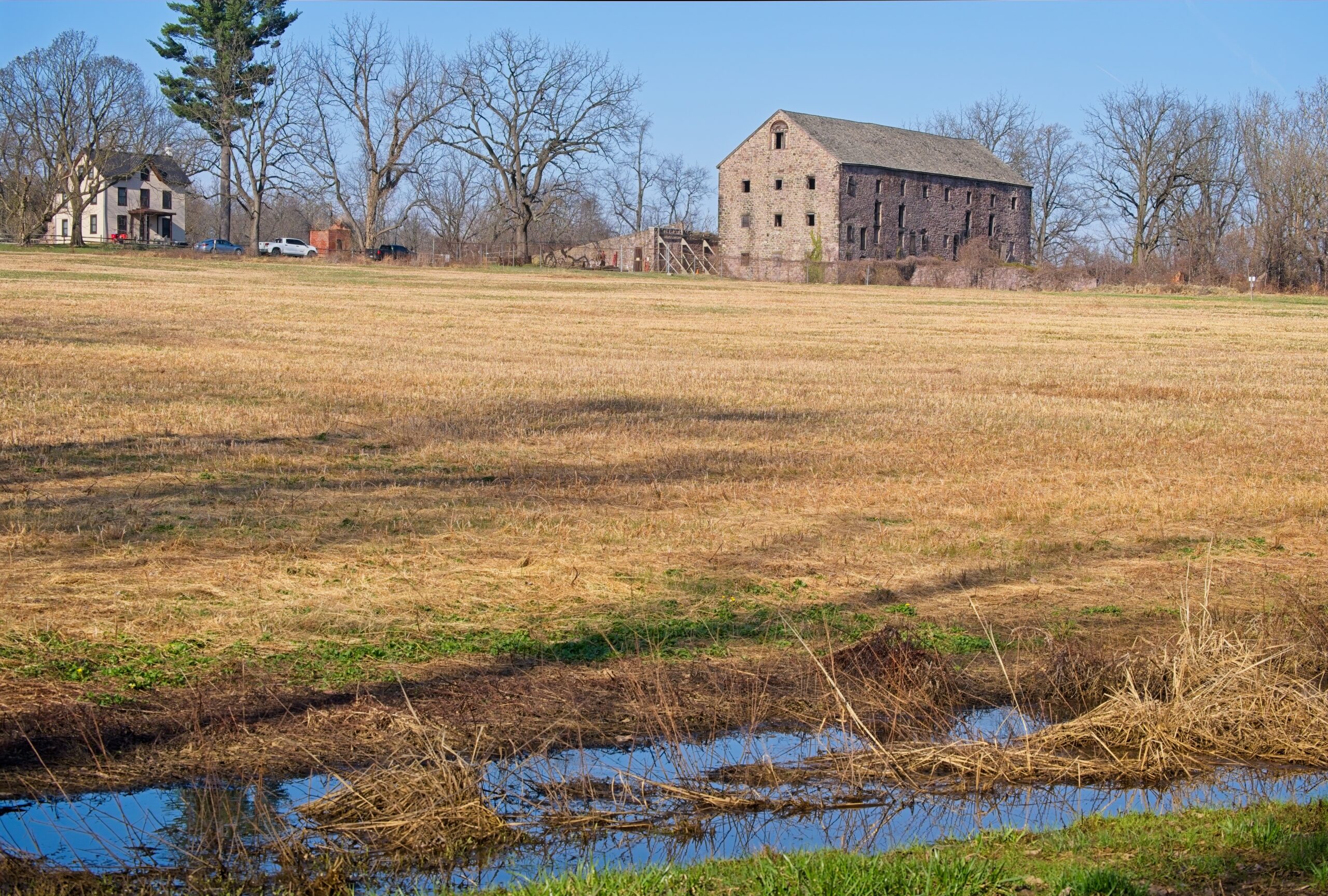
Snyder’ s Mill also sits in the park. It was a linseed oil mill in the 1800s, and could be the graining mill of the 1775 Continental Powder Mill Complex. In recent years, Snyder’s Mill had been on the verge of total collapse. The East Pikeland Historical Commission has stabilized the mill and is working to promote the site as a heritage tourism destination.


A short distance upstream is the Hares Hill Road Bridge, a single-span, wrought iron, bowstring-shaped lattice girder bridge. It was built in 1869 by Moseley Iron Bridge and Roof Company and is the only known surviving example of this kind.


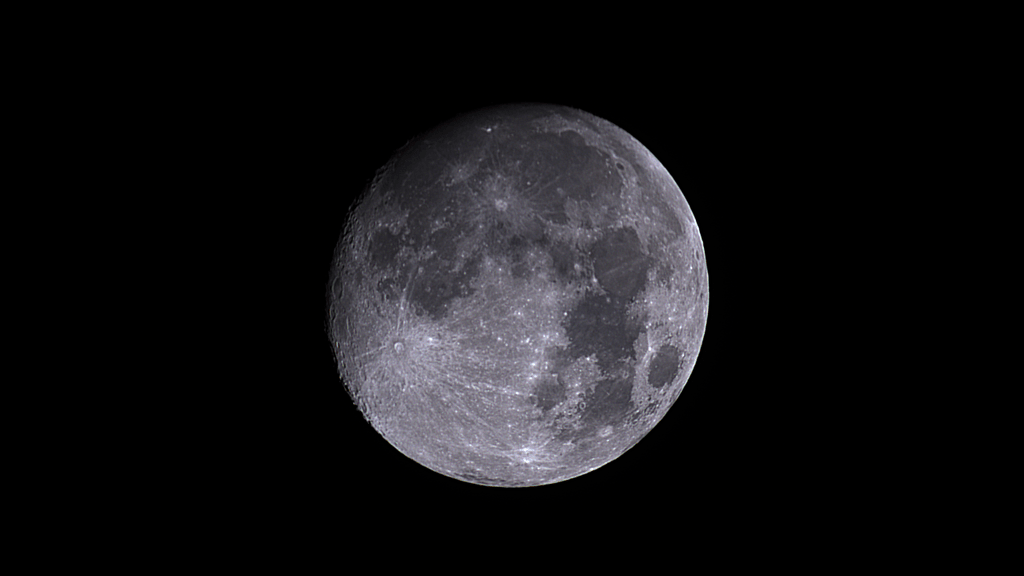
Since I began learning how to do astrophotography post-processing over the past year or so, there as been a definite change for the better in the end results. I have put a few examples below. The differences are mainly down to taking an increased number of exposures per image and improvements in processing skills and software. Here are a few examples.


To see some truly awful astrophotography, you can go back to some of my early Hubble Challenge posts. You can find these posts by clicking on Hubble Challenge category link at the top of the page.
Here are some new astrophotography images taken with the Seestar S30 Pro. These images were processed with only the in-app software. These photos show the wide field capability of the scope. Mosaic mode was not used, and all were cropped to some extent.



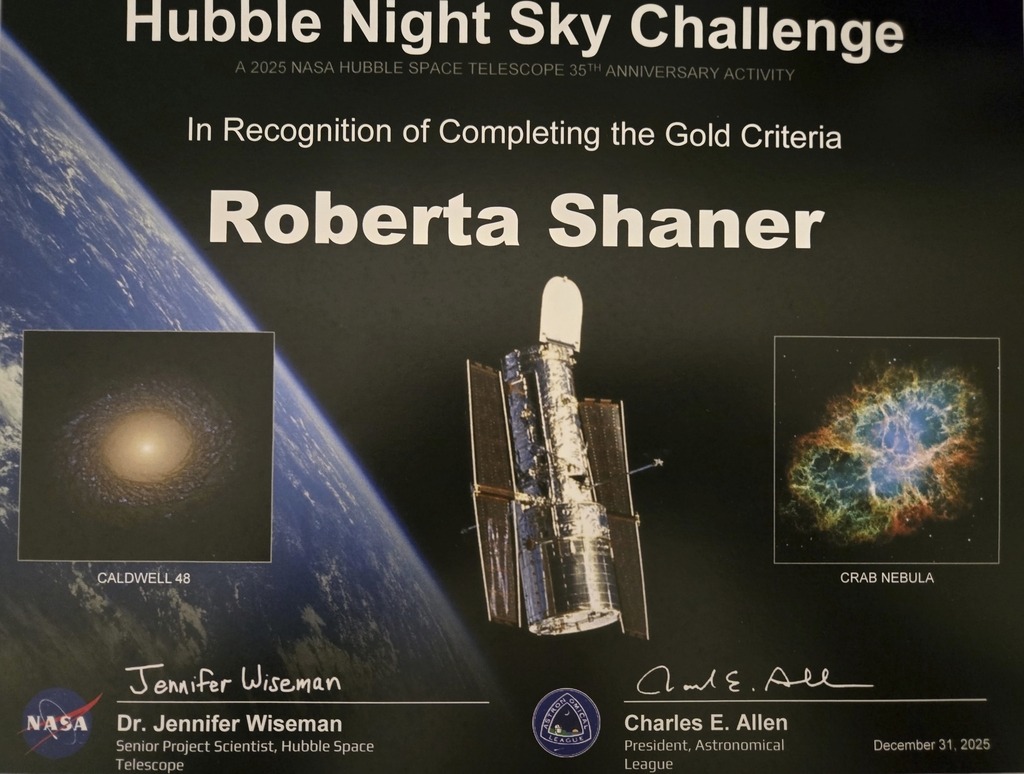
The Hubble 35th Anniversary Challenge has been completed. You can read more about the challenge here on the Night Sky page. Although I did set out to complete the gold level, I managed to earn the Gold Certificate and pin. The pin was a bonus, as I didn’t realize there was one for this program.

This winter has been particularly harsh, with prolonged periods of below average temperatures that have kept me trapped at home when the snow fails to melt around my car. I did, however, manage to travel to a farming area in northwestern Chester County to do some birding on New Year’s weekend.
This area is known for attracting winter migrant species that prefer open habitats, such as horned larks, Lapland longspurs, and snow buntings. I have had lucky seeing the horned larks before. This time, I saw the flocks of birds but had difficulty making out individuals with my binoculars or camera. However, a popular bird sound id app did pick up all of the species above, including the snow bunting and longspur. To access this site, one has to try to pull off by the side of the road and sit an wait. There was one other car during the time I was there. The locals must think we are crazy.
In terms of pictures, I had to content myself with scenes of the local area.


I made my way home via Marsh Creek State Park. Alas, the gull photos I took there were too distant and blurry.


A belated Christmas gift brought the redundantly named Dwarf Mini smart telescope my way. You can see more information about this scope here. I was interested in this telescope due to its extreme portability and the ability to get a wider field of view compared to my Seestar S50.
Weather here this Winter has been below average in temperature and overcast. When it does clear, it has been very cold and windy. Here are some sample photos I managed to get processed with only the Stellar Studio software in the Dwarflabs app. Most of these stellar objects here have been featured in this blog before. Total integration time for most targets was about 1-2 hours.


December marks the final month of the Hubble 35th Anniversary Challenge. More about the challenge can be found on the Night Sky page.
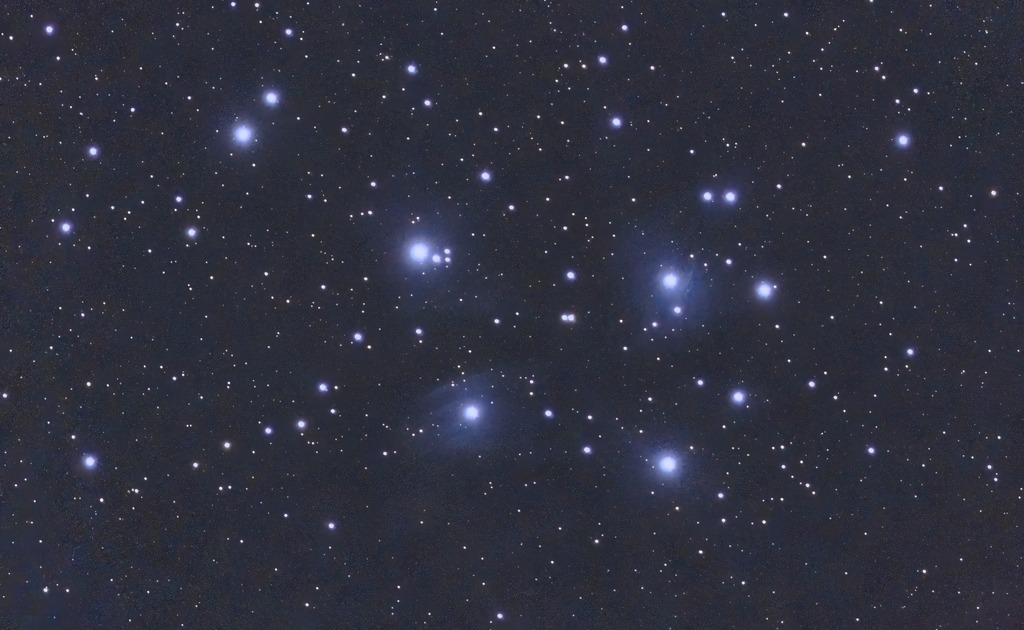
The first target is a familiar one – even to those who view the night sky with their naked eyes – the Pleiades, also known as Seven Sisters and Messier 45 (M45). It is an asterism of an open star cluster containing young B-type stars in the northwest of the constellation Taurus. At a distance of about 444 light-years, it is among the nearest star clusters to Earth and the nearest Messier object to Earth, being the most obvious star cluster to the naked eye in the night sky. It contains the reflection nebulae NGC 1432, an HII region, and NGC 1435, known as the Merope Nebula. Around 2330 BC the Pleiades marked the vernal point. Due to the brightness of its stars, the Pleiades is viewable from most areas on Earth, even in locations with significant light pollution.
The cluster is dominated by hot blue luminous stars that have formed within the last 100 million years. Reflection nebulae around the brightest stars were once thought to be leftover material from their formation, but are now considered likely to be an unrelated dust cloud in the interstellar medium through which the stars are currently passing. Computer simulations have shown that the Pleiades were probably formed from a compact configuration that once resembled the Orion Nebula.
Together with the open star cluster of the Hyades, the Pleiades form the Golden Gate of the Ecliptic. The Pleiades have been said to “resemble a tiny dipper,” and should not be confused with the “Little Dipper,” or Ursa Minor. The cluster has been of considerable cultural and practical importance around the Earth for millennia.
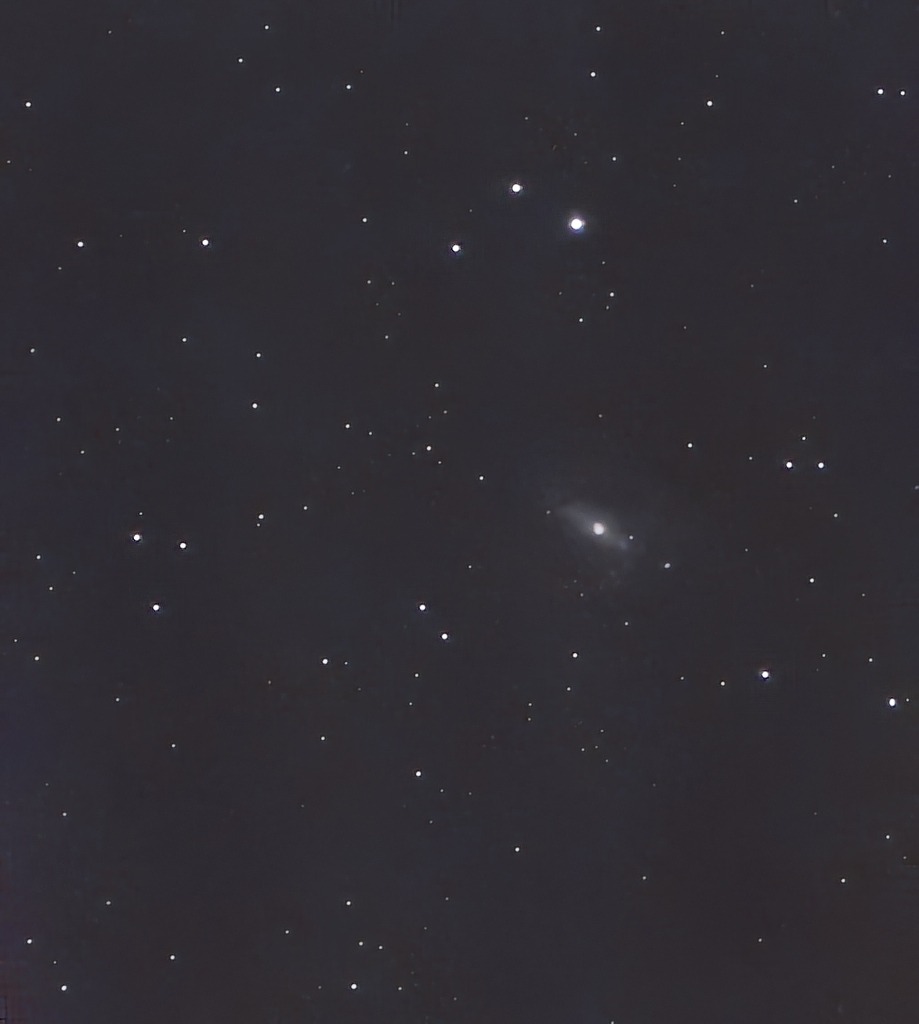
The remaining targets are significantly smaller when viewed in the night sky. Messier 77 (M77), also known as NGC 1068 or the Squid Galaxy, is a barred spiral galaxy in the constellation Cetus. It is about 47 million light-years (14 Mpc) away from Earth, and was discovered by Pierre Méchain in 1780, who originally described it as a nebula. Méchain then communicated his discovery to Charles Messier, who subsequently listed the object in his catalog. Both Messier and William Herschel described this galaxy as a star cluster. Today, however, the object is known to be a galaxy. It is one of the Seyfert galaxies featured this month. Seyfert galaxies are one of the two largest groups of active galaxies, along with quasar host galaxies. They have quasar-like nuclei (very luminous sources of electromagnetic radiation that are outside of our own galaxy) with very high surface brightness whose spectra reveal strong, high-ionization emission lines, but unlike quasars, their host galaxies are clearly detectable. M77 is one of the brightest Seyfert galaxies visible from Earth and has a diameter of about 27.70 kiloparsecs (90,000 light-years).
In a smart telescope, it appears as a roundish, hazy smudge with a bright core.

Next up is Caldwell 67. NGC 1097 (also known as Caldwell 67 or C67) is a barred spiral galaxy about 45 million light years away in the constellation Fornax. It was discovered by William Herschel on 9 October 1790. It is a severely interacting galaxy with obvious tidal debris and distortions caused by interaction with the companion galaxy NGC 1097A. C67 is also a Seyfert galaxy. Deep photographs revealed four narrow optical jets that appear to emanate from the nucleus. These have been interpreted as manifestations of the (currently weak) active nucleus. The optical jets are in fact composed of stars. The failure to detect atomic hydrogen gas in the jets with the Very Large Array radio telescope and numerical simulations led to the current interpretation that the jets are actually the shattered remains of a cannibalized dwarf galaxy. C67 has a supermassive black hole at its center, which is 140 million times the mass of the Sun.
Here C67 appears as an almost edge-on galaxy, a faint elongated smudge with a bright core.
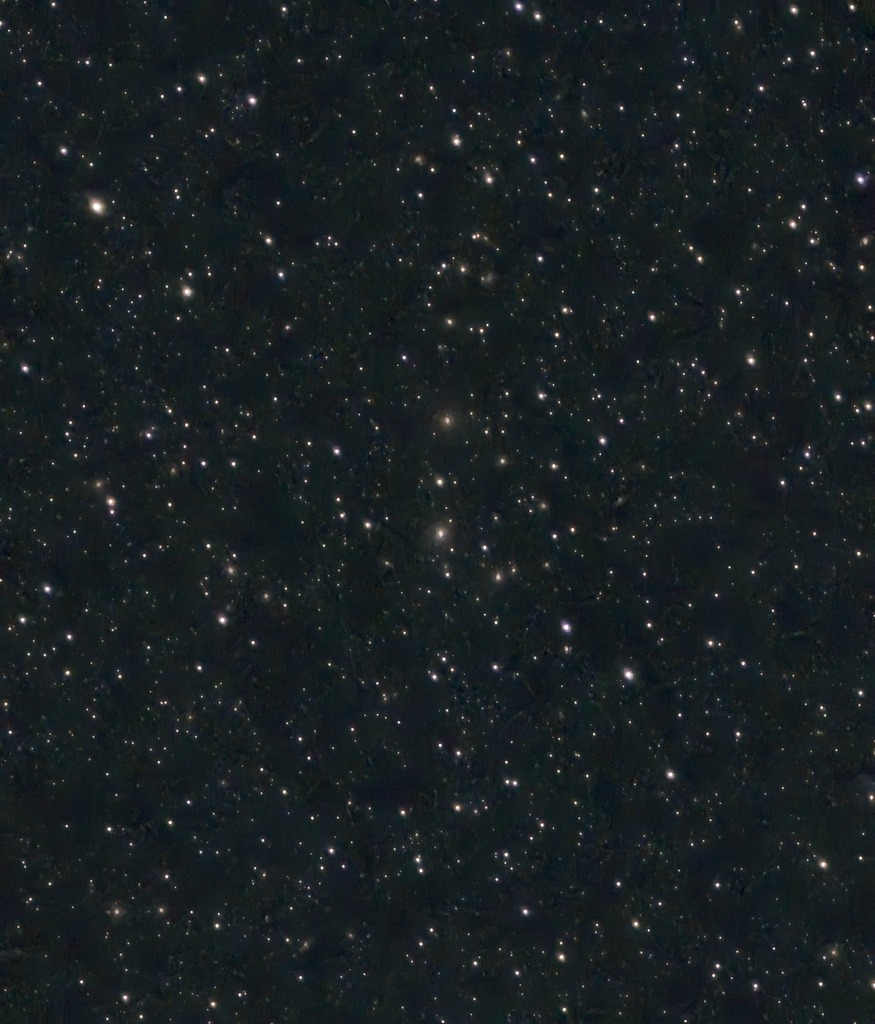
Finally, we come to C24. NGC 1275 (also known as Perseus A or Caldwell 24) is a type 1.5 Seyfert galaxy located around 225 million light-years away from Earth in the direction of the constellation of Perseus. C24 is a member of the large Perseus Cluster of galaxies. It was discovered by German-British astronomer William Herschel on 17 October 1786.
C24 consists of two galaxies, a central type-cD galaxy in the Perseus Cluster, and a so-called high velocity system (HVS) which lies in front of it. The HVS is moving at 3000 km/s towards the dominant system, and is believed to be merging with the Perseus Cluster. The HVS is not affecting the cD galaxy as it lies at least 200 thousand light years from it. However tidal interactions are disrupting it and the ram pressure produced by its interaction with the intra-cluster medium of Perseus is stripping its gas as well as producing large amounts of star formation within it.
In the photo below, the monster galaxy appears as a roundish smudge near the center. There is a parallelogram shape of four bright smudges. C24 is the lower left member of this group of four.
The penultimate installment of the Hubble 35th Anniversary Night Sky Challenge went ahead, despite the government shutdown, thanks to the Astronomical League. The League got the word out about the monthly targets.
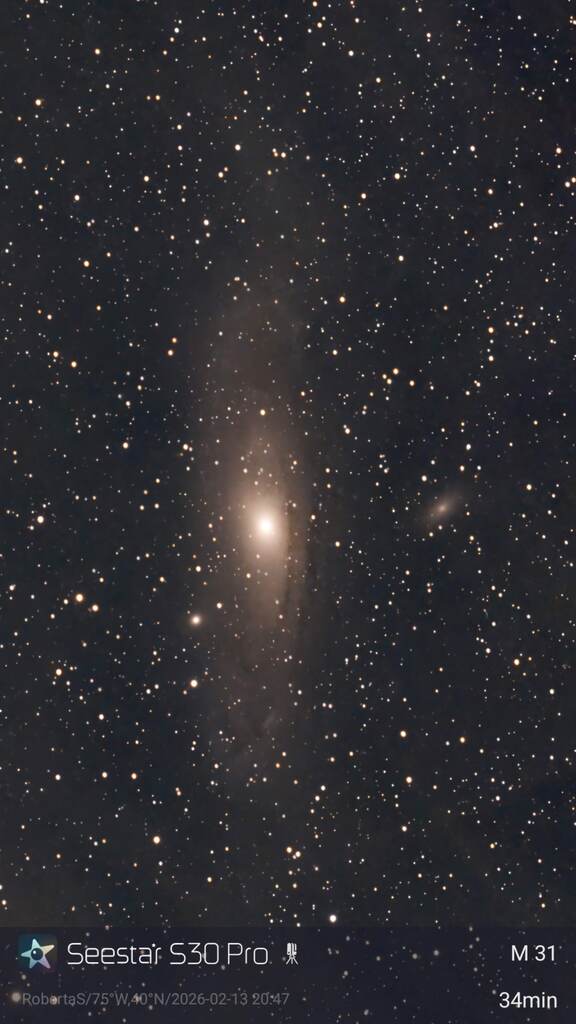
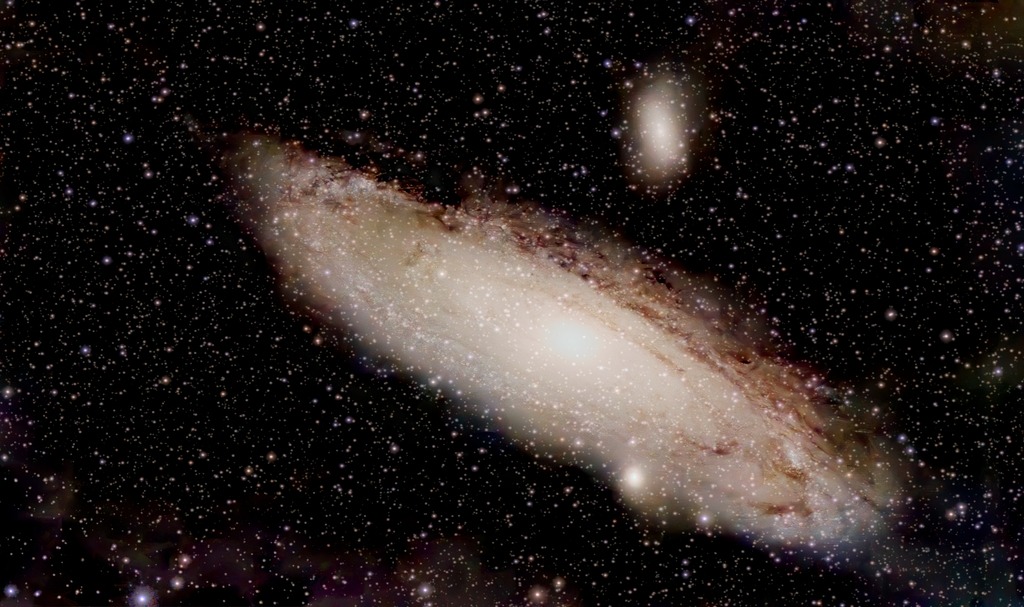
The Andromeda Galaxy is a popular astrophotography target. It is a barred spiral galaxy and is the nearest major galaxy to the Milky Way. It was originally named the Andromeda Nebula and is cataloged as Messier 31, M31, and NGC 224. Andromeda is approximately 765 kpc (2.5 million light-years) from Earth. The galaxy’s name stems from the area of Earth’s sky in which it appears, the constellation of Andromeda, which itself is named after the princess who was the wife of Perseus in Greek mythology. The Andromeda Galaxy has a diameter of about 46.56 kpc (152,000 ly), making it the largest member of the Local Group of galaxies in terms of extension.
The Milky Way and Andromeda galaxies have about a 50% chance of colliding with each other in the next 10 billion years, merging to potentially form a giant elliptical galaxy or a large lenticular galaxy. With an apparent magnitude of 3.4, the Andromeda Galaxy is among the brightest of the Messier objects, and is visible to the naked eye from Earth on moonless nights, even when viewed from areas with moderate light pollution.
It is flanked in this photo by two smaller satellite galaxies M110 (upper center right) and M32 (lower center right on edge of M31). Based on current evidence, it appears that M32 underwent a close encounter with the Andromeda Galaxy in the past. M32 may once have been a larger galaxy that had its stellar disk removed by M31 and underwent a sharp increase of star formation in the core region, which lasted until the relatively recent past. M110 also appears to be interacting with the Andromeda Galaxy, and astronomers have found in the halo of the latter a stream of metal-rich stars that appear to have been stripped from these satellite galaxies. M110 does contain a dusty lane, which may indicate recent or ongoing star formation. M32 has a young stellar population as well.
The Triangulum Galaxy is a non-dwarf galaxy that lies 750,000 light-years from Andromeda. It is currently unknown whether it is a satellite of Andromeda.[It is a spiral galaxy 2.73 million light-years (ly) from Earth in the constellation Triangulum. It is catalogued as Messier 33 or NGC 598. The Triangulum Galaxy is the third-largest member of the Local Group of galaxies, behind the Andromeda Galaxy and the Milky Way.
The galaxy is the second-smallest spiral galaxy in the Local Group after the Large Magellanic Cloud, which is a Magellanic-type spiral galaxy. It is believed to be a satellite of the Andromeda Galaxy or on its rebound into the latter due to their interactions, velocities, and proximity to one another in the night sky.
Under exceptionally good viewing conditions with no light pollution, the Triangulum Galaxy can be seen by some people with the fully dark-adapted naked eye; to those viewers, it is the farthest permanent entity visible without magnification, being about half again as distant as Messier 31, the Andromeda Galaxy.
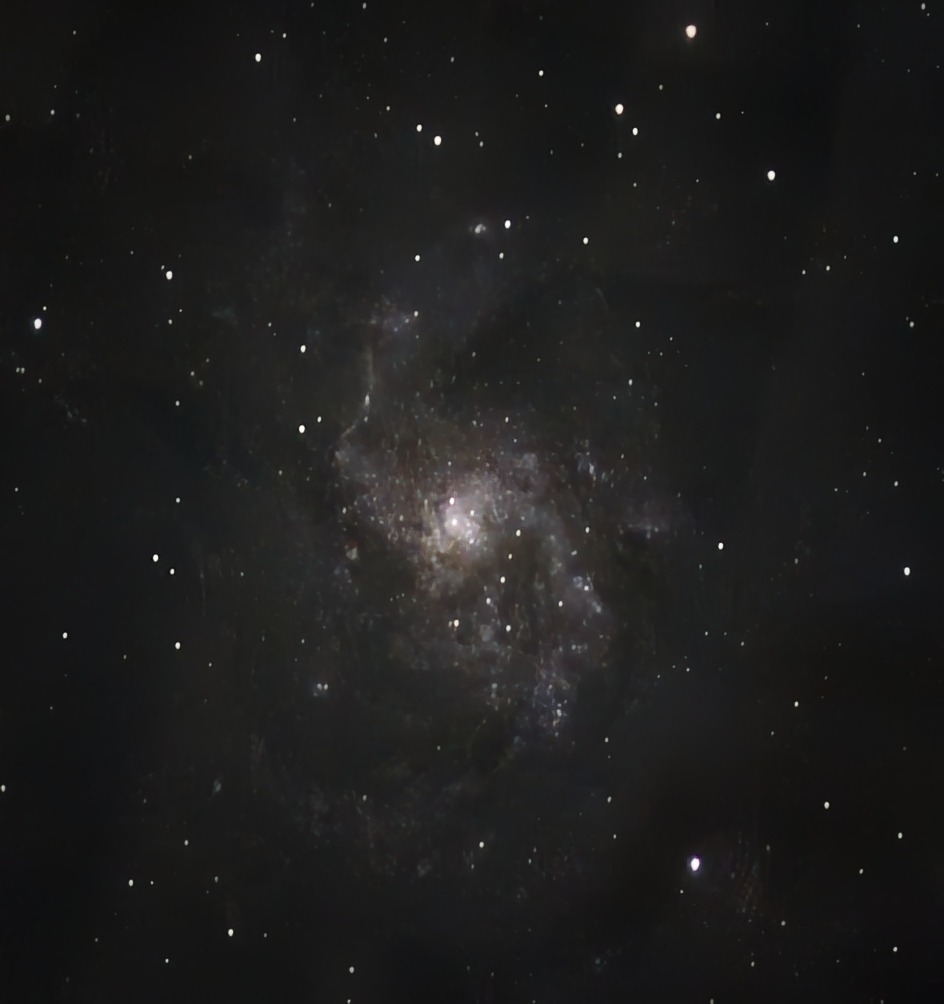
Messier 74 (also known as NGC 628 and Phantom Galaxy) is a large spiral galaxy in the equatorial constellation Pisces. It is about 32 million light-years away from Earth. The galaxy contains two clearly defined spiral arms and is therefore used as an archetypal example of a grand design spiral galaxy. The galaxy’s low surface brightness makes it the most difficult Messier object for amateur astronomers to observe. Its relatively large angular (that is, apparent) size and the galaxy’s face-on orientation make it an ideal object for professional astronomers who want to study spiral arm structure and spiral density waves. It is estimated that M74 hosts about 100 billion stars.
M74 was discovered by Pierre Méchain in 1780. He then communicated his discovery to Charles Messier, who listed the galaxy as M74 in his catalog of permanent celestial objects that should not be confused with transient objects in the sky. This galaxy has the second-lowest Earth-surface brightness of any Messier object, making observation by amateur astronomers a challenge. (M101 has the lowest.) It requires a good night sky.
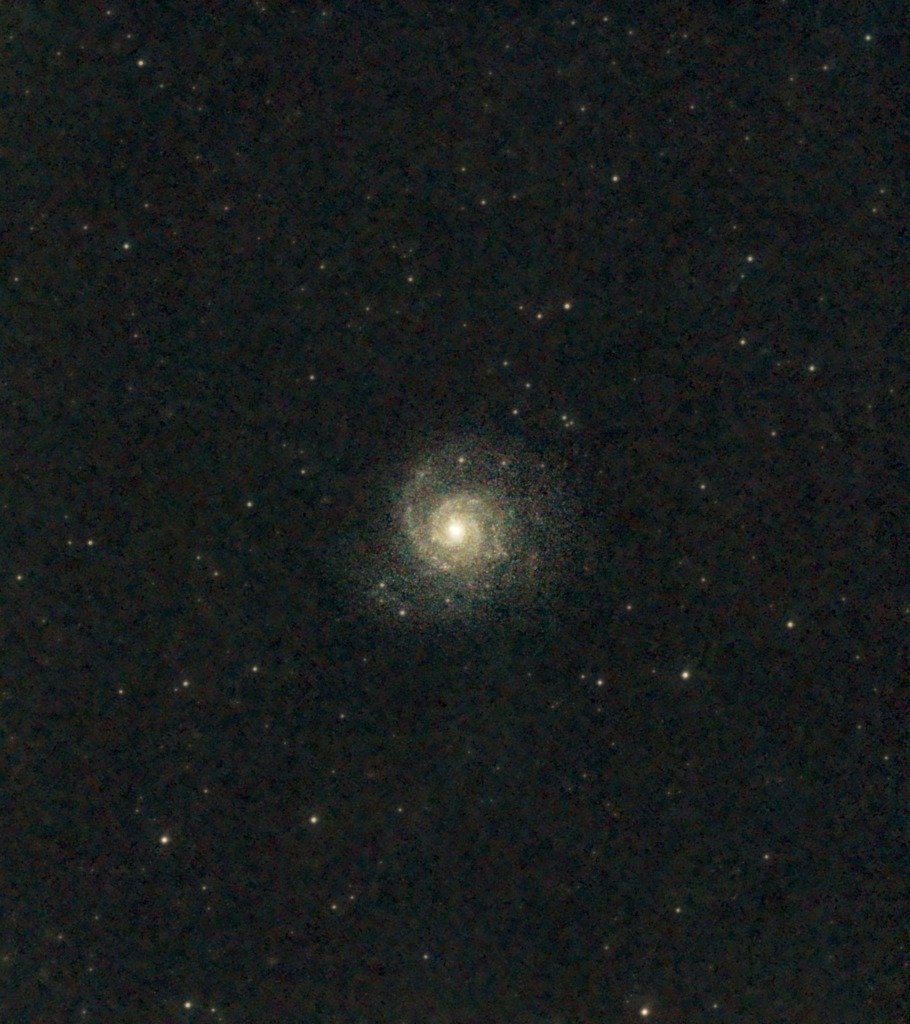
The Sculptor Galaxy (also known as the Silver Coin Galaxy, Silver Dollar Galaxy, NGC 253, or Caldwell 65) is an intermediate spiral galaxy in the constellation Sculptor. The Sculptor Galaxy is a starburst galaxy, which means that it is currently undergoing a period of intense star formation. I found it to be more of a challenge to image as it lies low in my southern skies.
The galaxy was discovered by Caroline Herschel in 1783 during one of her systematic comet searches. Many years later, John Herschel observed it using his 18-inch metallic mirror reflector at the Cape of Good Hope. He wrote: “very bright and large (24′ in length); a superb object…. Its light is somewhat streaky, but I see no stars in it except 4 large and one very small one, and these seem not to belong to it, there being many near…”
In 1961, Allan Sandage wrote in the Hubble Atlas of Galaxies that the Sculptor Galaxy is “the prototype example of a special subgroup of Sc systems….photographic images of galaxies of the group are dominated by the dust pattern. Dust lanes and patches of great complexity are scattered throughout the surface. Spiral arms are often difficult to trace…. The arms are defined as much by the dust as by the spiral pattern.” Bernard Y. Mills, working out of Sydney, discovered that the Sculptor Galaxy is also a fairly strong radio source.
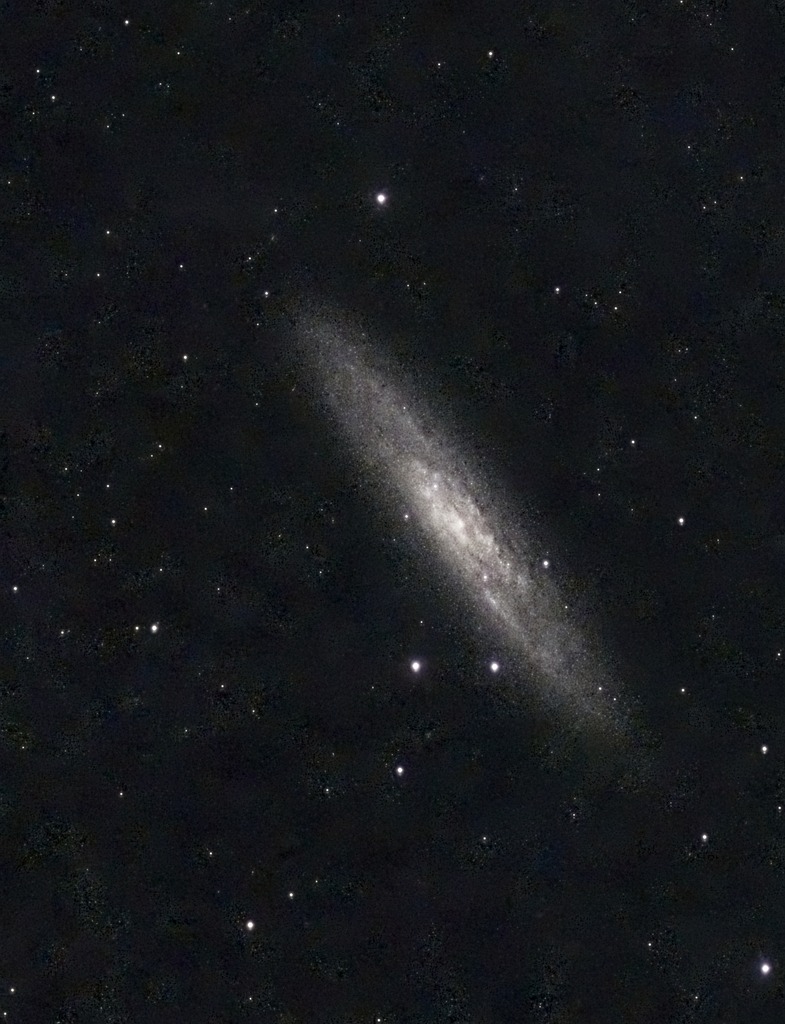
NGC 246 (also known as the Skull Nebula or Caldwell 56) is a planetary nebula in the constellation Cetus. It was discovered in 1785 by William Herschel.
The nebula is roughly 3,500+720 −850 light-years away. NGC 246’s central star is the 12th magnitude white dwarf HIP 3678 A. In 2014, astronomers discovered a second companion to NGC 246’s central star, which has a comoving companion star called HIP 3678 B. The second companion star, a red dwarf known as HIP 3678 C, was discovered using the European Southern Observatory’s Very Large Telescope. This makes NGC 246 the first planetary nebula to have a hierarchical triple star system at its center. It is currently the only known example of a planetary nebula with more than two central stars.
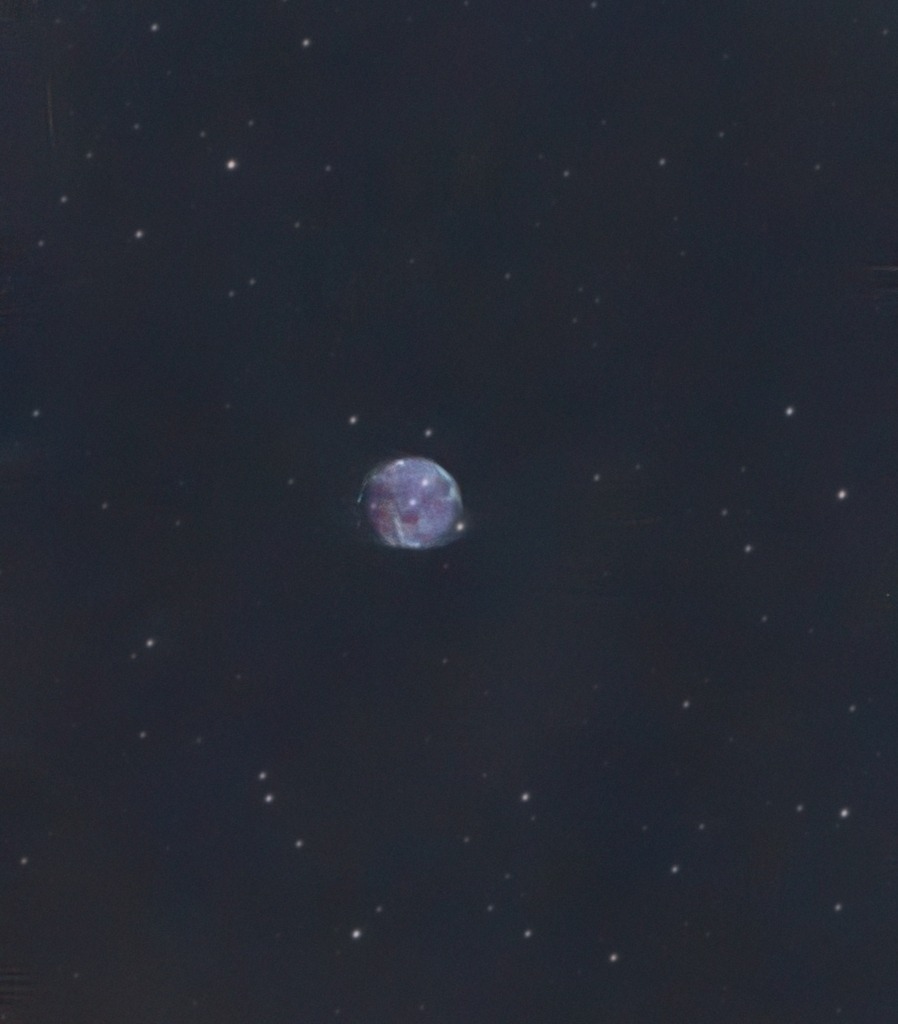
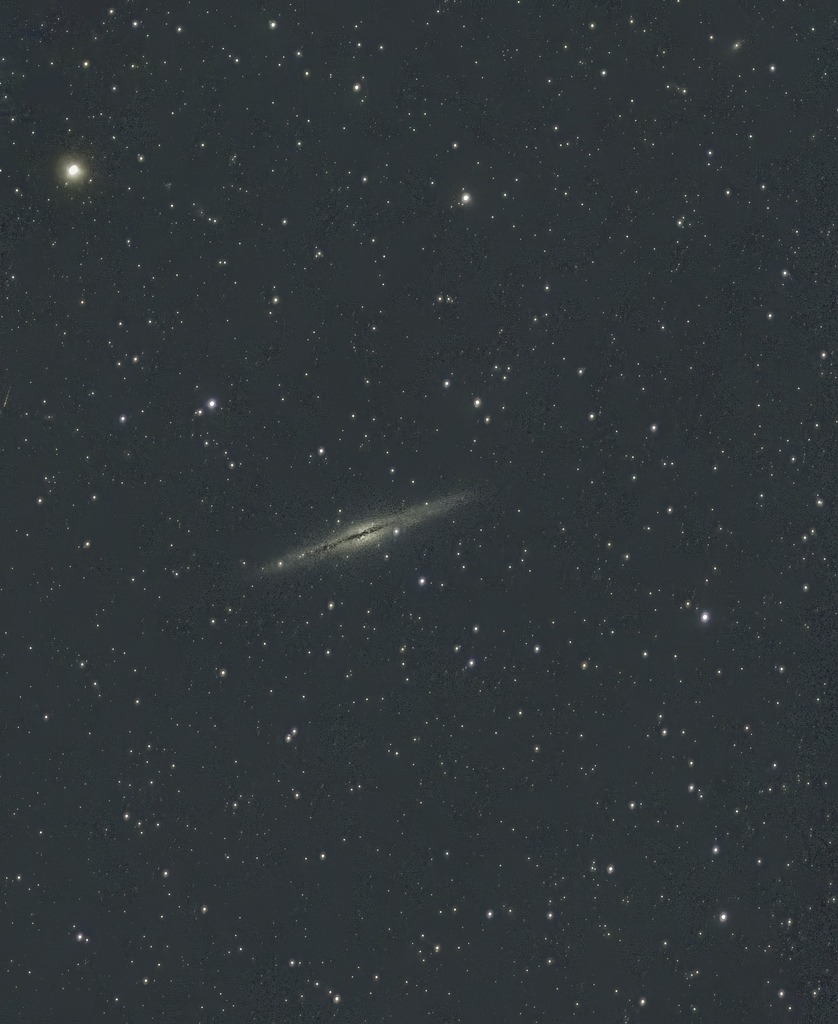
NGC 891 (also known as Caldwell 23, the Silver Sliver Galaxy, and the Outer Limits Galaxy) is an edge-on unbarred spiral galaxy about 30 million light-years away in the constellation Andromeda. It was discovered by William Herschel on October 6, 1784. The galaxy is a member of the NGC 1023 group of galaxies in the Local Supercluster. It has an H II nucleus. The object is visible in small to moderate size telescopes as a faint elongated smear of light with a dust lane visible in larger apertures.
In 2005, due to its attractiveness and scientific interest, NGC 891 was selected to be the first light image of the Large Binocular Telescope.[In 2012, it was again used as a first light image of the Lowell Discovery Telescope with the Large Monolithic Imager. Supernova SN 1986J was discovered on August 21, 1986 at apparent magnitude 14.
NGC 891 appears alongside M67, the Sombrero Galaxy(M104), the Pinwheel Galaxy(M101), NGC 5128, NGC 1300, M81, and the Andromeda Galaxy in the end credits of the Outer Limits TV series, which is why it is occasionally called the Outer Limits Galaxy.
The soundtrack of the 1974 film Dark Star by John Carpenter features a muzak-style instrumental piece called “When Twilight Falls on NGC 891”. The first solo album by Edgar Froese, Aqua, also released in 1974, contained a track called “NGC 891”. Side 2 of the album, which included this track, was unusual in having been a rare example of a commercially issued piece of music recorded using the artificial head system.
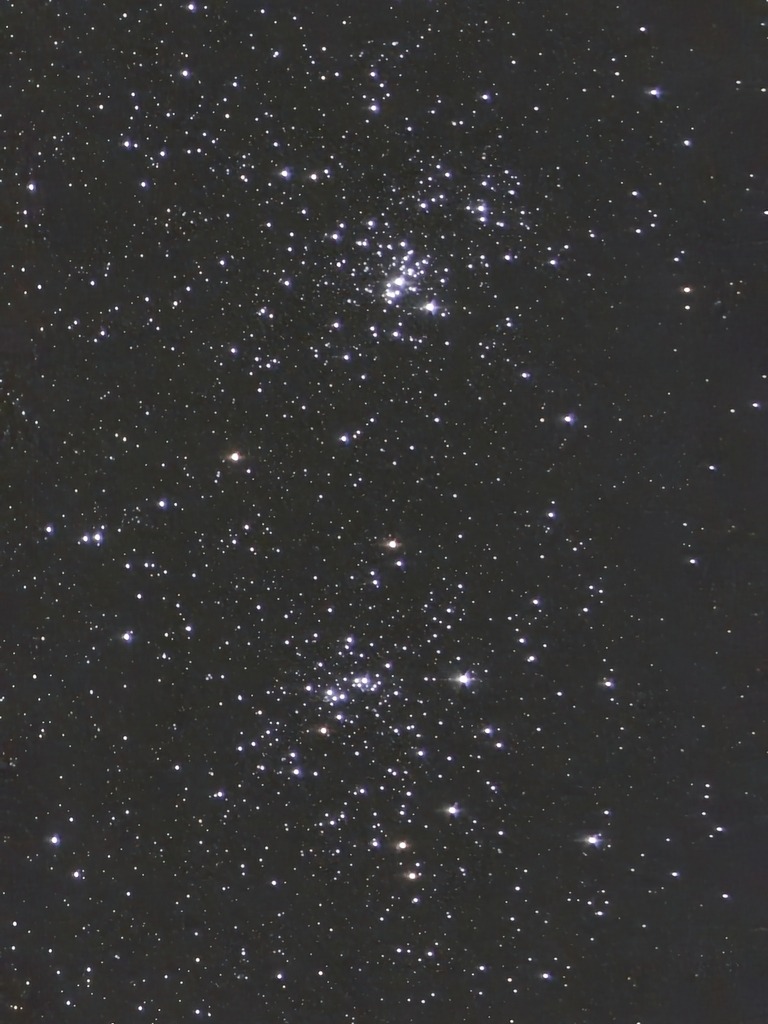
Finally we have another non-galaxy, the Double Cluster, also known as Caldwell 14, consists of the open clusters NGC 869 and NGC 884 (often designated h Persei and χ (chi) Persei, respectively), which are close together in the constellation Perseus. Both visible to the naked eye, NGC 869 and NGC 884 lie at a distance of about 7,500 light-years (2,300 pc) in the Perseus Arm of the Milky Way galaxy.
Greek astronomer Hipparchus cataloged the object (a patch of light in Perseus) as early as 130 BCE. To Bedouin Arabs the cluster marked the tail of the smaller of two fish they visualized in this area, and it was shown on illustrations in Abd al-Rahman al-Sufi’s Book of Fixed Stars. However, the true nature of the Double Cluster was not discovered until the invention of the telescope, many centuries later. In the early 19th century William Herschel was the first to recognize the object as two separate clusters. The Double Cluster is not included in Messier’s catalog, but is included in the Caldwell catalogue of popular deep-sky objects.
The targets for the Hubble Telescope 35th Anniversary Challenge were a diverse range of objects.
The first up is my favorite planetary nebula – the Helix Nebula (NGC 7293 or Caldwell 63). Although not quite as easy to photograph as the Dumbbell Nebula, I like the circular form and range of colors in the Helix. The object is a planetary nebula located in the constellation Aquarius. Discovered by Karl Ludwig Harding, most likely before 1824, this object is one of the closest of all the bright planetary nebulae to Earth. The distance is 655±13 light-years from Earth. It is similar in appearance to the Cat’s Eye Nebula and the Ring Nebula, whose size, age, and physical characteristics are in turn similar to the Dumbbell Nebula, differing only in their relative proximity and the appearance from the equatorial viewing angle. The Helix Nebula has sometimes been referred to as the “Eye of God” in pop culture, as well as the “Eye of Sauron”.

Messier 30 (also known as M30, NGC 7099, or the Jellyfish Cluster) is a pretty globular cluster of stars in the constellation of Capricornus. It was discovered by the French astronomer Charles Messier in 1764, who described it as a circular nebula without a star. In the New General Catalogue, compiled during the 1880s, it was described as a “remarkable globular, bright, large, slightly oval.” It can be easily viewed with a pair of 10×50 binoculars, forming a patch of hazy light some 4 arcminutes wide that is slightly elongated along the east–west axis.

Messier 2 or M2 (also designated NGC 7089) is also a globular cluster, but in the constellation Aquarius, five degrees north of the star Beta Aquarii. It was discovered by Jean-Dominique Maraldi in 1746, and is one of the largest known globular clusters. M2 was discovered by the French astronomer Jean-Dominique Maraldi in 1746 while observing a comet with Jacques Cassini. Charles Messier rediscovered it in 1760, but thought that it is a nebula without any stars associated with it. William Herschel, in 1783, was the first to resolve individual stars in the cluster. M2 is, under extremely good conditions, just visible to the naked eye. Binoculars or a small telescope will identify this cluster as non-stellar, while larger telescopes will resolve individual stars, of which the brightest are of apparent magnitude 6.5.

NGC 7814 (also known as Caldwell 43) is a spiral galaxy about 40 million light-years away in the constellation Pegasus. The galaxy is seen edge-on from Earth. It is sometimes referred to as “the little sombrero”, a miniature version of Messier 104. The star field behind NGC 7814 is known for its density of faint, remote galaxies as can be seen in the vicinity of this object, in the same vein as the Hubble Deep Field.
It’s among the few bright galaxies that exhibit modest distortion and twisting of the galaxy’s plane in optical wavelengths. The light from the distant background galaxies becomes more red as it passes through NGC 7814’s halo. This has been used to determine the amount of gas and dust in the halo. One supernova has been observed in NGC 7814: SN 2021rhu (Type Ia, mag 15.66) was discovered by Automatic Learning for the Rapid Classification of Events (ALeRCE) on 1 July 2021.

NGC 7662 is a planetary nebula located in the northern constellation Andromeda. It is known as the Blue Snowball Nebula, Snowball Nebula, and Caldwell 22. This nebula was discovered October 6, 1784 by the German-born English astronomer William Herschel. In the New General Catalogue it is described as a “magnificent planetary or annular nebula, very bright, pretty small in angular size, round, blue, variable nucleus”. The object has an apparent visual magnitude of 8.3. Parallax measurements give a distance estimate of 5,730 ± 340 ly (1,757 ± 103 pc). NGC 7662 is a popular planetary nebula for casual observers. A small telescope will reveal a star-like object with slight nebulosity. A 6″ telescope with a magnification around 100x will reveal a slightly bluish disk.