The grim winter weather continues in Chester County. I was able to get away on a Sunday to visit a few spots along French Creek.
Rapp’s Dam Covered bridge has been featured before on this blog. This bridge is a 105-foot-long (32 m), Burr truss bridge that was constructed in 1866 by Benjamin F. Hartman. It has fieldstone abutments, horizontal siding and boxed cornices with returns at its portals. It is one of three covered bridges that cross French Creek, the others being Hall’s Bridge and Kennedy Bridge. The Rapps Bridge was renovated in 1978 and again in 2011.
The bridge is adjacent to the French Creek Heritage Park which has picnic tables and access for the French Creek Trail.
Snyder’ s Mill also sits in the park. It was a linseed oil mill in the 1800s, and could be the graining mill of the 1775 Continental Powder Mill Complex. In recent years, Snyder’s Mill had been on the verge of total collapse. The East Pikeland Historical Commission has stabilized the mill and is working to promote the site as a heritage tourism destination.
A short distance upstream is the Hares Hill Road Bridge, a single-span, wrought iron, bowstring-shaped lattice girder bridge. It was built in 1869 by Moseley Iron Bridge and Roof Company and is the only known surviving example of this kind.
This building in the Kimberton area caught my attention.
Since I began learning how to do astrophotography post-processing over the past year or so, there as been a definite change for the better in the end results. I have put a few examples below. The differences are mainly down to taking an increased number of exposures per image and improvements in processing skills and software. Here are a few examples.
The Monkey Head Nebula . I had considered this one of my fairly good images.Monkey Head redux, this time in Hubble Palette using Veralux Alchemy script in Siril.The Rosette Nebula in RGB.The Rosette, also strangely in RGB. More processing time and better software to bring out more blue.The adorable Cocoon Nebula in RGB. I was probably was too light on the star stretching here.The Cocoon Nebula in Hubble Palette using the Veralux Alchemy script in Siril.
To see some truly awful astrophotography, you can go back to some of my early Hubble Challenge posts. You can find these posts by clicking on Hubble Challenge category link at the top of the page.
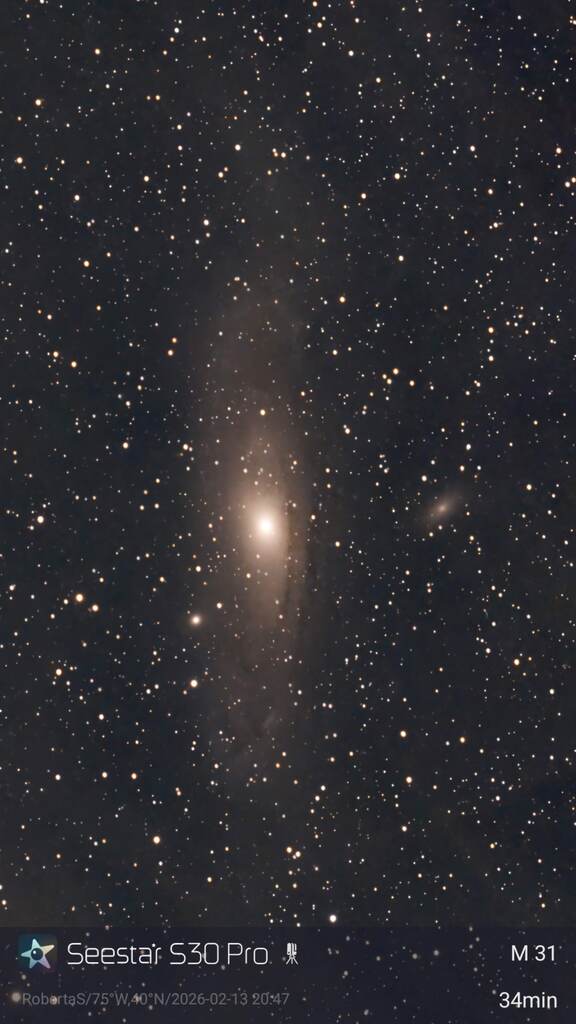
Here are some new astrophotography images taken with the Seestar S30 Pro. These images were processed with only the in-app software. These photos show the wide field capability of the scope. Mosaic mode was not used, and all were cropped to some extent.
IC 434, the Horsehead NebulaM 42. the Orion Nebula, with NGC 1981, the Coal Car Cluster.M 31, the Andromeda Galaxy with a short integration time.
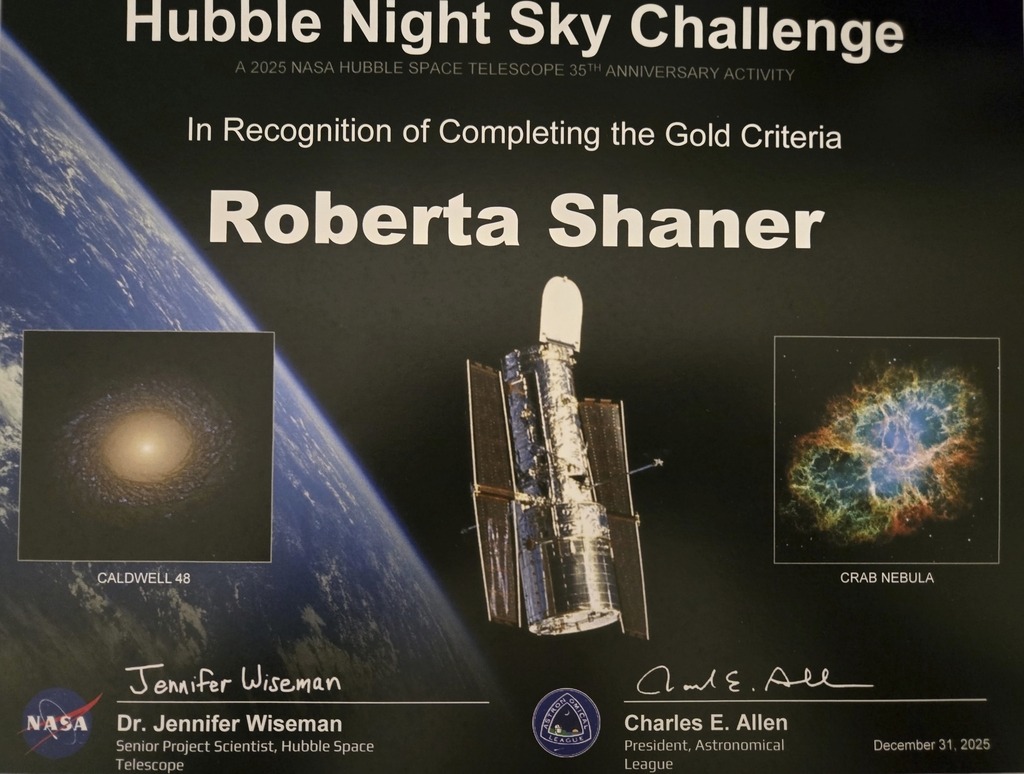
The Hubble 35th Anniversary Challenge has been completed. You can read more about the challenge here on the Night Sky page. Although I did set out to complete the gold level, I managed to earn the Gold Certificate and pin. The pin was a bonus, as I didn’t realize there was one for this program.
The Schuylkill River once had a navigation along its length. A few structures associated with this waterway remain – including Lock 60 at Mont Clare, Montgomery County. I visited on Valentine’s Day as part of a trip along the River to look for waterfowl. A few areas of the River that were free of ice had groups of ducks, including Hooded and Common Mergansers, Goldeneye, Mallard, Greater Scaup, Ring-necked, Bufflehead and a rarity – the Tufted Duck.
Lock 60 is a fully restored, working lock on the Schuylkill Canal, originally built as part of the Schuylkill Navigation system. The lock is demonstrated for groups and during special events by the Schuylkill Canal Association. This lock, one of 71 originally built on the canal, was constructed in the 1820s and was originally part of the Oakes Reach. The site includes the original Locktender’s house as well as canal information and interpretation. The house is open by appointment and during special events.
The lock gates
Some views of the lockkeeper’s house.
The Locktender’s House
Some looks along the Canal and the River – sadly no ducks were present here, as both areas were covered in ice.
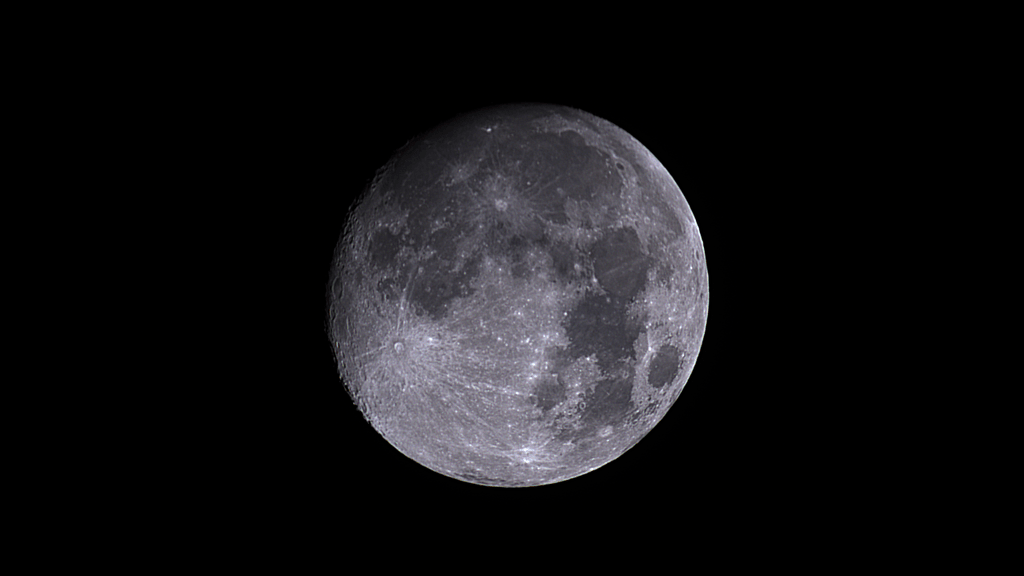
As the weather continues to keep me indoors, I thought I’d post a few astrophotos taken with the Dwarf Mini smart telescope. Temps are on the rise, so I hope to get out this weekend to do some bird watching.
The Rosette Nebula in Monoceros. This is an RGB photo,The nearly full moon.
This winter has been particularly harsh, with prolonged periods of below average temperatures that have kept me trapped at home when the snow fails to melt around my car. I did, however, manage to travel to a farming area in northwestern Chester County to do some birding on New Year’s weekend.
This area is known for attracting winter migrant species that prefer open habitats, such as horned larks, Lapland longspurs, and snow buntings. I have had lucky seeing the horned larks before. This time, I saw the flocks of birds but had difficulty making out individuals with my binoculars or camera. However, a popular bird sound id app did pick up all of the species above, including the snow bunting and longspur. To access this site, one has to try to pull off by the side of the road and sit an wait. There was one other car during the time I was there. The locals must think we are crazy.
In terms of pictures, I had to content myself with scenes of the local area.
Gee, this farm looks familiar.Cows sheltering in the woods.
I made my way home via Marsh Creek State Park. Alas, the gull photos I took there were too distant and blurry.
A belated Christmas gift brought the redundantly named Dwarf Mini smart telescope my way. You can see more information about this scope here. I was interested in this telescope due to its extreme portability and the ability to get a wider field of view compared to my Seestar S50.
Weather here this Winter has been below average in temperature and overcast. When it does clear, it has been very cold and windy. Here are some sample photos I managed to get processed with only the Stellar Studio software in the Dwarflabs app. Most of these stellar objects here have been featured in this blog before. Total integration time for most targets was about 1-2 hours.
M31, the Andromeda GalaxyM45, the PleiadesM33, the Triangulum GalaxyC19, the Cocoon NebulaM44, the Beehive ClusterM35, the Shoe Buckle Cluster with NGC 2158 in the lower rightThe Eastern Veil Nebula in Cygnus
The Duportail House and Federal Barn lie within the Chesterbrook development in Chester County and date back to colonial times. A history of these properties can be found at https://duportailhouse.com/history/. It is a location that I photograph often, if not for the pages of this blog. The house is on the National Register of Historic Places and can be rented for weddings or other events.
Here is a look at the property after a January snowfall.
My attempts at imaging the February objects for the Hubble Anniversary Challenge were more timely. You can read more about this challenge the Pennsylvania Night Sky page. These images are taken for documentation and learning purposes and are not meant to be great examples of astrophotography. The items below are mostly star clusters, which I find easier to photograph. Three also all contain a connection to the Herschel family.
The first object is the star cluster Messier 46. It is also known as NGC 2437, and it is an open cluster of stars in the constellation of Puppis. It was discovered by Charles Messier in 1771. It is about 5,000 light-years away from Earth. There are an estimated 500 stars in the cluster, and it is thought to have an estimated age of 251.2 million years old.
M46 is in the center and skewed about to the right in this photo.
M46
Caldwell 58 (aka NGC 2360 or Caroline’s Cluster) is an open cluster in the constellation Canis Major. It was discovered on 26 February 1783 by Caroline Herschel, who described it as a “beautiful cluster of pretty compressed stars near 1/2 degree in diameter”. Her notes were overlooked until her brother William included the cluster in his 1786 catalogue of 1000 clusters and nebulae and acknowledged her as the discoverer.
C58 or Caroline’s Cluster
Caldwell 39 is known as the Clown Face Nebula, Lion Nebula or the Eskimo Nebula (aka NGC 2392). It is a bipolar double-shell planetary nebula. It was discovered by astronomer William Herschel in 1787. The formation resembles a person’s head surrounded by a parka hood and is surrounded by gas that composed the outer layers of a Sun-like star. A planetary nebula is an area of cosmic gas and dust formed from the cast-off outer layers of a dying star. Despite their name, planetary nebulae don’t have anything to do with planets.
C39 lies about 6500 light-years away, and is visible with a small telescope in the constellation of Gemini. The object is the round spot in the center of the image below that is ringed by a faint blue glow.
C39
Caldwell 25 (aka NGC 2419 ) is a globular cluster in the constellation Lynx. It was discovered by William Herschel on December 31, 1788. NGC 2419 is at a distance of about 300,000 light years from the Solar System and about the same distance from the Galactic Center.
C25 bears the nickname “the Intergalactic Wanderer,” which was bestowed when it was once thought not to be in orbit around the Milky Way. Its orbit takes it farther away from the galactic center than the Magellanic Clouds, but it can be considered as part of the Milky Way. It takes three billion years to make one trip around the galaxy.
The globular cluster is the fuzzy spot in the center of the image.
I was able to attend the first star party of the season on March 8 and got to view multiple objects (such as the Orion Nebula, Uranus and a crescent phase of Venus) through a variety of telescopes. It was still quite cold in early March but still worth it to get out before daylight savings time set in.
Barnards Orchards is a fourth generation business in Kennett Square, Chester County, I was able to visit shortly after Christmas and found some great produce and treats to take home.