• A Gaggle of Globs

    The Hubble 35th Anniversary Challenge for July put the emphasis on globular clusters. These dense star formations are forgiving astrophotography targets, so this month’s batch of photos may be a bit better than the usual mixed bag of results.

    A globular cluster is a spherical collection of stars, typically containing hundreds of thousands or even millions of stars, all gravitationally bound together. These clusters are ancient, with their stars often being among the oldest in their host galaxies, and they orbit the galactic core in a halo-like structure.

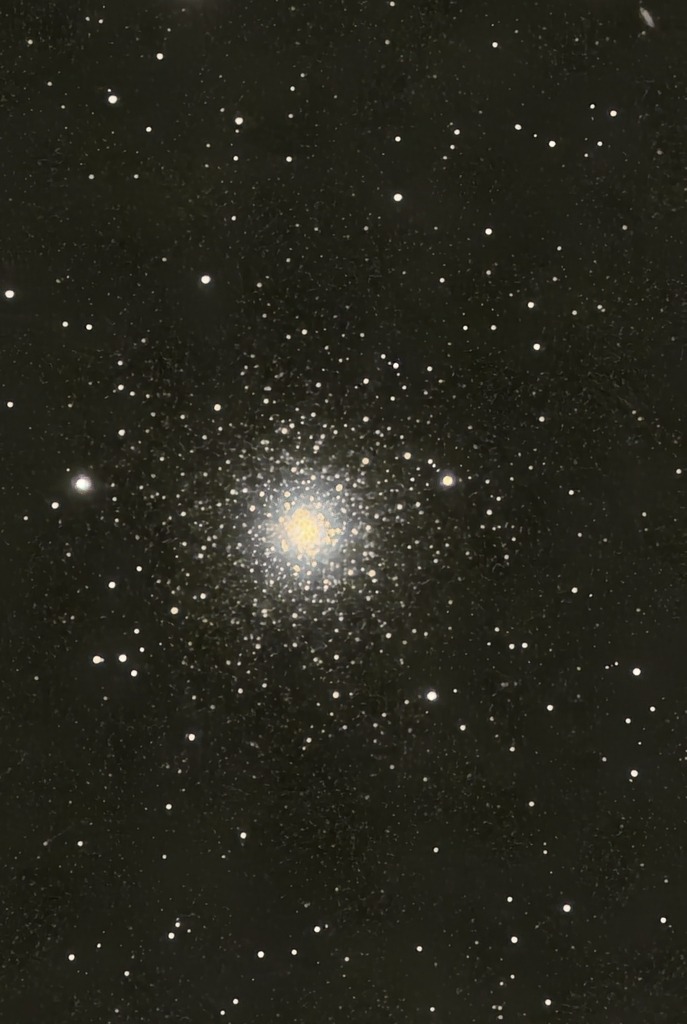
    One of the most famous is Messier 13 (M 13 or NGC 6205) in the constellation Hercules , which contains several hundred thousand stars. Messier 13 was discovered by Edmond Halley in 1714, and cataloged by Charles Messier on June 1, 1764, into his list of objects not to mistake for comets; Messier’s list, including Messier 13, eventually became known as the Messier catalog. Messier 13 is often described by astronomers as the most magnificent globular cluster visible to northern observers.

    M 13

    Messier 92 (also known as M92, M 92, or NGC 6341) is a globular cluster of stars also in the constellation of Hercules. It was discovered by Johann Elert Bode on December 27, 1777, then published in the Berliner Astronomisches Jahrbuch during 1779. It was inadvertently rediscovered by Charles Messier on March 18, 1781, and added as the 92nd entry in his catalog. William Herschel first resolved individual stars in 1783.

    It is one of the brighter of its sort in apparent magnitude in the northern hemisphere and in its absolute magnitude in the galaxy, but it is often overlooked by amateur astronomers due to proximity to bright Messier 13. Though when compared to M13, M92 is only slightly less bright, but about 1/3 less extended. It is visible to the naked eye under very good viewing conditions.With a small telescope, M92 can be seen as a smudge even in a severely light-polluted sky.

    M 92

    Messier 107 or M107, also known as NGC 6171 or the Crucifix Cluster, is a very loose globular cluster in a southern part of the sky in Ophiuchus, and is the last object in the Messier Catalog. It was discovered by Pierre Méchain in April 1782, then independently by William Herschel in 1793. Herschel’s son, John, in his 1864 General Catalog, described it as a “globular cluster of stars, large, very rich, very much compressed, round, well resolved, clearly consisting of stars”

    M 107

    Messier 62 or M62, also known as NGC 6266 or the Flickering Globular Cluster, is a globular cluster of stars in the south of the equatorial constellation of Ophiuchus. It was discovered in 1771 by Charles Messier, then added to his catalog eight years later.

    M62 is among the ten most massive and luminous globular clusters in the Milky Way, showing an integrated absolute magnitude of −9.18. It is essentially spherical.
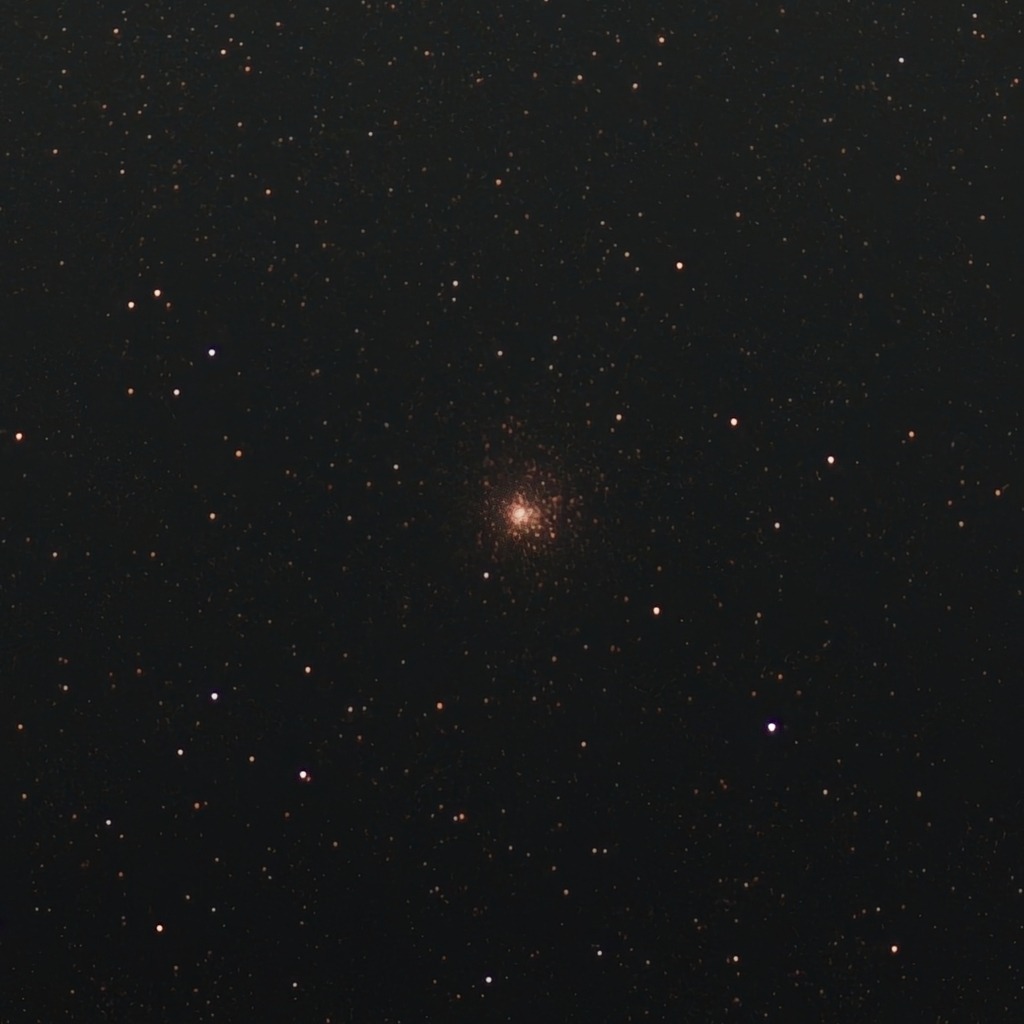
    M 62
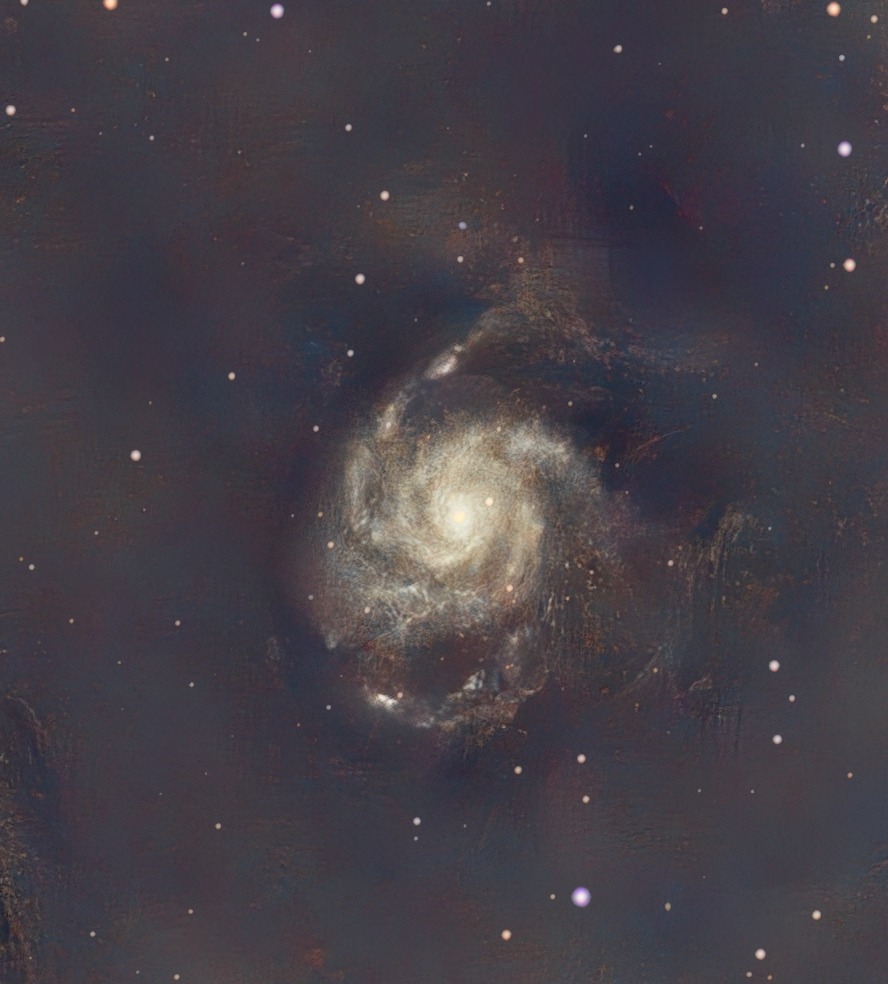
  • A Pinwheel Shines in June

    My submission for the Hubble Challenge for June consisted of a striking face-on spiral galaxy, some pretty globular clusters and another spiral galaxy. with hot star forming regions. You can read more about the Hubble 35th Anniversary Challenge on the Night Sky page.

    The two globular clusters, M3 and M5, proved to be forgiving astrophotography targets. Messier 3 (M3) is a brilliant globular cluster located in the constellation Canes Venatici. It’s a popular target for amateur astronomers, especially during “globular season” in the spring. Easily visible with binoculars and stunning through a telescope, M3 is known for its large size, high concentration of stars, and numerous variable stars. It lies about 34,000 light years from Earth.

    M3

    Messier 5 (M5) is a bright globular star cluster located in the constellation Serpens, approximately 24,500 light-years from Earth. It’s one of the oldest globular clusters in our galaxy, with an estimated age of 13 billion years. M5 is visible with binoculars under dark skies and is a popular target for both visual observers and astrophotographers.

    M5

    Messier 101, also known as the Pinwheel Galaxy, is a face-on spiral galaxy located in the constellation Ursa Major. It’s a stunning example of a classic spiral galaxy, with bright, luminous arms and extensive star-forming regions. At a distance of 22 to 25 million light-years, it’s a relatively close galaxy and is known for its large size, nearly twice the diameter of our Milky Way. This galaxy was barely discernible in photographs for some reason, but I was able to tease some detail out of it.

    M101

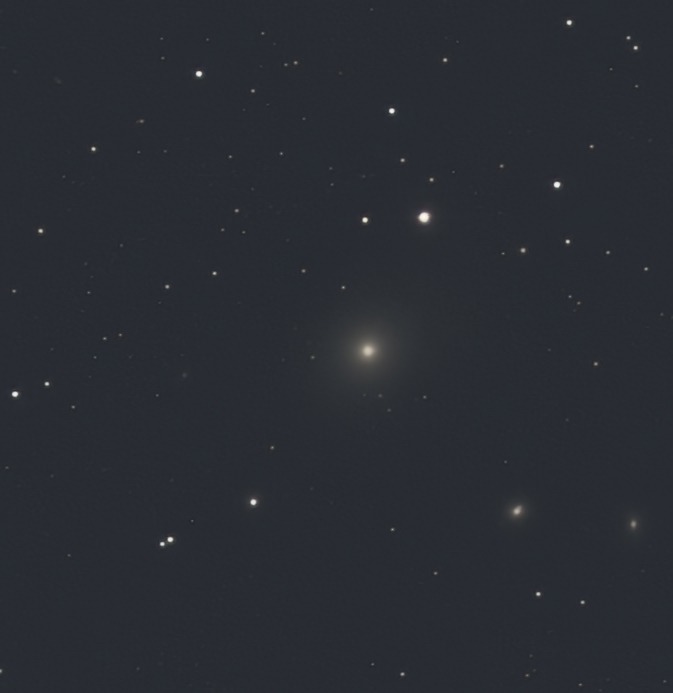
    NGC 5248 (also known as Caldwell 45 or C45) is a compact intermediate spiral galaxy in the constellation Boötes. NGC 5248 is a member of the NGC 5248 Group of galaxies, itself one of the Virgo III Groups strung out to the east of the Virgo Supercluster of galaxies. It is a cute, but petite, spiral here.

    C45

  • The Hubble Challenge for May

    Galaxy season continues. May was a mixed bag for imaging for the Hubble Challenge. Some targets proved quite challenging, and it was difficult to get any decent amount of exposure time to produce something that wasn’t a bleary smudge. The best of the rest are featured here. More information on the challenge can be found on the Pennsylvania Night Sky page.

    Our first subject is the Whirlpool Galaxy, also known as Messier 51a (M51a) or NGC 5194, an interacting grand-design spiral galaxy. It lies in the constellation Canes Venatici, and was the first galaxy to be classified as a spiral galaxy. It is 31 million lightyears (9.5 megaparsecs/Mpc) away and 23.58 kiloparsecs (76,900 ly) in diameter.

    The galaxy and its companion, the dwarf galaxy NGC 5195, are interacting with each other. They are easily observed, and the two galaxies may even be seen with binoculars under the right conditions. The Whirlpool Galaxy has been extensively observed by professional astronomers, who study it and its pair with dwarf galaxy NGC 5195 to understand galaxy structure (particularly structure associated with the spiral arms) and galaxy interactions. Its pair with NGC 5195 is among the most famous and relatively close interacting systems, and thus is a favorite subject of galaxy interaction models.

    I had a lot more integration time for this shot (about 4 hours). Although it won’t be winning any awards, I am pretty please with this image at this stage of my learning process. Compare the distinct spiral arms of M51 with the other galaxies featured below.

    M51 and NGC 5195

    Caldwell 21, also known as NGC 4449, is an irregular Magellanic type galaxy in the constellation Canes Venatici, being located about 13 million light-years away. It was discovered by German-British astronomer William Herschel on 27 April 1788. It is part of the M94 Group or Canes Venatici I Group that is relatively close to the Local Group hosting our Milky Way galaxy. This galaxy is similar in nature to the Milky Way’s satellite galaxy, the Large Magellanic Cloud, though is not as bright nor as large. C21 has a general bar shape, also characteristic of the LMC, with scattered young blue star clusters. The bar shape can be seen in the image.

    C21

    Caldwell 52 (NGC 4697) is an elliptical galaxy some 40 to 50 million light-years away in the constellation Virgo. It is a member of the NGC 4697 Group, a group of galaxies also containing NGC 4731 and several generally much smaller galaxies. This group is about 55 million light-years away; it is one of the many Virgo II Groups, which form a southern extension of the Virgo Supercluster of galaxies. The distance to NGC 4697 is not known with high precision: measurements vary from 28 to 76 million light-years. According to the NASA Extra-galactic Database, the average is about 38 million light-years; according to SIMBAD, about 50 million light-years.

    C52

    Messier 87 (also known as NGC 4486) is a supergiant elliptical galaxy in the constellation Virgo that contains several trillion stars. One of the largest and most massive galaxies in the local universe it has a large population of globular clusters, about 15,000 compared with the 150–200 orbiting the Milky Way, and a jet of energetic plasma that originates at the core and extends at least 1,500 parsecs (4,900 light-years). It is one of the brightest radio sources in the sky and a popular target for both amateur and professional astronomers.

    The French astronomer Charles Messier discovered M87 in 1781, and cataloged it as a nebula. M87 is about 16.4 million parsecs (53 million light-years) from Earth and is the second-brightest galaxy within the northern Virgo Cluster, having many satellite galaxies. Unlike a disk-shaped spiral galaxy, M87 has no distinctive dust lanes. Instead, it has an almost featureless, ellipsoidal shape (evident below) typical of most giant elliptical galaxies, diminishing in luminosity with distance from the center.

    M87
  • An Enigmatic Structure

    The Airglow Observatory sits atop a ridge on Laurel Mountain Road. It is in a state of poor repair, and there is some dispute as to whether it is abandoned. There is a large dome here for instrumentation. It looks like it was used for astronomical obesrving or weather monitoring.

    I drove onto the site to take some pictures. As I was unsure whether I should be there, I did not stay long or look around the back of the building. There are other pictures online which can be found through search. There was no signage that I noticed when I was there, except for what was on the building. There are some antennae and lights on the building, which appear fairly modern and in good repair. The paint on some of the lower windows appears newer.

    The building was constructed by the University of Pittsburgh under a NSF grant, with construction beginning in 1965, according to a press release. The purpose of the building was to study the atmosphere of Earth and the other planets, as stated in the release. Airglow is a faint emission of light by a planetary atmosphere. In the case of Earth’s atmosphere, this optical phenomenon causes the night sky never to be completely dark, even after the effects of starlight and diffused sunlight from the far side are removed. This phenomenon originates with self-illuminated gases and has no relationship with Earth’s magnetism or sunspot activity, causing aurorae.

    The Airglow Observatory.
  • April Starry Nights

    Welcome to this month’s post for the Hubble 35th Anniversary Challenge. More information about the challenge can be found on the Pennsylvania Night Sky page (link in the upper right).

    I successfully submitted for a Silver Certificate for this challenge for February and March. Spring is known as “Galaxy Season,” and here are several examples for April. (The galaxies are the bigger fuzzy blobs, in case you can’t tell.)

    Messier 65 and 66 are galaxies which are part of a group known as the Leo Triplet. M66 is on left in this photo, and M65 is on the right. They are both spiral galaxies. This small group is about 35 million light-years away from our solar system in the constellation Leo. The group also contains NGC 3628, which is not pictured here..

    M66 and M65

    NGC 3115 (also called the Spindle Galaxy or Caldwell 53) is a field lenticular galaxy in the constellation Sextans. The galaxy was discovered by William Herschel on February 22, 1787. At about 32 million light-years away from Earth, it is several times bigger than the Milky Way. It is a lenticular galaxy because it contains a disk and a central bulge of stars, but without a detectable spiral pattern. NGC 3115 is seen almost exactly edge-on, and it is believed to contain a supermassive black hole in its center.

    C53

    Messier 95 and 96 are a pairing of spiral galaxies lying under a degree apart at the center of Leo. They are remarkably similar in size and brightness, with Messier 96 (NGC 3368), about 31 million light-years away, being marginally the brighter than Messier 95 (NGC 3351). M95 is slightly larger and about 33 million light-years away. M96 is a spiral galaxy, while M95 sports a central bar.

    M96 , upper left, and M95, lower right

    NGC 3632 (also known as Caldwell 40 and NGC 3626) is an unbarred lenticular galaxy also in the constellation Leo. It was discovered by William Herschel, on 14 March 1784. The galaxy belongs to the NGC 3607 group and is some 70 million light-years away.

    C40

    Finally, for something different, we have NGC 3242 (also known as Caldwell 59), a planetary nebula located in the constellation Hydra. William Herschel discovered the nebula on February 7, 1785. John Herschel also observed it from the Cape of Good Hope, South Africa, in the 1830s. This planetary nebula is most frequently called the Ghost of Jupiter, or Jupiter’s Ghost due to its similar shape to the planet, but it is also sometimes referred to as the Eye Nebula. The nebula measures around two light-years long from end to end, and contains a central white dwarf. The nebula is the round spot in the center with the purplish ring around it.

    C59
  • It’s Time for More Astrophotography

    Although the weather has continued to be worse than normal, I was able to get out in March and image the night sky objects for the Hubble Anniversary Challenge for the month. More about the challenge can be found here.

    This month’s objects contained a few star clusters. The first of which is Messier 67, a lovely open cluster in Cancer. It is also known as M67 or NGC 2682 and is sometimes called the King Cobra Cluster or the Golden Eye Cluster. It was discovered by Johann Gottfried Koehler in 1779. Estimates of its age range between 3.2 and 5 billion years. Distance estimates are likewise varied, but typically are 800–900 parsecs . It is well populated, almost appearing like a globular cluster, and is a paradigm study object in stellar evolution. I find it to be the most interesting looking object of this group.

    M67

    Next up is the well-known Beehive Cluster, also an open cluster in Cancer. It is known as Praesepe (Latin for “manger”, “cot” or “crib”), M44, NGC 2632, or Cr 189. One of the nearest open clusters to Earth, it contains a larger population of stars than other nearby bright open clusters, holding around 1,000 stars. Under dark skies, the Beehive Cluster looks like a small nebulous object to the naked eye, and has been known since ancient times. Classical astronomer Ptolemy described it as a “nebulous mass in the breast of Cancer”. It was among the first objects that Galileo studied with his telescope. The distance to M44 is often cited to be between 160 and 187 parsecs (520–610 light years).

    Age and proper motion coincide with those of the Hyades, suggesting they may share similar origins. Both clusters also contain red giants and white dwarfs, which represent later stages of stellar evolution, along with many main sequence stars.

    M44

    Continuing the theme of open clusters, we continue to Messier 48, also known as NGC 2548. It is in the equatorial constellation of Hydra. It sits near Hydra’s westernmost limit with Monoceros, to the east and slightly south of Hydra’s brightest star, Alphard. This grouping was discovered by Charles Messier in 1771, but there is no cluster precisely where Messier indicated; he made an error, as he did with M47. Credit for discovery is sometimes given instead to Caroline Herschel in 1783.

    M48 is visible to the naked eye under good atmospheric conditions. The cluster is located some 2,500 light-years from the Sun. The age estimated from isochrones is 400±100 million years, while gyrochronology age estimate is 450±50 million yearsr – in good agreement.

    M48

    Finally, we come to Caldwell 48, also known as NGC 2775,. It is a spiral galaxy in the constellation Cancer. It is 67 million light-years away from the Milky Way. It was discovered by William Herschel in 1783. C48 belongs to the Antlia-Hydra Cluster of galaxies and is the most prominent member of the NGC 2775 Group, a small galaxy group in the Virgo Super-cluster, along with the Local Group. Other members of the NGC 2775 Group include NGC 2777 and UGC 4781. This object reminds us that Spring is known as “galaxy season” due to the prevalence of these distant objects in the night sky.

    Due to the distance, this objects appears small in Seestar S50. It is the fuzzy object in the center of the photo.

    C48

  • The February Hubble Challenge Objects

    My attempts at imaging the February objects for the Hubble Anniversary Challenge were more timely. You can read more about this challenge the Pennsylvania Night Sky page. These images are taken for documentation and learning purposes and are not meant to be great examples of astrophotography. The items below are mostly star clusters, which I find easier to photograph. Three also all contain a connection to the Herschel family.

    The first object is the star cluster Messier 46. It is also known as NGC 2437, and it is an open cluster of stars in the constellation of Puppis. It was discovered by Charles Messier in 1771. It is about 5,000 light-years away from Earth. There are an estimated 500 stars in the cluster, and it is thought to have an estimated age of 251.2 million years old.

    M46 is in the center and skewed about to the right in this photo.

    M46

    Caldwell 58 (aka NGC 2360 or Caroline’s Cluster) is an open cluster in the constellation Canis Major. It was discovered on 26 February 1783 by Caroline Herschel, who described it as a “beautiful cluster of pretty compressed stars near 1/2 degree in diameter”. Her notes were overlooked until her brother William included the cluster in his 1786 catalogue of 1000 clusters and nebulae and acknowledged her as the discoverer.

    C58 or Caroline’s Cluster

    Caldwell 39 is known as the Clown Face Nebula, Lion Nebula or the Eskimo Nebula (aka NGC 2392). It is a bipolar double-shell planetary nebula. It was discovered by astronomer William Herschel in 1787. The formation resembles a person’s head surrounded by a parka hood and is surrounded by gas that composed the outer layers of a Sun-like star. A planetary nebula is an area of cosmic gas and dust formed from the cast-off outer layers of a dying star. Despite their name, planetary nebulae don’t have anything to do with planets.

    C39 lies about 6500 light-years away, and is visible with a small telescope in the constellation of Gemini. The object is the round spot in the center of the image below that is ringed by a faint blue glow.

    C39

    Caldwell 25 (aka NGC 2419 ) is a globular cluster in the constellation Lynx. It was discovered by William Herschel on December 31, 1788. NGC 2419 is at a distance of about 300,000 light years from the Solar System and about the same distance from the Galactic Center.

    C25 bears the nickname “the Intergalactic Wanderer,” which was bestowed when it was once thought not to be in orbit around the Milky Way. Its orbit takes it farther away from the galactic center than the Magellanic Clouds, but it can be considered as part of the Milky Way. It takes three billion years to make one trip around the galaxy.

    The globular cluster is the fuzzy spot in the center of the image.

    I was able to attend the first star party of the season on March 8 and got to view multiple objects (such as the Orion Nebula, Uranus and a crescent phase of Venus) through a variety of telescopes. It was still quite cold in early March but still worth it to get out before daylight savings time set in.

  • The (late) January Astrophoto Post

    These are my photographs of objects that are part of the Hubble Night Sky Challenge for January. The challenge is coordinated by The Astronomical League in cooperation with NASA. More information about this project cam be found on the Night Sky page.

    First, we have two objects that were not official targets for January but that I think made for better pictures. The Rosette Nebula contains an open cluster known as the Satellite Nebula (NGC 224 or C50), This cluster contains some super bright stars and has been estimated to be less than 5 million years old. The nebula and the star clusters are in the constellation Monoceros.

    NGC 2244

    NGC 2264 gives you two objects for one – the Christmas Tree Cluster and the Cone Nebula. My photo did not pick up any significant nebulosity. I do see a “Christmas” tree with a star on top. Do you? The Christmas Tree star formation consists of young stars obscured by heavy layers of dust clouds. These dust clouds, along with hydrogen and helium are producing luminous new stars. This object is also in Monoceros.

    NGC 2264

    Due to short integration times, lost frames and incoming cloudy weather, the photos below are not all they could be. Hopefully this project will be a learning process for me to improve my astrophotography and visual observing. If you would like to see some beautiful photos of the objects taken by the Hubble Space Telescope, please visit the NASA page here. Do you see the objects in these photos below?

    A popular target for astrophotographers is Orion Nebula, also known as Messier 42, M42, or NGC 1976. It is a diffuse nebula south of Orion’s Belt in the constellation of Orion, and it is known as the middle “star” in the “sword” of Orion. It is one of the brightest nebulae and is visible to the naked eye in the night sky with an apparent magnitude of 4.0. I usually need binoculars to see this faint fuzzy patch in Orion. It is 1,344 ± 20 light-years away and is the closest region of massive star formation to Earth.

    M42

    Messier 43 or M43, also known as De Mairan’s Nebula and NGC 1982, is a star-forming nebula also in Orion. It was discovered by the French scientist Jean-Jacques d’Ortous de Mairan some time before 1731, then catalogued by Charles Messier in 1769. It is physically part of the Orion Nebula , separate from the main nebula by a dense lane of dust known as the northeast dark lane. I found this difficult to pick out in my telescope and tried to zoom in on the area designated as M43, but I the small pink blob at the top of this photo is what I’m looking for,

    M43

    NGC 2261 (aka Hubble’s Variable Nebula or Caldwell 46) is a variable nebula located in the constellation Monoceros. The nebula is illuminated by the star R Monocerotis (R Mon), which is not directly visible itself. The first recorded observation of the nebula was by William Herschel on December 26, 1783, being described as considerably bright and ‘fan-shaped’. It has also been described as looking like a small comet and can be variable in appearance due to changes in its apparent brightness. I definitely see the comet-like appearance in this phots. It also looks like a shuttlecock to me.

    C46

    Below is a very faint reddish blob which is a photo of the Crab Nebula (M1, NGC 1952, Taurus A), a supernova remnant and pulsar wind nebula in the constellation of Taurus. The common name comes from a drawing that somewhat resembled a crab with arms produced by William Parsons in 1842 or 1843. The nebula was discovered by English astronomer John Bevis in 1731. It corresponds with a bright supernova observed in 1054 AD by Native American, Japanese, and Arabic stargazers. The supernova was also recorded by Chinese astronomers as a guest star. The nebula was the first astronomical object identified that corresponds with a historically-observed supernova explosion. This is one I will definitely image again with longer exposure integration times.

    M1

    Messier 78 or M78, also known as NGC 2068, is a reflection nebula in the constellation Orion. It was discovered by Pierre Méchain in 1780 and included by Charles Messier in his catalog of comet-like objects that same year.

    M78 is the brightest diffuse reflection nebula of a group of nebulae which belong to the Orion B molecular cloud complex and is about 1,350 light-years distant from Earth. M78 is easily found in small telescopes as a hazy patch and involves two stars of 10th and 11th magnitude. These two B-type stars are responsible for making the cloud of dust in M78 visible by reflecting their light. The nebula came out quite faint and small in my photo and only the main area of nebulosity is visible.

    M78

error: Content is protected !!