

This Winter I traveled to northwestern Chester County in search of a snowy owl and some horned larks. I didn’t find either. However, I did find some pretty farms, interesting buildings and charismatic farm animals along the way.


This Winter I traveled to northwestern Chester County in search of a snowy owl and some horned larks. I didn’t find either. However, I did find some pretty farms, interesting buildings and charismatic farm animals along the way.
Let’s take a look at some state parks in southeastern Pennsylvania from way back in mid September. Benjamin Rush State Park is in norheast Philadelphia and is the only state park within the city boundary. It has trails for hikers and bikers, good spots for wildlife and bird watchers and a model airplane field (like Valley Forge).
The park was named for Benjamin Rush, signer of the Declaration of Independence and attendee at the Continental Congress. He is the Father of American Psychiatry and published the first text book on the subject in the U.S. He advocated improved conditions for mental patients and careful clinical observation and study. Dr. Rush pioneered addiction therapies including treatment of alcoholism as a disease. The park was created out of land from a former state mental hospital.
I found its most notable feature to be its large community garden, however.

The next location was in Bristol, PA, Bucks County, for two of the many access points for Delaware Canal State Park. A walk along the entirety of the 60-mile-long towpath of the Delaware Canal State Park is a stroll back in time. Following the Delaware River between Easton and Bristol, this park contains an historic canal and towpath, a 50-acre pond, many miles of river shoreline, 11 river islands, and diverse scenery.


Futher into town, we see the southern end of the canal.


Finally, White Clay Creek Preserve along the Delaware border is the only property in the state park system called a “preserve.” Maybe because it adjoins White Clay Creek State Park in Delware. The 2,072-acre White Clay Creek Preserve is in southern Chester County. One can enjoy hiking, biking, fishing, and horseback riding in the Preserve. The area of White Clay Creek Preserve is part of a larger tract of land sold to William Penn in 1683 by Lenni Lenape Chief Kekelappen. It is thought that Kekelappen lived in Opasiskunk, an “Indian Town” which appears on a survey map of 1699 at the confluence of the Middle and East branches of White Clay Creek. The creek is named for the white clay found along its banks and used to make pottery.
The London Tract Baptist Meetinghouse, built in 1929, is at the intersection of Sharpless and London Tract roads. In its stone-walled cemetery rest many of the area’s earliest settlers including Dr. David Eaton.


In 1984, the DuPont Company donated land to Pennsylvania and Delaware for the purpose of preserving the diverse and unique plant and animal species, and the rich cultural heritage of the area. Today, these lands form the bi-state White Clay Creek Preserve. Because White Clay Creek posses outstanding scenic, wildlife, recreational, and cultural value, it has been designated by Congress as a National Wild and Scenic River, and shall be preserved in free-flowing condition for the benefit and enjoyment of present and future generations.
Here are some scenes from around my local area which I shot during a short drive after Christmas dinner with family. Here’s hoping everyone had a safe and happy holiday ands is looking forward to the New Year.


Here are some more local houses.


Heavy rain last night washed away our remaining snow, so there was no white Christmas, but a joyful time was had by all.
My goal of viewing all the bridges in Chester County is (almost) complete. I was unable to view the the Hayes Clark and Speakman II (Mary Ann Pyle) covered bridges because they sit inside the Laurel Preserve, which is owned by the Brandywine Conservancy. You must be a conservancy member to access the property. As you will see below, it was also a rainy day when I went out to see the remaining bridges, and I was on a tight schedule. I will have to come back to see these at some later date.
The first bridge of the day was the Speakman I bridge south of Coatesville. If you are interested in learning more about these bridges, or would like to find your own local covered bridges, I suggest this site.

The next stop (after the aborted Laurel Preserve visit) was a cluster of bridges near the Maryland border. I often find that covered bridges come in clusters, which is very convenient when trying to visit them. These three all sit across Elk Creek.


The next bridge is the impressive Pine Grove Covered Bridge over Octoraro Creek. It is 198 feet long and the longest covered bridge in Chester or Lancaster counties.


I had to sneak in this shot in Oxford:

The final stop was in Lancaster County, because, well, it was nearby and ticks off another bridge.

Chester County still has a fair number of covered bridges, with 15 still in existence. Many of them are open to traffic. It also continues to share some bridges with surrounding counties (Bartram, Pine Grove, and Mercers Mill, for example). A cluster of bridges span French Creek in the northeastern section of the county, west of Phoenixville.
Heading east, we encounter the bridges, beginning with Rapps Dam Covered Bridge.
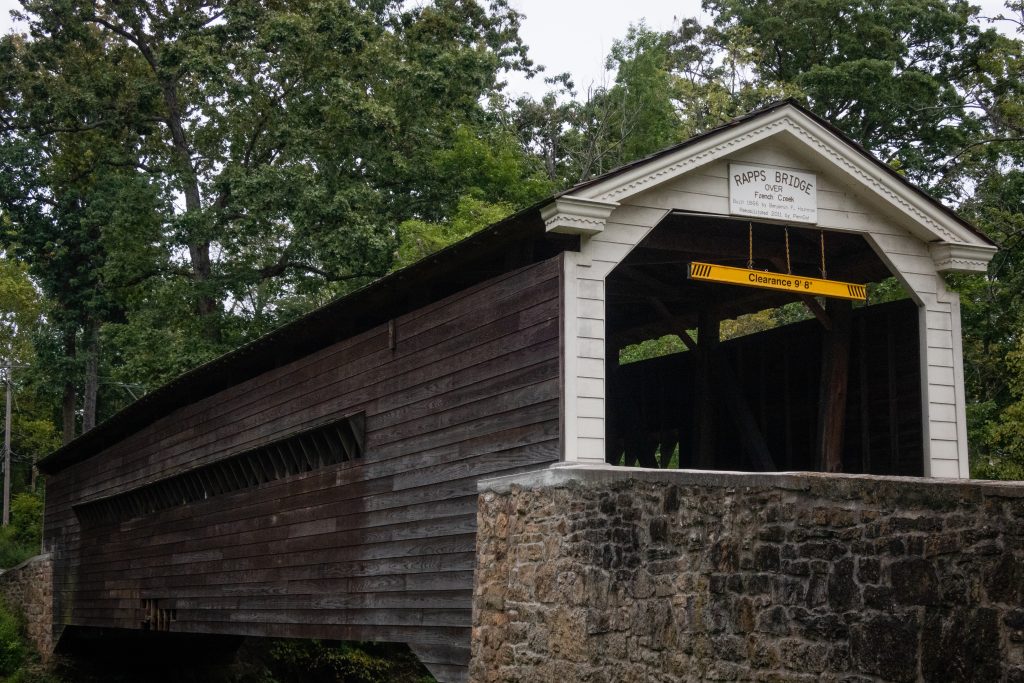
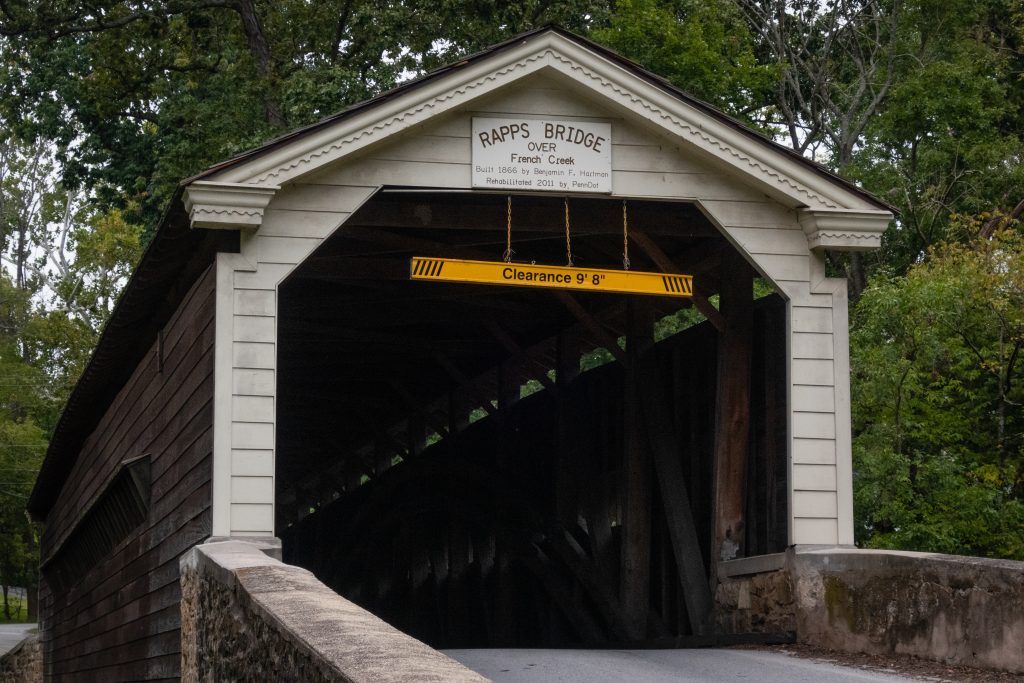
We come upon Kennedy Covered Bridge next.
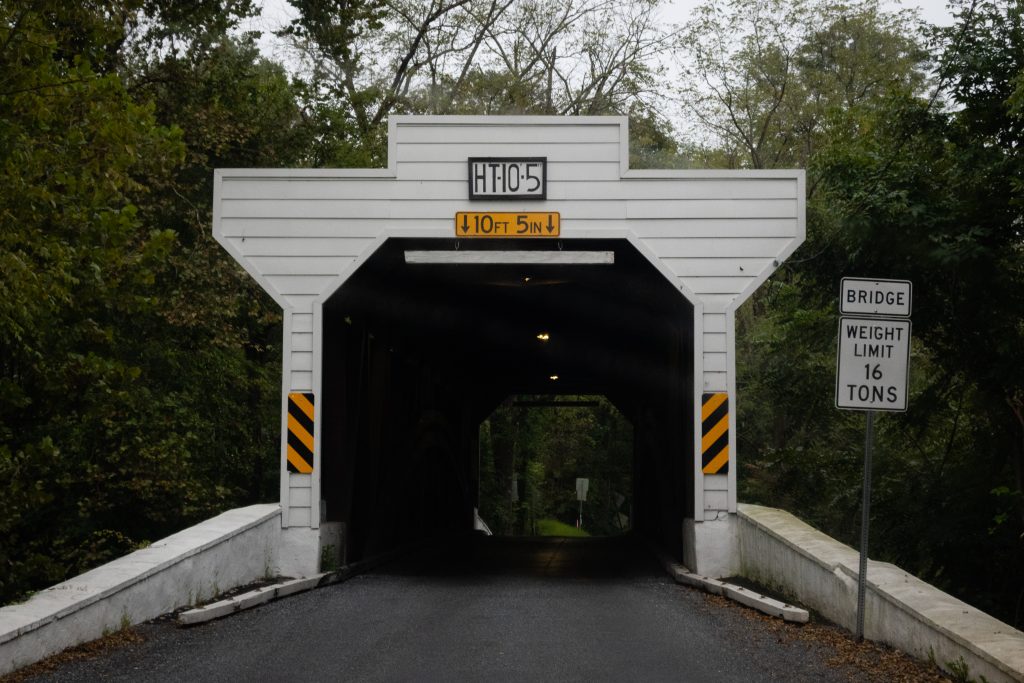
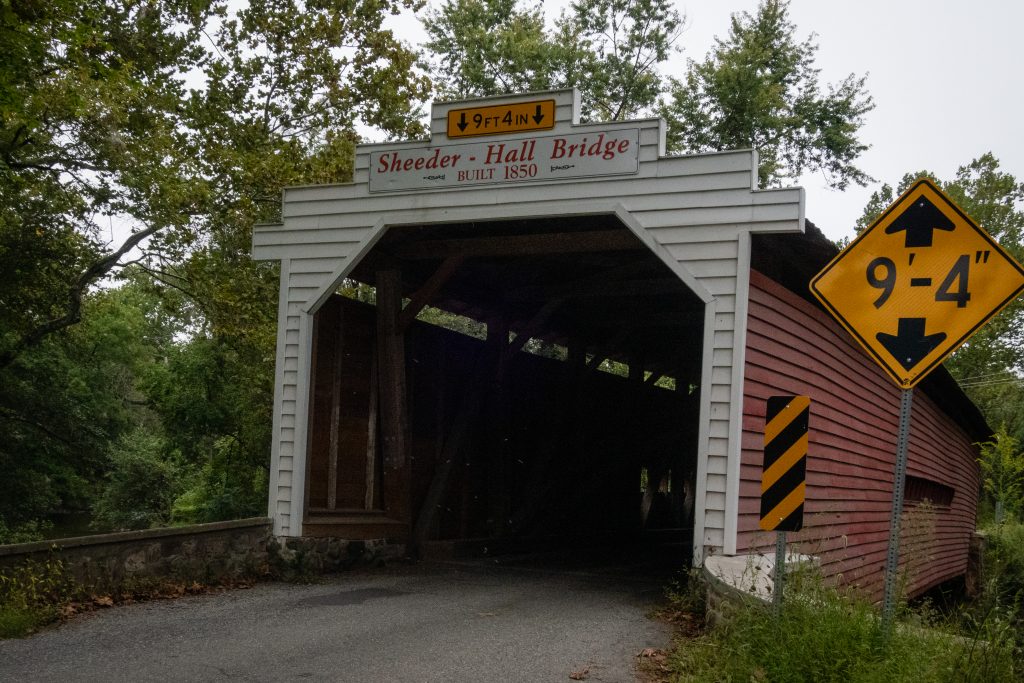
The western most is Sheeder Hall Covered Bridge.
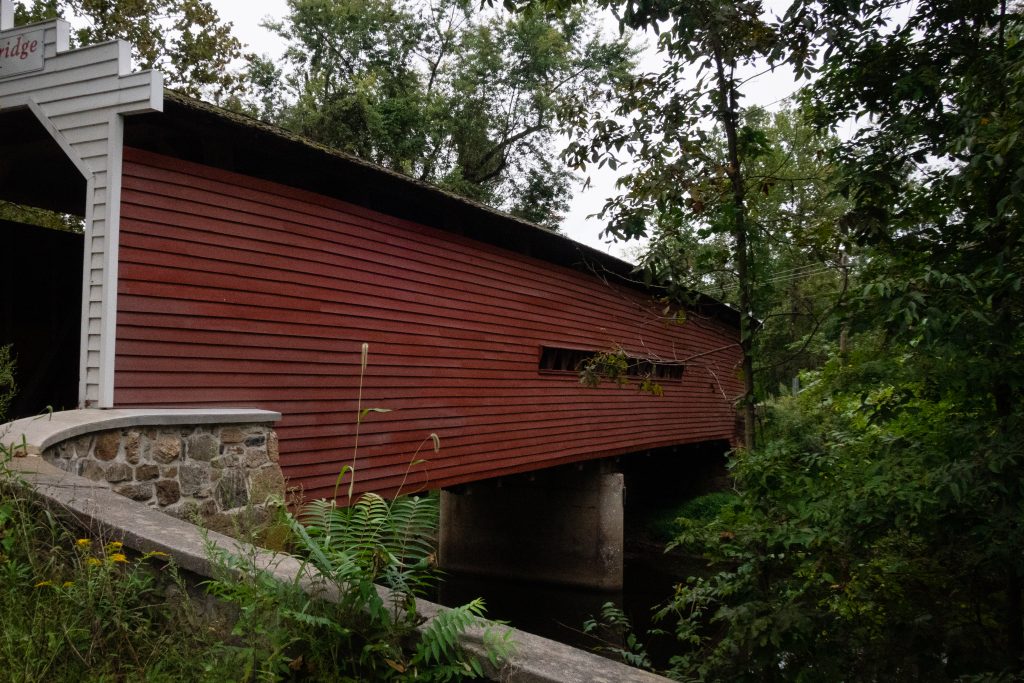
The covered bridge saga continues next week.
This post is just the beginning of the promised photos of covered bridges. I set out on a mission to view and, in most cases, photograph my local covered bridges. For those of you interested in finding these bridges for yourself, I recommend this site. A view of the Knox (Valley Forge) covered bridge can be found in my earlier post.
Covered bridges were sometimes called “kissing bridges” because they provided some privacy for travellers to sneak a kiss. While at the Mercer’s Mill Covered Bridge, I met a guy who used to bring his girlfriend there from Delaware in the 1980s. So it seems the tradition of young lovers being drawn to covered bridges extended well into the twentieth century.


The Bartram covered bridge straddles the border with Delaware County on Crum Creek. It would make one end, at least, Delaware County’s only covered bridge.

The Gibson covered bridge sits along side a busy road. Traffic through the bridge is only one way. The eastern side has a parking area for access to local hiking in the Brandywine Meadows Preserve.


Driving around locally usually produces more images of farms, even if I am mainly looking for covered bridges. The farms in Chester and Lancaster County are really visually interesting and varied, so I can’t help myself.


Plenty more covered bridge photos are upcoming, too.
Sometimes you just encounter some fun or interesting stuff while out with your camera.


This month has certainly seen some wild changes in the weather. We recently went from sunny and low eighties to low thirties within a 24 hour period. It is a relief to get outdoors whenever one can. I took some time to go in search of a trumpeter swan on Octoraro Lake. I didn’t see the swan, but the farms around this area are some of my favorite to photograph.
On my travels, I’ve noticed a lot of fallow fields and newly plowed fields in mid-May. This seems late to me for planting. Is it the weather, or something else?
Here is a sampling of the photographs.


