My submission for the Hubble Challenge for June consisted of a striking face-on spiral galaxy, some pretty globular clusters and another spiral galaxy. with hot star forming regions. You can read more about the Hubble 35th Anniversary Challenge on the Night Sky page.
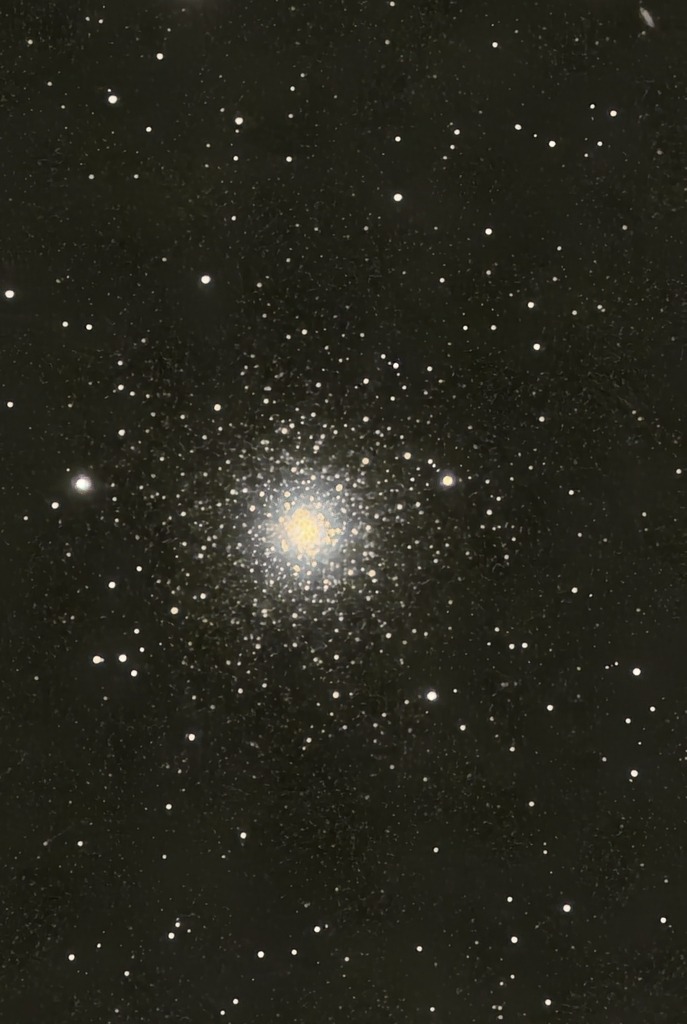
The two globular clusters, M3 and M5, proved to be forgiving astrophotography targets. Messier 3 (M3) is a brilliant globular cluster located in the constellation Canes Venatici. It’s a popular target for amateur astronomers, especially during “globular season” in the spring. Easily visible with binoculars and stunning through a telescope, M3 is known for its large size, high concentration of stars, and numerous variable stars. It lies about 34,000 light years from Earth.
M3
Messier 5 (M5) is a bright globular star cluster located in the constellation Serpens, approximately 24,500 light-years from Earth. It’s one of the oldest globular clusters in our galaxy, with an estimated age of 13 billion years. M5 is visible with binoculars under dark skies and is a popular target for both visual observers and astrophotographers.
M5
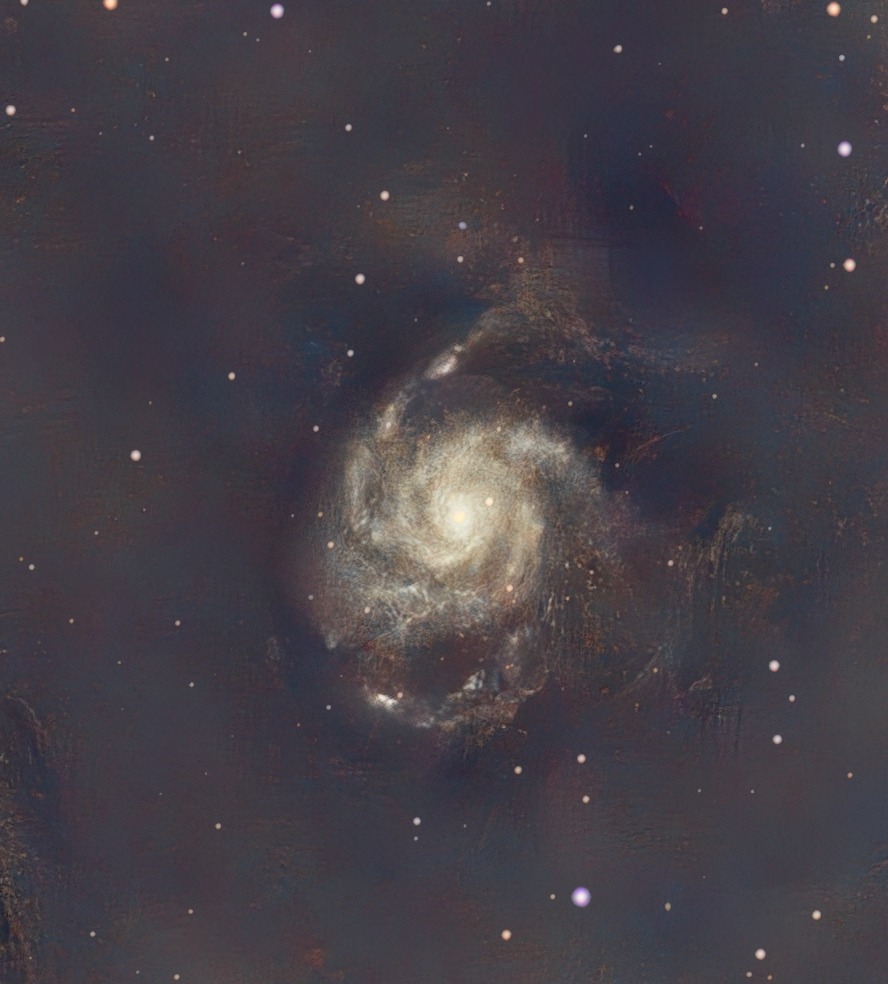
Messier 101, also known as the Pinwheel Galaxy, is a face-on spiral galaxy located in the constellation Ursa Major. It’s a stunning example of a classic spiral galaxy, with bright, luminous arms and extensive star-forming regions. At a distance of 22 to 25 million light-years, it’s a relatively close galaxy and is known for its large size, nearly twice the diameter of our Milky Way. This galaxy was barely discernible in photographs for some reason, but I was able to tease some detail out of it.
M101
NGC 5248 (also known as Caldwell 45 or C45) is a compact intermediate spiral galaxy in the constellation Boötes. NGC 5248 is a member of the NGC 5248 Group of galaxies, itself one of the Virgo III Groups strung out to the east of the Virgo Supercluster of galaxies. It is a cute, but petite, spiral here.
Galaxy season continues. May was a mixed bag for imaging for the Hubble Challenge. Some targets proved quite challenging, and it was difficult to get any decent amount of exposure time to produce something that wasn’t a bleary smudge. The best of the rest are featured here. More information on the challenge can be found on the Pennsylvania Night Sky page.
Our first subject is the Whirlpool Galaxy, also known as Messier 51a (M51a) or NGC 5194, an interacting grand-design spiral galaxy. It lies in the constellation Canes Venatici, and was the first galaxy to be classified as a spiral galaxy. It is 31 million lightyears (9.5 megaparsecs/Mpc) away and 23.58 kiloparsecs (76,900 ly) in diameter.
The galaxy and its companion, the dwarf galaxy NGC 5195, are interacting with each other. They are easily observed, and the two galaxies may even be seen with binoculars under the right conditions. The Whirlpool Galaxy has been extensively observed by professional astronomers, who study it and its pair with dwarf galaxy NGC 5195 to understand galaxy structure (particularly structure associated with the spiral arms) and galaxy interactions. Its pair with NGC 5195 is among the most famous and relatively close interacting systems, and thus is a favorite subject of galaxy interaction models.
I had a lot more integration time for this shot (about 4 hours). Although it won’t be winning any awards, I am pretty please with this image at this stage of my learning process. Compare the distinct spiral arms of M51 with the other galaxies featured below.
M51 and NGC 5195
Caldwell 21, also known as NGC 4449, is an irregular Magellanic type galaxy in the constellation Canes Venatici, being located about 13 million light-years away. It was discovered by German-British astronomer William Herschel on 27 April 1788. It is part of the M94 Group or Canes Venatici I Group that is relatively close to the Local Group hosting our Milky Way galaxy. This galaxy is similar in nature to the Milky Way’s satellite galaxy, the Large Magellanic Cloud, though is not as bright nor as large. C21 has a general bar shape, also characteristic of the LMC, with scattered young blue star clusters. The bar shape can be seen in the image.
C21
Caldwell 52 (NGC 4697) is an elliptical galaxy some 40 to 50 million light-years away in the constellation Virgo. It is a member of the NGC 4697 Group, a group of galaxies also containing NGC 4731 and several generally much smaller galaxies. This group is about 55 million light-years away; it is one of the many Virgo II Groups, which form a southern extension of the Virgo Supercluster of galaxies. The distance to NGC 4697 is not known with high precision: measurements vary from 28 to 76 million light-years. According to the NASA Extra-galactic Database, the average is about 38 million light-years; according to SIMBAD, about 50 million light-years.
C52
Messier 87 (also known as NGC 4486) is a supergiant elliptical galaxy in the constellation Virgo that contains several trillion stars. One of the largest and most massive galaxies in the local universe it has a large population of globular clusters, about 15,000 compared with the 150–200 orbiting the Milky Way, and a jet of energetic plasma that originates at the core and extends at least 1,500 parsecs (4,900 light-years). It is one of the brightest radio sources in the sky and a popular target for both amateur and professional astronomers.
The French astronomer Charles Messier discovered M87 in 1781, and cataloged it as a nebula. M87 is about 16.4 million parsecs (53 million light-years) from Earth and is the second-brightest galaxy within the northern Virgo Cluster, having many satellite galaxies. Unlike a disk-shaped spiral galaxy, M87 has no distinctive dust lanes. Instead, it has an almost featureless, ellipsoidal shape (evident below) typical of most giant elliptical galaxies, diminishing in luminosity with distance from the center.
One of my favorite locations to photograph is along Templin Road in northern Chester County. The area is adjacent to the Thomas P. Bentley Nature Preserve and Warwick Furnace and sits in the valley of the French Creek, South Branch.
This pond has been a favorite subject in the past. Here is a sunset shot from quite a few years ago.
The Warwick Furnace Farms is a historic district that is located in northern Chester County that includes the ruins of an early iron furnace that was owned by Anna Rutter Nutt, widow of Samuel Nutt. The iron furnace was previously featured here. I wanted to return to visit the farm and was able to do so when I had the day off for Good Friday.
Anna Rutter Nutt was the daughter of Thomas Rutter, who erected the first ironwork in Pennsylvania at Pine Forge Mansion and Industrial Site. Samuel Nutt bought the original tracts of land for the Coventry area with partners William Branson and Mordecai Lincoln, the great-great grandfather of Abraham Lincoln. The 786-acre historic district was listed by the National Register of Historic Places in 1976. The related village of Coventryville can be seen here.
In 2015, the French & Pickering Creeks Conservation Trust permanently protected the 553-acre Warwick Furnace Farm through conservation easements and the acquisition of 108 acres, which will be the future home of a public preserve.
The ironmaster’s house and workers’ houses, the historic farmhouse and the barns in this historic district are currently used in the operation of a working farm, which produces lavender and lavender products. The farm has a shop and which sells the wonderful local lavender products. Check the web site for information, hours, special events and to purchase online.
A look toward the main house.The extensive barns.The shop tucked into the corner.The color in the budding trees in Spring always amazes me.
Yellow Springs Village is a historic village in West Pikeland Township in Chester County, Pennsylvania. The community includes historic churches, established in the 1770s by German Reformed and Lutheran members. It has been a location for a boys’ school, the country school of the Pennsylvania Academy of the Fiine Arts, a restaurant, an inn and many other uses. Today it is a haven for artists and hosts special events.
The village was busy the day I visited, so I concentrated on the peripheral areas. The early Spring color was still in evidence. You can learn more here.
Although the weather has continued to be worse than normal, I was able to get out in March and image the night sky objects for the Hubble Anniversary Challenge for the month. More about the challenge can be found here.
This month’s objects contained a few star clusters. The first of which is Messier 67, a lovely open cluster in Cancer. It is also known as M67 or NGC 2682 and is sometimes called the King Cobra Cluster or the Golden Eye Cluster. It was discovered by Johann Gottfried Koehler in 1779. Estimates of its age range between 3.2 and 5 billion years. Distance estimates are likewise varied, but typically are 800–900 parsecs . It is well populated, almost appearing like a globular cluster, and is a paradigm study object in stellar evolution. I find it to be the most interesting looking object of this group.
M67
Next up is the well-known Beehive Cluster, also an open cluster in Cancer. It is known as Praesepe (Latin for “manger”, “cot” or “crib”), M44, NGC 2632, or Cr 189. One of the nearest open clusters to Earth, it contains a larger population of stars than other nearby bright open clusters, holding around 1,000 stars. Under dark skies, the Beehive Cluster looks like a small nebulous object to the naked eye, and has been known since ancient times. Classical astronomer Ptolemy described it as a “nebulous mass in the breast of Cancer”. It was among the first objects that Galileo studied with his telescope. The distance to M44 is often cited to be between 160 and 187 parsecs (520–610 light years).
Age and proper motion coincide with those of the Hyades, suggesting they may share similar origins. Both clusters also contain red giants and white dwarfs, which represent later stages of stellar evolution, along with many main sequence stars.
M44
Continuing the theme of open clusters, we continue to Messier 48, also known as NGC 2548. It is in the equatorial constellation of Hydra. It sits near Hydra’s westernmost limit with Monoceros, to the east and slightly south of Hydra’s brightest star, Alphard. This grouping was discovered by Charles Messier in 1771, but there is no cluster precisely where Messier indicated; he made an error, as he did with M47. Credit for discovery is sometimes given instead to Caroline Herschel in 1783.
M48 is visible to the naked eye under good atmospheric conditions. The cluster is located some 2,500 light-years from the Sun. The age estimated from isochrones is 400±100 million years, while gyrochronology age estimate is 450±50 million yearsr – in good agreement.
M48
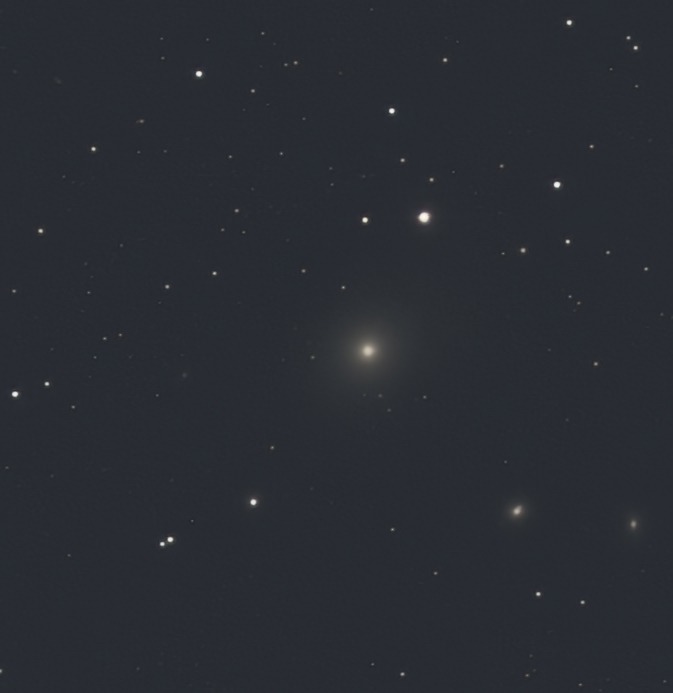
Finally, we come to Caldwell 48, also known as NGC 2775,. It is a spiral galaxy in the constellation Cancer. It is 67 million light-years away from the Milky Way. It was discovered by William Herschel in 1783. C48 belongs to the Antlia-Hydra Cluster of galaxies and is the most prominent member of the NGC 2775 Group, a small galaxy group in the Virgo Super-cluster, along with the Local Group. Other members of the NGC 2775 Group include NGC 2777 and UGC 4781. This object reminds us that Spring is known as “galaxy season” due to the prevalence of these distant objects in the night sky.
Due to the distance, this objects appears small in Seestar S50. It is the fuzzy object in the center of the photo.
I took advantage of some nearly 80 degree weather to go to the Brandywine Museum of Art before my annual pass ran out. While I was having some mushroom soup in the cafe, I noticed a few fisherman in Brandywine Creek. I’m not sure what they were fishing for in March, maybe panfish.
I made a few stops on the way home to get some RAW files to test new photo editing software that I am using (goodbye Adobe). These shots, as well as the forsythia from last week, are the result.
First a some exterior shots of the Goshenville historic site on Route 352.
I am never sure that this is the front of this cute, but unassuming, building.
This is the blacksmith shop. It was open when I visited another time.
The next stop was the Thornbury CSA even though it is a bit early for local produce.
The forsythia sort of snuck up on me this year. It has been an unusually cold weather with a lot of daytime highs well below average. Here are some views of the herald of spring from around Chester County.
Some sneaky forsythia to the right. I mostly liked the barn.